

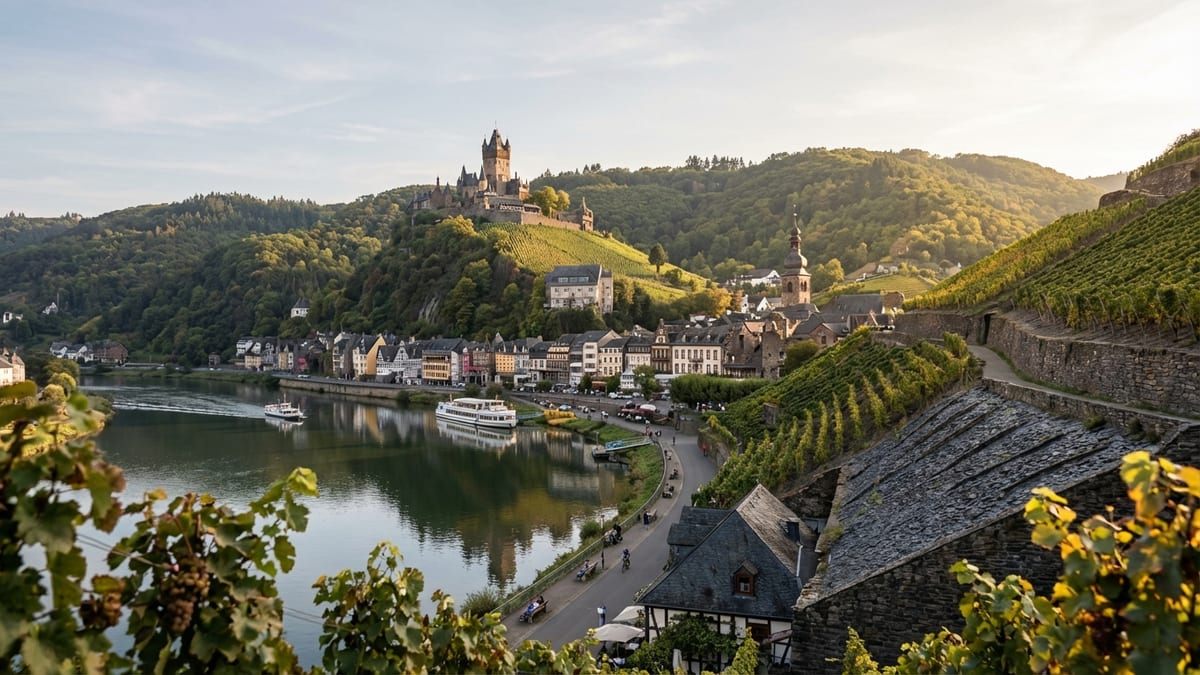
Cochem clings to a dramatic bend of the Moselle River like something out of a romantic painting: half-timbered houses stacked against steep, vine-covered slopes, crowned by a fairy-tale castle. Yet beyond the postcard views, this small town in Rhineland-Palatinate offers a remarkably rich story.
Its strategic position on the Moselle shaped centuries of trade, conflict and rebuilding, while the vineyards that terrace the valley have produced wine for roughly two millennia.
Today Cochem combines deep-rooted tradition with easygoing riverside charm, making it one of the most compelling gateways to the Moselle Valley for travelers who care about history, wine and landscape in equal measure. Once you understand the background, it becomes easier to judge whether Cochem is worth visiting.
Cochem in Context: Gateway to the Moselle Valley
Cochem sits roughly halfway between Trier and Koblenz on the Moselle, in a section of the river famous for its looping course, steep slate hillsides and tightly packed wine villages. Here the river carves one of its narrowest and most picturesque stretches, creating a natural amphitheater for vineyards and for the town itself.
For travelers, Cochem is large enough to have a proper old town, good accommodation and regular train and boat connections, yet small enough to feel intimate and walkable within minutes of arrival. Cultural context helps explain the most popular things to do in Cochem.
The surrounding Moselle Valley is a transnational wine and cultural landscape that spans France, Luxembourg and Germany, but the German Mosel (often spelled Moselle in English) is where the scenery becomes particularly dramatic. The valley is renowned for steep-slope viticulture, with some vineyards rising at dizzying angles above the river. Cochem lies in the Lower Moselle section, where medieval castles and terraced vineyards share the skyline and small villages unfurl along the banks in a near-continuous ribbon.
Because Cochem sits on a major rail line linking Koblenz and Trier, and on the cruise routes favored by riverboats, it has become a natural base for visitors exploring the valley for a few days. From here it is easy to branch out to quieter villages, bike or hike along both shores, or head upriver to the Roman heritage of Trier or downriver to where the Moselle meets the Rhine at Koblenz. That accessibility means you can immerse yourself in Moselle wine culture without needing a car, a rare convenience in a rural wine region.
Although tourism is a leading industry today, Cochem is still firmly rooted in the wine trade and in the rhythms of the agricultural year. Vineyards, cellars, cooperatives and wine festivals shape the local calendar. Visitors who time their trip to coincide with these events, or who simply take the time to talk with local vintners at a small tasting room, will find that wine here is not just a product but a living bridge between past and present.
From Celts to the Present: A Compressed History of Cochem
Human settlement in the Moselle Valley predates written records, and Cochem’s story follows the wider region’s arc from Celtic and Roman roots through the Middle Ages and into modern Germany. The Romans brought large-scale viticulture to the Moselle around 2,000 years ago, carving terraces into the slopes and exploiting the region’s mild climate and slate soils. Evidence of Roman wine-growing is found up and down the valley, and while Cochem itself is first mentioned later, it grew in the shadow of this early wine economy that helped make the Moselle a prosperous frontier of the empire.
The first recorded mention of Cochem dates from the early Middle Ages, when the town began to emerge as a fortified settlement controlling a strategic crossing of the river. Its position made it valuable to regional princes and church authorities who levied tolls on river traffic. Over time the town developed defensive walls, towers and, high above, a castle that would become its defining landmark. The medieval decades were shaped by the overlapping influences of secular lords, ecclesiastical territories and later the Electorate of Trier, all vying for control of this lucrative corridor.
Like many Moselle towns, Cochem suffered heavily in the 17th century, particularly during the Nine Years’ War when French troops sacked and largely destroyed both town and castle. The hilltop fortress lay in ruins for more than 150 years, while the town slowly rebuilt itself at river level. Even in this period of hardship, viticulture and river trade continued, providing the economic backbone that allowed Cochem to recover. The pattern of destruction and renewal left a layered urban fabric, where later half-timbered houses and baroque church towers coexist with remnants of medieval walls.
The 19th century brought new fortunes with the rise of romanticism and the advent of rail travel. As artists and writers popularized images of ruined castles and steep vineyards, the Moselle became a favorite destination for travelers seeking picturesque Germany. Wealthy industrialists and the Prussian crown became interested in restoring historic monuments, and Cochem’s castle was a prime candidate, setting the stage for its striking rebirth above the town.
Reichsburg Cochem: The Castle that Defined a Skyline
The hilltop fortress known as Reichsburg Cochem dominates both the town and the river bend below. Originally built around the 11th century, it served as a key defensive and administrative center overlooking the Moselle’s trade routes. For centuries its walls and towers symbolized power and stability in an otherwise contested frontier landscape. The catastrophic destruction by French troops in 1689 reduced the structure to a romantic ruin, its silhouette slowly crumbling into the hillside while the town lived on beneath it.
In the mid-19th century, during a wave of enthusiasm for the medieval past, a wealthy Berlin businessman acquired the ruins and commissioned a complete reconstruction in a neo-Gothic style. Rather than an exact archaeological restoration, the project created a 19th-century vision of what a medieval castle ought to look like, with turrets, oriels and decorative stonework. The result is a dramatic, almost theatrical ensemble that today feels inseparable from Cochem’s identity, even though much of what visitors see reflects 19th-century tastes and romantic imagination as much as medieval reality.
For travelers, the castle offers both a window into these layered histories and one of the finest panoramic views in the valley. Walking or taking a shuttle up to the hilltop, you pass through narrow streets and vineyards before reaching the castle courtyard. From the terraces you can trace the Moselle’s curve, pick out the pattern of vineyards on opposing slopes and look down onto Cochem’s market square and riverside promenade. Guided tours typically move through wood-paneled rooms furnished in neo-Gothic style, highlighting how 19th-century elites appropriated medieval motifs while enjoying modern comfort.
The castle’s presence has also shaped how Cochem developed as a destination. Its instantly recognizable profile appears on wine labels, tourist brochures and local signage, reinforcing Cochem’s brand as a quintessential Moselle town. Evening illuminations and seasonal events at the castle help extend the tourist season beyond summer and contribute to a sense of continuity between past and present. For visitors interested in how heritage shapes regional identity, Reichsburg Cochem is as much a cultural symbol as a monument.
The Moselle Valley: Landscape, Climate and Terroir
The Moselle Valley’s beauty is not just visual. It is a landscape engineered over centuries for winegrowing, where geology, microclimate and human labor combine to produce distinctive wines. Between Trier and Koblenz the river winds through a narrow, twisting gorge, carving steep slopes that catch and reflect sunlight. Much of the valley’s best vineyard land lies on these south and southwest facing slopes, where vines can exploit every possible hour of warmth in what is otherwise a relatively cool climate for wine.
Slate is the dominant note in the terroir, and it plays multiple roles. Dark slate soils absorb heat during the day and release it at night, moderating temperatures around the vines and helping grapes ripen fully even in marginal seasons. The fractured slate also promotes excellent drainage while forcing roots deep into the subsoil, drawing out mineral nuances that Moselle wines are famous for. Walk any hillside path near Cochem and you will find yourself crunching over loose shards of slate that tell this geological story underfoot.
The climate along the Moselle has historically supported white grape varieties that thrive in cooler conditions. Gentle summers, long ripening seasons and significant diurnal temperature swings favor slow, aromatic development rather than sheer power. In recent decades, climate shifts have slightly warmed the region, enabling some diversification into red varieties while also raising questions about how to preserve the classic balance of acidity and fruit that made Moselle whites so sought after. Winemakers around Cochem experiment with canopy management, harvest timing and site selection to adapt while maintaining regional character.
Beyond viticulture, the valley’s landscape sustains a rich mosaic of biodiversity. Terraces create microhabitats where rare plants and animals find refuge among the vines and dry-stone walls. Many local projects now promote sustainable and organic farming practices, not just for environmental reasons but also to appeal to a new generation of wine travelers who care about the ecological footprint of their glass. For visitors who hike or bike between villages, the interplay of natural and cultivated beauty is part of the region’s enduring appeal.
Moselle Wine Culture: Riesling, Traditions and Tastings
The Moselle has been a wine region for roughly two thousand years, and it remains Germany’s oldest major winegrowing area. Its international reputation rests above all on Riesling, a grape that, in this terroir, produces wines with luminous acidity, pronounced aromatics and remarkable longevity. Around Cochem, you will find wines ranging from bone-dry expressions that pair well with modern cuisine to lusciously sweet late-harvest bottles that have long been prized by collectors. Many share a hallmark combination of low to moderate alcohol and intense flavor, a balance that makes them both food friendly and refreshing in summer.
Moselle statistics underscore the dominance of white wine. The vast majority of production in the region is white, with Riesling taking the leading share, followed by other varieties such as Müller-Thurgau and Elbling. Red grapes like Pinot Noir and regional crossings account for a smaller but growing portion of the vineyards, responding to evolving tastes and warmer conditions. Across the board, Moselle wines are known for their interplay of fruit and acidity rather than heavy oak or extraction, a style that feels particularly contemporary to drinkers who favor finesse over power.
In Cochem itself and in neighboring villages, wine culture is woven into daily life. Cooperative cellars sit alongside family-run estates that may farm just a few hectares of steep slopes. Many producers open their courtyards or tasting rooms for informal visits, especially from spring through autumn. Tastings tend to be relaxed and conversational: expect to sample a flight that moves from dry to sweeter styles, while winemakers explain the differences between vineyard sites, vintages and classifications. For English-speaking visitors, patience and a phrasebook help, but hospitality is generous even when language is limited.
Traditional dishes strongly influence how locals enjoy their wine. Expect regional fare such as hearty sausages, roasted pork, river fish and seasonal specialties like asparagus in spring, often paired with different expressions of Riesling. Guests quickly learn that categories like dry or off-dry only hint at the nuanced spectrum of Moselle wines, where sweetness is often balanced by vibrant acidity. Exploring this spectrum over a few days in Cochem can feel like a master class in how climate, soil and human choices shape what ends up in the glass.
Festivals, Wine Weeks and Seasonal Life in Cochem
Cochem’s calendar is structured around the vine, and visitors who time their stay well can experience the town at its most exuberant. Spring and early summer bring wine-focused events such as Moselle Wine Week, when local winegrowing communities transform central squares into open-air tasting villages. Stands from the Cochem holiday region pour their Rieslings and sparkling wines at communal tables, and live music fills the evenings. The atmosphere is relaxed rather than crowded, with both residents and travelers sampling new vintages and catching up after winter.
Late summer is dominated by the local history and wine festival, held each year on the last weekend in August. This multi-day celebration spreads along the Moselle promenade and into the historic market square. Wine stalls line the riverside, food vendors serve regional dishes and two stages host bands and performances through the evening. The festival parade, typically held on Sunday afternoon, sees local wine queens, marching bands and themed floats weave through Cochem’s streets, culminating in evening fireworks above the river. While dates change year to year, the pattern of wine-centered festivities anchoring the late August period is a constant feature of local life.
Harvest time in early autumn adds another dimension to Cochem’s character. As grapes ripen on the surrounding slopes, small harvest festivals and vineyard events pop up in neighboring villages. Travelers may find themselves invited to try Federweißer, a cloudy, partially fermented new wine that appears briefly each year, usually paired with onion tart in simple wine taverns. Even outside the formal festival dates, the mood in town shifts as tractors move through the streets towing picking crews and bins of fruit, reminding everyone that the year’s work in the vineyards is reaching its climax.
Winter is quieter but not dormant. Christmas markets bring lights, mulled wine and craft stalls to the town center, and some estates host cellar tastings by appointment. For visitors who prefer fewer crowds and a more contemplative atmosphere, this can be an appealing season. The bare vines highlight the steep geometry of the slopes, and the castle’s silhouette against an early dusk takes on a different sort of romance. Regardless of when you visit, understanding how the seasons govern everyday life and celebration in Cochem enriches the experience.
Exploring Cochem: Old Town, Riverfront and Vineyards
For a relatively small town, Cochem rewards unhurried exploration. Start in the compact old town, where timbered houses flank narrow lanes leading up from the river to the central market square. Cafes spill onto cobblestones, and small shops sell local specialties such as wine, brandies and regional baked goods. The parish church, with its distinctive tower, punctuates the skyline at street level while always drawing the eye back up to the castle far above.
The Moselle promenade is Cochem’s living room. Here riverboats dock, cyclists pause and families stroll in the evening light. Benches face the water and the steep slopes beyond, creating one of the best spots to appreciate the interplay of town, river and vineyards. It is easy to see how the Moselle’s role as a transport artery shaped Cochem’s growth, as warehouses, boat landings and merchant houses once lined the same riverfront that now hosts cafes and guesthouses. Modern cruise ships glide past the same currents that carried Roman barges and medieval rafts laden with wine casks.
Venturing upward, you move through quiet residential streets into the vineyards. Well-marked paths lead from town toward the castle and onto hillside trails that loop above the river. Within minutes the noise drops away, replaced by the rustle of leaves and the crunch of slate underfoot. Information boards often explain the grape varieties, slope angles and cultivation methods, giving walkers a deeper sense of how demanding steep-slope viticulture can be. From these vantage points, Cochem looks like a model village set into a giant amphitheater carved by water and time.
For travelers, one of Cochem’s strengths is how compactly it brings together key elements of the Moselle experience: a historic town core, an emblematic castle, accessible vineyards and a working riverfront. This makes it an excellent base for those who have only a few days in the region. Even a short stay can include castle visits, wine tastings, a river cruise segment and a vineyard hike without long transfers or complex logistics. That convenience, paired with genuine local character, explains much of Cochem’s enduring appeal.
Day Trips and Routes Through the Wider Moselle
While Cochem could easily occupy a long weekend on its own, its central location invites exploration up and down the valley. To the southwest, the Moselle climbs toward Trier, Germany’s oldest city, where Roman monuments and a lively university atmosphere offer a different perspective on the region’s history. En route, villages such as Beilstein and Bruttig-Fankel provide snapshots of Moselle life on a smaller scale, each with its own church tower, riverside promenade and patchwork of vineyards.
Downriver toward Koblenz, the valley tightens and the slopes often grow steeper. Here you will find some of the Moselle’s most dramatic vineyard terraces, their stone retaining walls testifying to centuries of manual labor. Train and boat routes make it straightforward to hop between towns, enabling travelers to compare different microclimates and village characters in a single day. Koblenz itself, at the confluence of Moselle and Rhine, adds another urban note, with its fortress, cable car and promenades facing the larger river’s shipping traffic.
Cochem also connects readily to side valleys and upland routes. Cyclists can follow dedicated paths that parallel the Moselle on both banks, using ferries and bridges to create loops of varying length. Hikers may opt for segments of long-distance trails that climb to viewpoints above the river before dropping into villages for rest and refreshment. Wine enthusiasts can use Cochem as a hub for visiting selected estates in neighboring villages, many of which remain more focused on production than on tourism, offering a quieter, more workaday view of Moselle wine culture.
Because public transport is relatively frequent along the main valley corridor, particularly between spring and autumn, it is feasible to explore without a car. Trains, buses and riverboats can be combined in flexible itineraries that balance sightseeing with tastings and time outdoors. This accessibility allows travelers to engage deeply with the Moselle’s landscape and wines while minimizing logistical stress, reinforcing Cochem’s role as both a destination and a gateway.
The Takeaway
Seen from the river, Cochem looks like the distilled essence of the Moselle: a castle-topped hill, a dense riverside core and steep vineyards catching the light at impossible angles. Spend a little time here, however, and it becomes something richer. The town embodies centuries of history from Roman viticulture through medieval trade and 19th-century romanticism to today’s blend of tourism and tradition. Its wines express a terroir shaped by slate, climate and painstaking work on challenging slopes. Its festivals and everyday rituals tie modern life back to the cycles of the vine and the flow of the river.
For travelers intrigued by the intersection of landscape, culture and taste, Cochem offers an unusually complete story in a compact setting. You can walk from a Gothic-styled castle to a tasting in a family cellar in under an hour, or from a riverfront cafe to a panoramic vineyard trail in minutes. At each step the connection between place and product, between history and present-day hospitality, is palpable. Whether you come for a day trip or a longer stay, Cochem and the surrounding Moselle Valley invite you to slow down, look closely and let a distinctive sense of place unfold glass by glass, view by view.
FAQ
Q1. Where exactly is Cochem located in Germany?
Cochem is in the state of Rhineland-Palatinate in western Germany, on the Moselle River roughly midway between Trier and Koblenz. It sits in the Lower Moselle section, in a narrow, steep-sided valley characterized by vineyards and small wine villages.
Q2. What is Cochem best known for?
Cochem is best known for its hilltop castle, Reichsburg Cochem, its picturesque old town with half-timbered houses and its position in one of Germany’s most famous wine regions. Visitors come for wine tastings, river cruises, hiking and the romantic scenery of the Moselle Valley.
Q3. Why is the Moselle Valley important for wine?
The Moselle Valley is one of Europe’s classic cool-climate wine regions, with more than two thousand years of viticultural history. Its steep slate slopes and river-moderated climate are ideal for Riesling, which here produces intensely aromatic wines with vibrant acidity and relatively low alcohol, styles that are widely admired by wine professionals and enthusiasts.
Q4. What types of wine are produced around Cochem?
Most wines produced around Cochem are white, dominated by Riesling. You will also encounter Müller-Thurgau, Elbling and other white varieties, along with a smaller share of reds such as Pinot Noir. Styles range from dry to sweet, but even sweeter wines are usually balanced by refreshing acidity, making them versatile with food.
Q5. When is the best time of year to visit Cochem for wine-related events?
Late spring through early autumn is ideal for wine travelers. Wine weeks and festivals typically take place from early summer into late August, while the grape harvest and new wine celebrations fall in early autumn. Dates vary by year, so it is wise to check current festival schedules when planning a trip.
Q6. Is it possible to explore Cochem and the Moselle Valley without a car?
Yes. Cochem is served by regular trains along the Moselle line between Koblenz and Trier, and riverboats connect many towns in season. Local buses and bike paths supplement these routes, making it realistic to visit vineyards, castles and neighboring villages using public transport, bicycles and walking trails.
Q7. How difficult are the vineyard hikes around Cochem?
Vineyard hikes range from gentle riverside walks to steep climbs onto the slopes above the town. Paths are generally well marked, but some sections can be demanding because of the gradient and loose slate underfoot. Good footwear is advisable, and those with limited mobility may prefer lower-level routes that still offer excellent views.
Q8. What role did the castle play in Cochem’s history?
Reichsburg Cochem originated as a medieval fortress controlling a strategic river crossing and collecting tolls from passing traffic. It was destroyed in the late 17th century and lay in ruins until the 19th century, when it was rebuilt in neo-Gothic style. Today it serves as a symbol of the town and a focal point for tourism rather than a military stronghold.
Q9. Are there opportunities to taste wine directly from producers in Cochem?
Yes. Cochem and the surrounding villages host a mix of cooperative cellars and family-run estates that welcome visitors. Many have tasting rooms where you can sample several wines for a modest fee or purchase bottles. Opening hours can be seasonal, so checking ahead or asking at the local tourist office can help you plan visits.
Q10. How does Cochem compare to other Moselle towns for first-time visitors?
Cochem is one of the most accessible and visitor-friendly towns on the Moselle, with a striking castle, a compact old town, good accommodation and frequent transport links. While smaller villages may feel quieter or more traditional, Cochem offers a strong introduction to the region’s history, wine culture and landscape, making it an excellent base for a first trip to the Moselle Valley.