


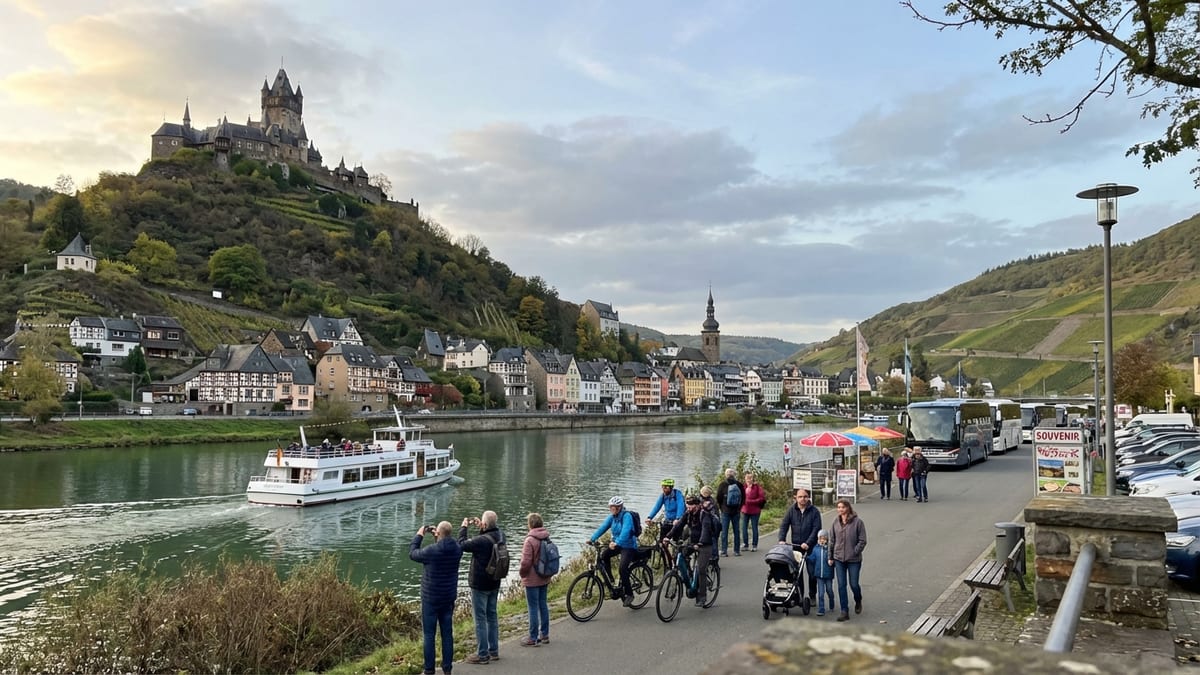
I arrived in Cochem with a suitcase, a notebook, and slightly inflated expectations. Photos online made it look like the ultimate Mosel Valley postcard: half-timbered houses, vineyards sliding down impossibly steep slopes, and a castle floating above the river. After several days on the ground, walking its cobbled streets in early shoulder season, I left with a more nuanced view.
Cochem is pretty, sometimes very pretty. It is also crowded, occasionally kitschy, and limited in what it actually offers beyond that classic river view. Whether it is worth visiting depends a lot on what you expect, when you go, and how long you plan to stay. If you decide to go, this overview of the best hotels in Cochem helps you choose the right base.
First Impressions: The Postcard vs. Reality
My first glimpse of Cochem was from the train window. The line from Koblenz hugs the Mosel so closely that you feel like you might skim the water. After about 35 minutes, the town appears: a tight cluster of slate-roofed houses squeezed between river and hillside, with Reichsburg Castle looking theatrically perfect above it all. From a distance, it is exactly the romantic valley town the tourism brochures promise.
Stepping out of the station, the mood shifted somewhat. The immediate area around Cochem Bahnhof is functional rather than charming: a busy road, parking lots, and a row of very unromantic supermarkets. The pretty part of town is a 10 to 15 minute walk along the river. That walk is pleasant enough, but it was my first sign that the images I had seen only showed one carefully framed angle of Cochem and not the full picture.
Once I reached the old town, the postcard returned. The medieval gate, Markt square with its fountain, and the tangle of narrow lanes felt atmospheric and genuinely attractive. At the same time, I quickly realized that a large share of the ground-floor spaces are geared almost entirely to tourists: wine shops with identical labels, souvenir stores, ice cream stands, and menus in four languages advertising schnitzel and “original Mosel specialties” side by side with currywurst. It is not ugly, but it has that slightly theme-park feel that can make you wonder how many actual locals still live in the old center.
Getting There and Getting Around: Easy Rails, Small Frustrations
From a practical point of view, reaching Cochem is one of the town’s biggest strengths. I came from Koblenz, and the regional trains between Koblenz Hauptbahnhof and Cochem run frequently, with a typical journey time around 35 to 40 minutes and regular departures through the day. Tickets are reasonably priced, especially with day passes or regional tickets. For a car-free traveler, it felt refreshingly straightforward. Many visitors consider river experiences, especially when evaluating Cochem boat tours.
There are caveats. The Mosel line is heavily used for both regional traffic and tourism, and maintenance works are not rare. During my planning I came across notices about temporary closures and bus replacement services on the Koblenz–Cochem–Trier stretch in autumn due to track and bridge works. That kind of disruption can abruptly turn an easy half-hour train ride into an hour-plus on a bus snaking along narrow valley roads. If your itinerary is tight, it is worth double-checking schedules close to your travel dates rather than assuming everything will run like clockwork.
Inside Cochem, I mostly walked. The town is compact, but not entirely flat. The riverfront promenade is easy, the lanes of the old town are short, and I never needed public transport to get between the station, central square, and most restaurants. Where things got more tiring was anything involving elevation: climbing to viewpoints and up to the castle. There is a local bus that goes up toward Reichsburg from near the old town, and a shuttle service closer to the castle in main season, but timetables felt irregular, and information on stops and frequencies was not as clear as I would have liked on the ground.
If you rely fully on public transport and have mobility issues, you will feel the constraints. There are no trams or subways, the river cruise piers are just a short walk from the center but involve stairs in some spots, and the famous Cochem chairlift, which used to be a handy way to gain height for views and hikes, is currently closed for an extended period. According to the operator, the Sesselbahn is shut until March 27, 2026, so if you have seen photos of people gliding above vineyards, that experience is off the table for now. I had intended to use it and had to adjust my plans on arrival.
The Castle Experience: Photogenic but Not Magical
Reichsburg Cochem is the single image most people associate with the town, and it absolutely dominates the skyline. Seeing it for the first time looming over the river felt genuinely impressive. The approach, however, was more work than wonder. From the old town, I followed signs up a steep cobbled lane, then on to a paved path that winds past guesthouses and vineyards. It took about 20 minutes at a steady pace, and I arrived slightly out of breath and sharing the path with several tour groups.
It is worth noting that visiting the interior of Reichsburg is only possible on guided tours; you cannot simply wander the rooms at your own pace. Tours run regularly in peak season, with a mix of German and foreign-language departures, and sometimes audio options. I appreciated that the schedule was clearly posted at the entrance and that I did not have to reserve weeks ahead, but it did mean waiting around for the next slot rather than walking straight in. The courtyard views are open only to ticket holders, so even casual visitors must commit to the full tour format.
The tour itself was a mixed bag. On the plus side, the interior is photogenic, with wood paneling, stained glass, and a scatter of 19th-century romanticized medieval décor. The guide offered a succinct overview of the castle’s history, rebuilt in the 19th century after earlier destruction. On the minus side, the rooms are heavily curated to match that 19th-century vision of the Middle Ages rather than presenting a deep or particularly nuanced historical narrative. The script felt rehearsed and slightly rushed, as if it had been delivered hundreds of times before that morning alone. I did not leave with a strong emotional connection to the place, more like I had ticked a box.
Where the castle shines is outside. The terrace and walls provide superb views over the Mosel and the clustered town below, especially on a clear day or toward sunset. For me, those views justified the climb and the admission fee more than the interior tour. It did get crowded, though. At peak times, it was hard to find a quiet corner, and photo spots turned into informal queues. If I did it again, I would aim for either the first tours of the day or a later afternoon visit to avoid the thickest crush of bus tour groups.
Scenery and Outdoor Activities: Beautiful, But With Limits
What ultimately makes Cochem attractive is not just the town itself but its position in the Mosel Valley. The river curves gently here, vineyards line both slopes, and on a sunny day the whole scene can look almost painterly. I spent long stretches walking the riverside promenade, sitting on benches watching boats slide past, and simply soaking in that gentle landscape. Those moments were as pleasant as I had hoped. Travelers often compare nearby towns, especially Cochem vs Bernkastel-Kues.
Yet I found that in Cochem proper, casual access to varied walking and hiking felt a bit more constrained than I expected. With the chairlift out of action during my stay and for the foreseeable future, reaching certain high viewpoints required either a fairly strenuous uphill hike or a car.
Some trailheads are not especially well signposted from the center, and printed maps available locally were basic. Once I was on the paths that cut through vineyards and forests, I enjoyed them, but it took more effort and trial-and-error than in some other German walking destinations where signage and routes are more polished.
River cruises are a big part of Cochem’s appeal. Several operators run short Mosel trips from the piers near the old town, especially between late spring and autumn. I took a round-trip cruise to see the valley from the water.
It was relaxing, and the view of Cochem’s skyline as you pull away is probably the most flattering angle the town has. Commentary on board, though, was minimal and very basic. It felt more like a floating sun terrace than an interpretive experience. If you want deeper understanding of the landscapes and wine culture, you have to seek it out elsewhere.
Cycling is another option, and the Mosel cycle path is a popular route, with mostly flat riding along the river between towns. I rented a bike for a day and rode out and back. The scenery is undeniably pretty, but on busier days you share the path with a lot of people: e-bikes, families, and group tours that ride in loose clusters. It is not the quiet rural ride you might imagine from promotional photos. I enjoyed it, but I would class it as gently pleasant rather than unforgettable.
Atmosphere, Crowds, and Seasonality: Timing Matters
I visited in the shoulder season, outside school holidays but still within river cruise season. Cochem was busy. Not gridlocked, but consistently full: coaches lined the parking areas, mid-size cruise ships docked by the river, and the market square was rarely without at least one large tour group. I could imagine that in the height of summer, especially on weekends, it would feel genuinely crowded, with long waits at restaurants and jostling for space on viewpoints and narrow lanes.
The atmosphere reflected that tourist-heavy reality. Many cafés and restaurants have menus clearly geared to quick turnover, with laminated cards in multiple languages and efficient but not especially personal service. I did find some friendlier, slower-paced places away from the main strip, but it took deliberate effort to wander deeper into less obvious streets. The mix of languages I heard was wide, which I liked, but I did occasionally miss the feeling of being in a place that primarily serves locals and only secondarily caters to visitors.
The flip side is that Cochem functions well for visitors in practical terms. Tourist information offices are well stocked, most staff in hotels and restaurants have at least basic English, and the infrastructure feels geared to people who might be here only for a night or two. Shops stay open into the early evening in season, and basic needs are easy to meet. The trade-off is authenticity. The central streets in particular can feel like a stage set, with every second building converted into guest accommodation or a business selling near-identical wines and souvenirs.
Seasonality is crucial in deciding whether Cochem is worth it for you. In winter, many attractions either reduce hours or close entirely, and boat services and some restaurants scale back. On the other hand, the town is quieter, accommodation is cheaper, and if you are content with walks, views, and a subdued atmosphere, that could be very appealing. In peak summer, you get the full menu of tours and cruises, but also the highest prices and the thickest crowds. If I returned, I would likely choose very early spring or late autumn, and avoid major holiday periods whenever possible.
Food, Wine, and Accommodation: Comfort Over Character
Cochem bills itself as a wine town, and everywhere you turn you are reminded that this is Riesling country. The reality, from a visitor perspective, is somewhat mixed. I tried several local wines in town. Some were genuinely good, with crisp, mineral notes and a sense of place. Others felt generic and over-sweet, clearly pitched at visitors who just want “something local” in a souvenir bottle.
Tasting opportunities in the center often feel more like retail than education: short pours, limited explanation, and a strong focus on buying rather than learning. For deeper, more personal encounters with local vintners, it is often better to visit smaller villages nearby or book tastings directly with wineries outside the town core.
Food followed a similar pattern. Around the main square and riverfront I encountered the standard spectrum of tourist-town menus: schnitzel in multiple variations, flammkuchen, burgers, and a few token vegetarian dishes. Portions were generous, prices reasonable for a tourist hotspot, but creativity and regional distinctiveness were limited.
A few places did stand out, especially when I walked further away from the main drag and asked for recommendations from locals. In those tucked-away spots I finally ate meals that felt more rooted in the Mosel: dishes featuring freshwater fish, seasonal produce, and thoughtful wine pairings. Finding them required effort, and casual short-stay visitors may never see that side. Extending your stay often depends on the available day trips from Cochem.
Accommodation options are plentiful, ranging from traditional guesthouses to modern riverside hotels. I stayed in a mid-range pension a short walk from the center. The room was clean but basic, with thin walls and decor that had not been refreshed for a while. Breakfast was a standard German spread of bread rolls, cold cuts, cheese, and boiled eggs served in a somewhat crowded dining room. Nothing was wrong, but nothing stood out either.
Talking to other travelers, this seems common: Cochem’s accommodation stock is largely comfortable and practical rather than stylish or memorable. If you want boutique flair or cutting-edge design, you will either pay a premium or look elsewhere in the region.
Price-wise, Cochem sits in that awkward middle zone. It is not extortionate, especially compared to big cities, but it is also not the bargain many expect from a small town. Because it is on so many river cruise and coach itineraries, demand can be strong, and some businesses clearly charge what the market will bear. I did not feel ripped off, but I also rarely felt pleasantly surprised by value for money.
Day Trip vs Base: How Long to Stay and What I Would Do Differently
In hindsight, the biggest question I ask myself is not whether Cochem is worth visiting at all, but how I should have structured my time there. I spent several nights in town, using it as a base to explore nearby villages and vineyards. That worked, but it also meant that each evening I came back into the same fairly touristy environment, and after the first two nights the charm wore thin.
The town is quite small, and once you have walked the lanes, visited the castle, and taken a river cruise, there is not a huge depth of additional attractions to fill multiple days unless you are very content to repeat the same simple pleasures.If I were planning again, I would probably treat Cochem primarily as a day trip rather than a long base. Understanding the main things to do in Cochem makes the decision clearer.
Coming in by morning train from Koblenz, walking the old town, visiting Reichsburg, taking a short cruise, and lingering over an early dinner would comfortably fill a long day and capture most of what the town has to offer. I would then sleep somewhere a bit quieter and perhaps more characterful, either in a smaller Mosel village or in a town that feels less dominated by tourism.
That said, there are scenarios where staying in Cochem makes sense. If you rely entirely on public transport and want easy access to trains, buses, and boat departures without dealing with very small stations, Cochem’s hub role is a genuine advantage. If you enjoy a lively, international atmosphere in the evenings and do not mind touristy menus and souvenir shops, the town’s busyness may feel energizing rather than irritating. And if you are traveling with children or older relatives, the convenience of having multiple dining options, riverside walks, and short, manageable excursions nearby might outweigh the downsides.
Personally, I would adjust two things on a return visit. First, I would pay closer attention to the operating status of key attractions like the chairlift and any weekend track works on the Mosel railway before fixing my dates, as the closure of the lift and some train disruptions definitely nudged my experience toward the more frustrating side. Second, I would carve out more time for nearby villages, treating Cochem more as a transit hub and less as the center of the story.
The Takeaway: Who Cochem Is (and Is Not) For
After walking its streets, climbing to its castle, and watching the light fade over its vineyards, I can say that Cochem is indeed worth visiting, but not for everyone and not in every scenario. Its strengths are clear. It is one of the most visually striking towns on the Mosel, easily reached by train, and compact enough that you can see a lot in a short time without a car. The classic view of the castle above the river is as pleasing in person as the photos suggest, especially if you catch it in soft morning or evening light. The surrounding valley offers gentle outdoor pleasures: riverside strolls, easy cycling, wine tasting, and short hikes.
Its weaknesses are equally real. The very qualities that make Cochem photogenic have also made it heavily touristed, so much so that large parts of the old town feel more like a tourism machine than a living community. Authentic local encounters and truly distinctive food and wine experiences exist, but they are not the default; you have to look for them. Practicalities like seasonal closures, attraction access rules, and occasional train disruptions add another layer of complexity that you do not always see in the brochure version.
In my view, Cochem is most worth it if you approach it with calibrated expectations. If you want a convenient, good-looking place to get a first taste of the Mosel Valley, are happy to share space with many other visitors, and plan to stay one or two nights at most, it delivers. If your priority is deep immersion in wine culture, quieter village life, or long, varied hikes with minimal infrastructure, you might find more satisfaction in smaller towns up or down the valley and treat Cochem as a brief stop rather than a main destination.
Would I go back? Yes, but differently. I would treat Cochem as one chapter in a longer Mosel story, not the whole book: a place to admire that classic castle view, catch a boat, maybe enjoy a glass of Riesling by the river, and then move on. Under those conditions, and with eyes open to both its charms and its compromises, Cochem is still worth a place on the itinerary.
FAQ
Q1: How many days do I really need in Cochem?
I found that one full day is enough to see the main sights: the old town, Reichsburg, and a short river cruise. Two nights can be comfortable if you use the town as a base for nearby villages, but beyond that you may find the options repetitive unless you are devoted to slow, low-key days.
Q2: Is Cochem a good base without a car?
Yes, within limits. The regional trains along the Mosel make it easy to reach Cochem from Koblenz and Trier, and river boats and local buses open up some surrounding areas. However, some viewpoints and wineries are easier with a car, and disruptions on the rail line can complicate plans, so flexibility is helpful.
Q3: How crowded does Cochem get in peak season?
In main season, especially on weekends and holidays, Cochem fills with coach tours, river cruise passengers, and day trippers. The market square, castle, and riverside promenade can feel very busy. If you dislike crowds, consider visiting in early spring, late autumn, or midweek outside school holidays.
Q4: Is Reichsburg Castle worth the climb and guided tour?
For me, the highlight was the view rather than the interior. The tours are the only way to see inside and are fairly standard, with a reconstructed, romanticized medieval aesthetic. I did not regret going, but I would time my visit to avoid the busiest hours and focus on enjoying the terrace and panorama.
Q5: What about the Cochem chairlift I have seen in photos?
The chairlift used to be a popular way to reach a great viewpoint above town, but it is currently closed for an extended period, with reopening planned for March 2026. During my visit it was not available, so I relied on steep walks instead. If riding it is important to you, check its status close to your travel date.
Q6: Is Cochem suitable for travelers with limited mobility?
The riverside promenade and central streets are relatively flat and manageable, though surfaces are often cobbled. The main challenges are the steep routes up to the castle and higher viewpoints, and the lack of extensive local public transport. If walking uphill is difficult, you may find some key sights hard to reach or need to rely on taxis where available.
Q7: How good is the food scene in Cochem?
I found the food scene to be mixed. Around the main square and riverfront, many menus cater to tourists with predictable dishes. With a bit of effort, I did find more characterful places that highlighted regional ingredients and wines, but they were not immediately obvious. If food is a priority, it pays to research and reserve rather than relying on the most visible options.
Q8: Is Cochem a good destination for wine lovers?
Cochem is a convenient gateway to Mosel wine, but not necessarily the best place for deep wine immersion. There are plenty of wine shops and a few tasting rooms, yet many feel oriented toward quick tourist purchases. Serious wine enthusiasts might prefer to spend more time in smaller wine villages and use Cochem for logistics and an overview.
Q9: Can I visit Cochem as a day trip from Koblenz?
Yes, and that is actually how I would recommend many travelers experience it. The train ride from Koblenz is short, and a full day gives enough time for the old town, castle, and a short cruise or riverside walk. Returning to Koblenz in the evening can offer a broader range of dining and a less tourist-saturated atmosphere.
Q10: Would I recommend Cochem to first-time visitors to the Mosel?
I would, with clear expectations. Cochem offers an accessible, visually striking introduction to the valley and works well if you accept its touristy side and plan a short stay. For travelers seeking more authenticity or tranquility, I would suggest pairing Cochem with at least one smaller village so you see both the polished postcard version and the quieter everyday Mosel.