

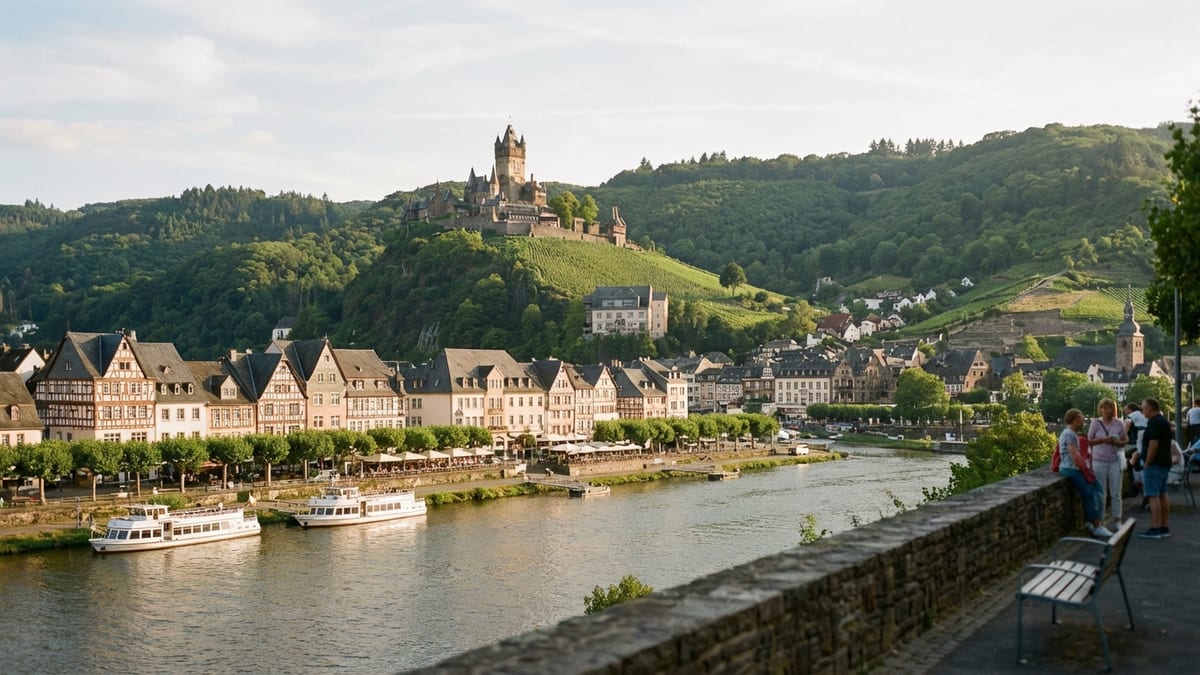
Cochem is one of those rare river towns that makes immediate sense when you arrive. The Moselle carves a tight curve between steep vine covered slopes, a cluster of half timbered houses presses against the water, and high above it all the towers of Reichsburg Cochem mark the skyline.
To understand Cochem is to read that landscape: the old town packed along the riverbank, the hillsides rising abruptly behind, and the broad sweep of the Moselle that defines how you move, see, and experience the place. Understanding the layout helps prioritize the main things to do in Cochem. This guide focuses on that physical layout so you can navigate Cochem with confidence, choose the right viewpoints, and appreciate how history and geography have shaped the town you see today.
Understanding Cochem’s Natural Setting
Cochem sits in one of the narrowest and most dramatic sections of the Lower Moselle, in a winding stretch of river known as the Cochemer Krampen. From above, this segment resembles a hooked clamp, with the Moselle looping back on itself in tight bends framed by the low mountains of the Eifel on one side and the Hunsrück on the other.
The town center lies roughly 80 to 85 meters above sea level, while the surrounding ridges climb to almost 300 meters, creating a sense that Cochem is cradled in a vast green amphitheater. This overview often leads travelers to ask whether Cochem is worth visiting.
This steep relief is not only scenic but also practical. The Moselle’s terraces and slopes have been cultivated for wine for centuries, and vineyards still pattern the hillsides around the town. The river’s curves dictate where roads, railways, and footpaths can go, and they also determine how visitors experience Cochem: long perspectives along the water, sudden vertical ascents to castles and viewpoints, and continual glimpses of vines as you move through the streets.
The town is divided by the Moselle into three principal built up areas. The historic center and the upstream neighborhood of Sehl sit on the left bank, while the district of Cond spreads along the right bank. Bridges connect these parts into a single urban area, but each side has its own character, views, and role in the town’s layout. Once you understand where you are in relation to the river’s bend and which bank you are on, navigating Cochem becomes straightforward.
The valleys feeding into the Moselle are another key part of the picture. Small tributary streams such as the Endertbach and Sehlerbach cut deep notches into the hills around Cochem, creating side valleys that funnel paths, roads, and sometimes entire walking routes from the high plateaus down to the old town. If you find yourself suddenly leaving busy riverfront streets for a quiet wooded path within minutes, you are likely following one of these ancient natural corridors.
The Shape and Feel of the Old Town
Cochem’s old town occupies a narrow strip between the river and the rising hillside, which gives it a long, slightly curved footprint rather than a compact grid. The central market square sits a short distance back from the Moselle promenade, with short lanes radiating from it like spokes. Many of these lanes respond directly to the terrain: some run uphill at a noticeable gradient, others squeeze between older buildings in alley like passages that once hugged sections of the medieval wall.
The architectural character is strongly marked by timber framed houses, steep roofs, and stone town walls. Streets like Herrenstraße, Oberbachstraße, Bernstraße, and Löhrstraße are lined with multi story half timbered buildings that lean toward each other above narrow pavements. Small squares open unexpectedly where the slope eases or where an earlier defensive structure has been repurposed. The town hall and fountain at the market square form the civic heart, and from here it is just a short walk to the riverfront in one direction and to the steep climb toward the castle in the other.
Because the historic center hugs a convex bend of the Moselle, the riverfront promenade acts almost like a stage for the town. Buildings along Moselpromenade have their facades turned toward the water, while terraces and hotel balconies exploit the open views up and down the valley. At street level, cafés and wine bars spill onto the pavements, particularly in fine weather, creating a lively but intimate sequence of spaces between the market square and the main bridge.
Despite its compact footprint, the old town has multiple vertical layers. At river level you find the promenade, boat landings, and shopfronts. A little higher up are the main commercial streets, churches, and the market. Above that, on terraces and ledges that begin to climb into the hillside, sit former monasteries, chapels, and small residential lanes that feel almost rural. Within a short radius you can transition from busy pedestrian zones to quiet paths where vineyards and small stone walls begin to dominate.
Hillsides, Vineyards, and Viewpoints
The steep hillsides around Cochem are as central to the town’s identity as the old streets themselves. Historically, these slopes were valued above all for viticulture, and much of the land immediately behind the town still hosts vineyard parcels that supply local producers with Riesling grapes. When you look at Cochem from the bridge or from the opposite bank, you see layers of terraced vines rising behind the church towers and roofs, reinforcing the sense that the settlement is simply one band in a larger cultivated landscape.
Access to the hillsides is easier than it looks from below. Several signed walking paths begin close to the town center and zigzag up through trees and vines to reach high level trails. One of the most famous ascents is to the Pinnerkreuz viewpoint, a rocky outcrop above the town that looks directly down onto the curve of the Moselle and across to the castle. You can hike up through the woods, tackling short but steep sections, or you can use the Cochem chairlift when it is operating, which reduces the climb to a gentle walk from the upper station.
The Pinnerkreuz sits at nearly 300 meters above sea level, which is roughly 200 meters above the river. From here the structure of Cochem is laid out like a map. You can clearly distinguish the old town pressed along the left bank, the district of Cond stretching opposite, and the continuation of buildings upstream toward Sehl. Beyond the town, vineyards pattern both sides of the valley, with higher forested ridges forming a dark green backdrop. It is the best place to grasp the full three dimensional relationship between river, town, and hills.
Other hillside destinations include Winneburg Castle, a romantic ruin hidden above a side valley, and chapels and viewpoints along the heights of the Eifel and Hunsrück plateaus. While these are slightly further from the center, they all reflect how Cochem uses its vertical environment: the more you climb, the quieter the paths become, and the stronger the sense that the town is only one component of a much larger river landscape.
The Moselle River and Cochem’s Linear Layout
For visitors, the Moselle is both a scenic feature and a practical orientation tool. The main bridge in Cochem marks the approximate center of the urban area. Stand on it and you see the old town to one side and Cond to the other, with the castle crowning the left bank hillside. Upstream, the river continues toward the neighborhood of Sehl and then into the tight loops of the Cochemer Krampen. Downstream, the water broadens slightly as it passes vineyards and smaller villages that line the Moselle on its way toward Koblenz.
The riverfront promenade is the spine that connects much of Cochem’s life. On the left bank, it runs beneath townhouses and hotels, lined with benches, plane trees, and terraces. It is here that excursion boats dock during the main season, and where evening strolls tend to gravitate. On the right bank, the promenade in Cond is simpler and quieter, but it offers some of the best full frontal views of the old town and castle. If you are seeking the classic postcard image of Cochem’s skyline, you will almost certainly find it on this side of the river.
The linear nature of the town is particularly evident if you follow the water on foot or by bicycle. Within a short distance you move from the dense historic core to stretches of riverside fields, caravan sites, and small docks, always with vines above. Regional cycle routes and walking paths piggyback on this narrow strip of flat ground along the Moselle, linking Cochem to neighboring villages in both directions. This linear arrangement makes it easy to add a pleasant riverside excursion to your stay without complicated navigation.
The Moselle also establishes Cochem’s rhythm over the course of the year. During the main river cruise season, typically from spring through early autumn, there is a steady flow of boats mooring in town. In shoulder seasons and winter, traffic reduces, and the riverfront becomes quieter, with mist rising from the water on cold mornings and snow sometimes dusting the upper vineyards. Regardless of season, the Moselle remains the most reliable thread tying your experience of the town together.
Navigating Between Old Town, Castle, and Cond
Once you understand that Cochem consists of several neighborhoods arranged along and above the Moselle, moving between them becomes easier. The old town is compact enough to navigate entirely on foot. Its streets, though occasionally confusing at first glance, all tend to feed back toward either the market square or the riverfront. If you feel disoriented in a side lane, simply keep walking downhill and you will almost inevitably reach the Moselle promenade or one of the main through streets such as Endertstraße or Ravenestraße.
Reichsburg Cochem, the reconstructed imperial castle, sits on a spur of hillside above the old town, dominating the view from almost every angle. Two principal ways lead from the river up to the castle: a footpath that climbs from the edge of the old town through a mixture of residential streets and woodland, and a shuttle that runs up the castle road during the main visitor season. Both routes highlight how the castle is perched on a natural promontory: as you ascend, you can look down on the river curling around the base of the hill and see the old town roofs spread out like a model below.
To reach Cond, you simply cross the Moselle on the main road and pedestrian bridge. From the old town, the bridge is directly accessible from the riverfront. On the Cond side, quiet residential streets follow the curve of the river, interspersed with small hotels, guesthouses, and local businesses. Cond is an excellent base if you want open views toward the castle right from your room or if you prefer a slightly calmer atmosphere while remaining within easy walking distance of the historic center.
Upstream, the area of Sehl extends the built up zone further along the left bank. It is effectively continuous with the old town but has a more village like feel, with a mix of houses, small hotels, and riverside accommodation. If you are strolling upriver, you will hardly notice when you have left the core of Cochem and entered Sehl, but the traffic thins and the ambience becomes more residential. Here too the steep hillsides remain a constant presence, with vineyards rising directly behind the last row of houses.
Seasonal Impressions and How Layout Shapes Your Stay
Cochem’s structure along the river and up the slopes means that the town changes personality with the seasons while remaining legible. In spring, when vines are budding and hillsides are just turning green, the vertical dimension draws the eye upward. Walking paths to Pinnerkreuz and the castle are especially rewarding as you catch glimpses of fresh foliage and longer views through not yet fully leafed trees. The riverfront begins to fill with early season cruisers, but there is still a sense of space on the promenades and in the market square.
Summer accentuates the linear riverside life. Outdoor seating along Moselpromenade is in full use, boats come and go at regular intervals, and paths along the river are busy with cyclists and walkers. The heat reflects from the stone and timber of the old town, which makes the shaded lanes leading uphill, or a ride on the chairlift to the breezier heights, particularly appealing. Because of the town’s narrow footprint, you are never far from either a cool riverside bench or a higher level viewpoint with moving air.
Autumn is arguably the best season to observe how the hillsides complete Cochem’s visual composition. As the vines turn golden and red, the contrast between the roofs of the old town and the colored terraces above becomes vivid. Wine festivals and tasting events make the connection between landscape and local glass particularly tangible. From Pinnerkreuz or the castle terraces, the entire valley glows with color, the river reflecting the slopes like a long mirror. It is at this moment that the logic of building tightly along the river below such productive hillsides feels most evident.
In winter, with leaves gone and occasional snow or frost on the upper ridges, Cochem appears sharper and perhaps more austere, but the basic pattern of river, town, and hillside is even clearer. The compactness of the historic center becomes an advantage, as you can move quickly between accommodations, cafés, and river views without long walks. The town’s Christmas market, when operating, typically fills the old town with stalls and lights, creating a sense that the historic fabric has contracted into an intimate stage beneath the castle’s silhouette.
Practical Tips for Experiencing Cochem’s Layout
To make the most of Cochem’s structure, start by orienting yourself along the river. Walk the left bank promenade from just downstream of the old town up past the bridge and into Sehl, then cross to the right bank and return through Cond. This simple loop, achievable in well under an hour at a gentle pace, will give you repeated oblique views of the castle, close up impressions of the waterfront buildings, and a clear sense of how the urban areas are strung along the Moselle’s curve.
Next, integrate a vertical element. Whether you choose the hike or the chairlift, a visit to the Pinnerkreuz viewpoint adds a crucial three dimensional understanding of the town. From there, take time to trace with your eyes the line of the river, the precise location of the bridge, the compactness of the old town core, and the way Cond extends along the opposite bank. Memorize a few visual landmarks, such as the town hall roof, church spires, or a particular riverside hotel, and then look for them once you return to street level. You will find that the mental map you build from above makes everyday navigation easier.
Allow time in your itinerary for unstructured wandering through the lanes that climb behind the old town. These semi hidden routes often follow ancient paths toward chapels, monasteries, or small vineyard huts. They may not lead to formal viewpoints, but they constantly reveal new angles on the river and castle. Because the hills rise quickly, you do not need to walk far before gaining a sense of separation from the commercial bustle below, even though you are still within the town limits.
Finally, think about how the river layout interacts with your choice of accommodation and activities. Staying on the left bank in the historic center offers immediate access to restaurants, shops, and boat landings, but slightly fewer straight on views of the castle. Choosing a base in Cond or Sehl typically gives you broader vistas across the water to the old town silhouette, at the price of a short, scenic walk or bridge crossing when you want to be in the thick of things. Both options take advantage of the same underlying structure, just from different angles.
The Takeaway
Cochem’s charm rests not only on individual sights but on the way those sights are arranged within a tight river valley framed by steep hillsides. The old town spreads in a slender ribbon along the left bank of the Moselle, watched over by a castle perched on a rocky spur. Across the water, Cond offers a quieter counterpart with commanding views back to the historic core, while upstream Sehl continues the settlement into a more village like stretch. Above all of it rise vineyards and wooded ridges punctuated by viewpoints like Pinnerkreuz that reveal the town’s plan in a single sweeping glance.
As a visitor, understanding this physical layout turns Cochem from simply picturesque into deeply legible. The river becomes your axis, the bridge your reference point, and the hillsides your vantage. Whether you arrive for a daytrip or several nights, you will find that the most rewarding experiences come when you connect these elements: walking the promenades, climbing into the vines, pausing on terraces and lookout points, and then descending again into the narrow lanes of the old town. In doing so, you are essentially tracing the same lines that have defined Cochem’s relationship to the Moselle for centuries.
FAQ
Q1. How is Cochem’s old town laid out in relation to the Moselle River?
The old town of Cochem runs as a narrow band along the left bank of the Moselle, pressed between the river and the steep hillside below Reichsburg Cochem. Most historic streets and squares lie just a short walk inland from the riverfront promenade, with lanes either parallel to the water or rising steeply toward the castle.
Q2. Which side of the river offers the best views of Cochem and the castle?
The right bank district of Cond generally offers the best full frontal views of the old town and castle. From the promenade and small riverside parks in Cond you can see the timber framed houses, church spires, and the castle rising above them in one composition, especially striking at sunset or after dark when buildings are illuminated.
Q3. How difficult is the walk from the old town up to Reichsburg Cochem?
The walk to Reichsburg Cochem is short but steep. It usually takes around 15 to 25 minutes from the riverfront, depending on your pace. The route follows a combination of streets and paths with stairs and inclined sections, so it is manageable for reasonably fit visitors but may be challenging for those with limited mobility.
Q4. What is the Pinnerkreuz viewpoint and how do I reach it?
Pinnerkreuz is a prominent lookout point on the ridge above Cochem that provides panoramic views over the town, castle, and Moselle valley. You can reach it by hiking a marked trail that climbs through the woods from near the town center, or by taking the Cochem chairlift, which carries you partway up the hillside to a short walking path leading to the viewpoint.
Q5. Is it better to stay in the old town, Sehl, or Cond for exploring Cochem?
Staying in the old town places you in the middle of historic streets, restaurants, and boat departures. Sehl, just upstream on the same bank, feels more residential and village like but is still walkable to the center. Cond across the river is usually quieter and often provides wider views back toward the castle and old town. All three areas work well; the best choice depends on whether you prioritize atmosphere, calm, or direct access to sights.
Q6. How long does it take to walk the length of Cochem along the river?
Walking the central stretch of Cochem along the riverfront, from the downstream edge of the old town through the bridge area and up into Sehl, typically takes 20 to 30 minutes at a leisurely pace. Extending the walk across the bridge and along Cond’s promenade adds another 15 to 20 minutes and provides contrasting perspectives on the town.
Q7. Can I explore Cochem without a car?
Yes, Cochem is very manageable without a car. The railway station is close to the river and within walking distance of the old town. Once in town, most attractions, including the castle, chairlift, and riverfront, can be reached on foot. Regional buses and boats connect Cochem to neighboring villages if you want to explore further along the Moselle.
Q8. Are there many stairs and steep paths in Cochem?
Cochem’s setting in a narrow valley with steep hillsides means that you will encounter stairs and inclined streets, especially when heading toward the castle, hillside chapels, or viewpoints. The riverfront and central market area are relatively flat, but venturing beyond them usually involves some climbing, which is part of the town’s character and charm.
Q9. When is the Cochem chairlift in operation and what should I know?
The Cochem chairlift typically operates from late March through mid November, with daily opening hours that vary slightly by month and daylight. It departs from a station near the town center and takes only a few minutes to reach the upper station near Pinnerkreuz. Chairs can be open or covered depending on weather, and the ride offers excellent views over the town and river.
Q10. How does Cochem’s layout affect crowds and quiet spots?
The compact linear layout means that crowds concentrate along the riverfront, in the market square, and on the main paths to the castle. To find quieter spots, simply move a little away from these axes: cross to the Cond side, walk upstream into Sehl, or follow side lanes that climb the hillside. Within minutes you can often find peaceful vantage points while still staying close to the central sights.