

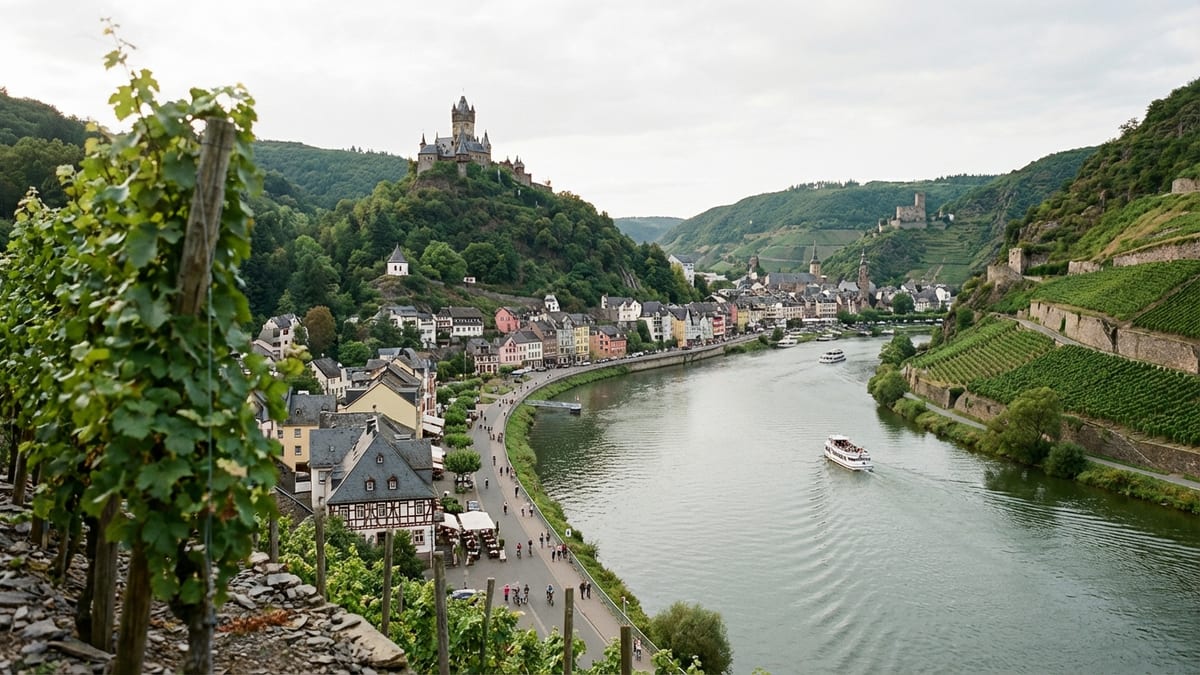
The Moselle Valley in western Germany is a patchwork of steep vineyards, storybook villages and medieval castles reflected in the slow sweep of the river. Two towns in particular have become favorites for travelers planning a Moselle escape: Cochem and Bernkastel-Kues.
Both promise half-timbered charm, excellent Riesling and river views, yet the experience in each town is surprisingly different. Choosing between them depends on what kind of trip you want: lively and accessible, or quietly atmospheric and deeply historic. This comparison works best after understanding whether Cochem is worth visiting on its own.
First Impressions: Character and Atmosphere
Cochem and Bernkastel-Kues are separated by about 40 miles of river yet feel like cousins with distinct personalities. Cochem is often a first Moselle stop for international travelers, in part because it lies directly on a major rail line and in part because images of its hilltop Reichsburg Castle have become symbolic of the valley itself.
The town hugs a wide curve in the river, with pastel facades and slate roofs rising behind a lively promenade of cafés and excursion boats. In high season Cochem feels busy, almost resort-like, with day-trippers from the Rhine and cruise passengers filling the streets.
Bernkastel-Kues, by contrast, reveals itself more slowly. The Bernkastel side of town is a tightly woven medieval core of crooked half-timbered houses and narrow alleys that open suddenly onto a perfectly preserved market square.
Across the bridge, Kues spreads more quietly along the riverbank and into the vineyards. While Bernkastel-Kues can certainly be crowded on festival weekends and summer afternoons, its slightly smaller scale and more intricate streets create a more intimate, almost theatrical atmosphere, especially in the early morning and after dusk when day-trippers have gone. Reviewing the main things to do in Cochem highlights how it differs from Bernkastel-Kues.
For travelers drawn to a postcard-perfect old town with a softer, more romantic mood, Bernkastel-Kues tends to feel like the quintessential Moselle village. Those who prefer a livelier base with an obvious central promenade and a more overt holiday buzz often find Cochem better suits their expectations of a river resort. Neither town is objectively more beautiful, but the balance between bustle and atmosphere is immediately apparent when you arrive.
Scenery and Setting Along the Moselle
Both towns enjoy dramatic river scenery, but the character of the surrounding landscape differs in ways that matter if you plan to hike, cycle or simply sit and admire the view. Cochem is framed by steep, wooded slopes that rise quickly from the water, with vineyards cut into the hillsides and the castle perched high above the town. From the river promenade, the visual focus is almost always Reichsburg, its towers and battlements dominating the skyline. The wider curve of the river near Cochem allows for broader panoramas, particularly from the castle terrace and nearby viewpoints, where you see boats threading a generous arc of water below.
The setting around Bernkastel-Kues feels more tightly wrapped, with the Moselle making a pronounced bend and vineyards climbing almost directly from the edge of town. Above Bernkastel sit the ruins of Landshut Castle, less imposing than Reichsburg but spectacularly positioned over a patchwork of vines. The views from here are among the most celebrated on the Middle Moselle, taking in the river’s sinuous loop, steep slate slopes and the compact medieval town at your feet. Because vineyards are so close to the center, you can be walking between rows of Riesling within minutes of leaving the market square.
If your idea of a perfect Moselle stay involves constant castle views framed by wooded hills, Cochem has an edge. If you prefer to feel surrounded by vineyards and to look down from a castle directly onto a medieval street plan, Bernkastel-Kues is hard to beat. In reality, many travelers report that the overall valley scenery feels marginally more dramatic near Bernkastel-Kues, where the slopes seem closer and the river’s curves more pronounced, though this is as much about mood as about geography.
Old Towns, Castles and Cultural Sights
When it comes to architecture and tangible history, Bernkastel-Kues generally offers the denser concentration of classic Moselle charm. The medieval marketplace in Bernkastel is one of the most photographed squares in the region, ringed by gabled half-timbered houses leaning at improbable angles. The Spitzhäuschen, or Pointed House, dates to the early fifteenth century and appears to overhang its ground floor, creating the sort of fairy-tale streetscape many visitors imagine when they book a Moselle trip. Nearby, the Renaissance-era town hall and St. Michael’s Church add layers of Gothic and Baroque detail to the compact core.
Above the town, Landshut Castle crowns the ridge. The structure today is a picturesque ruin, but recent restoration work has stabilized the remaining walls and integrated a contemporary restaurant and terrace into the historic fabric. The walk up, taking around 20 to 30 minutes from the center, rewards visitors with far-reaching views over the valley. On the Kues side of the river, the St. Nikolaus Hospital, or Cusanusstift, founded in the fifteenth century by the philosopher and theologian Nicholas of Cusa, houses a remarkable library of medieval manuscripts and a small museum, giving Bernkastel-Kues more intellectual depth than many river towns of comparable size.
Cochem’s historic quarter is also attractive, with its own mix of half-timbered houses, Baroque churches and a compact market square. Yet the town’s single most prominent cultural landmark is Reichsburg Cochem, a neo-Gothic reconstruction on the site of a medieval castle. Destroyed in the seventeenth century and rebuilt in the nineteenth, Reichsburg offers guided tours through furnished halls, showcasing the romanticized castle interiors popular with the era’s wealthy owners. The position of the castle is undeniably spectacular, and for many visitors the walk or shuttle ride up followed by views of the town and river is reason enough to stay in Cochem.
In the balance between intact medieval streets and a showpiece hilltop castle, Bernkastel-Kues tends to appeal to travelers seeking an immersive old-town experience, while Cochem is ideal for those who prioritize a classic castle visit with interiors. If you have time for only one castle tour and prefer authentic ruins with sweeping views, Landshut above Bernkastel-Kues has a slight advantage. If you want a more complete castle interior, Reichsburg Cochem is the obvious choice.
Wine Culture, Food and Festivals
Both Cochem and Bernkastel-Kues sit in the heart of one of Germany’s most prestigious wine regions, but the intensity and visibility of wine culture are particularly pronounced in and around Bernkastel-Kues. The town lends its name to Bernkasteler Doctor, a legendary vineyard on a steep south-facing slope above the Moselle whose Rieslings rank among the country’s most prized. Local lore credits this site’s wine with curing a medieval archbishop’s illness, and today its limited production and steep prices give Bernkastel-Kues a certain prestige among oenophiles.
Wineries and wine taverns cluster throughout Bernkastel-Kues, many offering tastings in historic cellars or riverside courtyards. The town serves as a focal point for wine events along this stretch of the Moselle, including the Middle Moselle Wine Festival, typically held around the first Sunday in September. Over several days thousands of visitors descend on the town for tastings, live music, fireworks and a winegrowers’ parade, creating an exuberant mood that showcases the local vintners and their Rieslings. Throughout the year, smaller street and courtyard festivals, open cellar days and vineyard hikes pair wine with local specialties such as smoked sausage, regional cheeses and onion tart.
Cochem also celebrates its wine heritage, with numerous Weinstuben offering Rieslings from the surrounding slopes and nearby villages like Winningen and Valwig. Harvest season brings wine festivals and Federweißer, the lightly fermented new wine served with onion tart, to terraces along the river. In general, however, Cochem’s wine culture is more evenly blended with broader tourism, from river cruises to family-oriented attractions, and the town does not command the same reputation among serious wine collectors as Bernkastel-Kues and its immediate neighbors along the Middle Moselle.
For food-focused travelers, both towns offer a spectrum from simple taverns to refined dining, often emphasizing regional ingredients like game, river fish and seasonal produce. Bernkastel-Kues holds an edge in the sheer density of wine-focused venues and in its proximity to some of the Moselle’s most celebrated vineyards. Wine enthusiasts looking for structured tastings, vineyard walks and deeper insight into Riesling styles will likely find Bernkastel-Kues the more compelling base, while casual wine drinkers may be equally content in either town.
Activities, Day Trips and Outdoor Options
Beyond castles and wine, many visitors come to the Moselle for its outdoor activities, from cycling the riverbanks to hiking ridge-top trails. Bernkastel-Kues sits at the heart of a particularly well-developed network of paths and routes. The Moselle Cycle Path passes directly through town, allowing easy day trips upriver and downriver with minimal gradients. More adventurous cyclists can connect to the Maare-Moselle Cycle Path, which links the river valley to the volcanic crater lakes of the Eifel region on a mostly traffic-free route. For walkers, the Moselsteig long-distance trail and a series of side routes traverse the surrounding slopes, frequently passing through Bernkastel-Kues or within short reach.
The proximity of vineyards to the old town makes spontaneous walks among the vines easy. A short, steep climb brings you to viewpoints above the Bernkasteler Doctor vineyard or to Landshut Castle, while gentler balcony paths contour the hillside with constant views of the river. River cruises also operate from Bernkastel-Kues, offering round-trip excursions that showcase the valley from the water and often include commentary on local history and wine.
Cochem is likewise a solid base for outdoor pursuits, though the nature of the terrain differs somewhat. The hills here are more forested, and hiking routes often mix woodland paths with vineyard sections and castle viewpoints. The Moselle Cycle Path also runs through Cochem, making it straightforward to ride between nearby villages, and popular local walks include trails to viewpoints above the town or to neighboring wine-growing communities. Boat companies based in Cochem run frequent cruises, including trips through scenic stretches of the lower Moselle and toward the Rhine, which can be particularly appealing for first-time visitors to the region.
In terms of day trips, Cochem enjoys slightly better access to major Rhine and Moselle sights by public transport, including the Roman city of Trier and the Rhine Gorge, thanks to its position on a main rail line. Bernkastel-Kues, while well connected by bus and boat to neighboring Moselle villages and to regional hubs, does require a bit more planning if you intend to rely entirely on trains. For travelers building a broader itinerary around rail travel, Cochem can be more convenient for quick side excursions, while those happy to use buses or a rental car will find Bernkastel-Kues an excellent launching point into the heart of the valley.
Access, Practicalities and Crowd Levels
One of the most significant practical differences between the two towns is how you reach them. Cochem has its own railway station on the busy Koblenz to Trier line, with regular regional trains linking it to both cities and to connections toward Cologne and Frankfurt. This makes Cochem particularly straightforward for visitors arriving by train or planning to combine the Moselle with Rhine Valley stops using public transport. The station lies within walking distance of the old town and riverfront, and local buses connect to outlying villages and attractions.
Bernkastel-Kues, in contrast, does not have a direct railway connection. The nearest stations are in Wittlich and Traben-Trarbach, each requiring a bus transfer to reach the town. This extra step is relatively simple to navigate but adds time and complexity, especially with luggage or in poor weather. Travelers with a rental car will find both towns easily accessible, though parking can be tight in high season. River cruise passengers arriving on multi-day itineraries often dock in or near Bernkastel-Kues, which underscores its importance as a classic Middle Moselle stop despite the lack of a station.
Seasonality and crowd levels also play into the choice. Cochem sees a high volume of day-trippers and coach tours, particularly between late spring and early autumn. On fine weekends, the promenade can feel crowded, with excursion boats loading and unloading passengers and terraces filled well into the evening. Bernkastel-Kues experiences pronounced peaks during major events such as the Middle Moselle Wine Festival and the Christmas market, when the medieval market square becomes a festival stage and hotel occupancy surges. Outside these periods, however, the town often feels calmer than Cochem, especially in the evenings.
For travelers who prioritize easy rail access, Cochem is the more convenient choice. Those who value quieter streets at night and are willing to factor in bus transfers or a car journey often find Bernkastel-Kues more rewarding. In both cases, visiting outside the busiest months of July and August, or planning your sightseeing early and late in the day, can significantly enhance the experience.
Accommodation, Budget and Trip Style
Both Cochem and Bernkastel-Kues offer a broad range of accommodation, from simple guesthouses to boutique hotels and apartment rentals, but the profile of their stays can shape the character of your visit. In Cochem, many hotels and pensions line the riverfront road and adjacent streets, taking full advantage of castle views.
This configuration suits travelers who want to be close to the promenade, excursion boats and evening activity. A number of mid-range hotels cater particularly to group tours and short stays, which reinforces Cochem’s identity as a classic base for first-time Moselle visitors. Accommodation options also influence the choice, especially when comparing the best hotels in Cochem.
Bernkastel-Kues distributes its accommodation between the medieval core, the riverside of both Bernkastel and Kues, and the surrounding hills and villages. Staying in the old town places you directly among the half-timbered houses and cobbled alleys, ideal for those who value atmosphere over vehicle access. Across the river, Kues offers slightly more spacious riverside hotels and guesthouses, as well as wine estates providing rooms among the vineyards. This mix makes Bernkastel-Kues especially attractive for travelers planning longer, slower stays with a focus on walking, tasting and exploring the surrounding countryside.
In terms of budget, both towns span a similar range, with prices influenced more by season and specific location than by the town itself. Festival weekends in Bernkastel-Kues and peak summer dates in Cochem can both command higher rates and require advance booking. Dining costs are broadly comparable, centered on hearty regional cuisine, seasonal menus and of course wines by the glass or bottle. For self-caterers, both towns have supermarkets and bakeries, though Bernkastel’s weekly markets and specialty wine and food shops may offer a slight edge in variety for longer stays.
If you imagine a short, two-night introduction to the Moselle with simple logistics, organized excursions and a lively evening scene, Cochem often fits the bill. If your ideal is a three to five night stay with slower rhythms, afternoons wandering alleys and vineyards, and evenings lingering in wine taverns, Bernkastel-Kues frequently emerges as the better base. In practice, many travelers choose to split time between the two, but if you must pick one, considering the style and tempo of your trip is just as important as checking boxes for views and castles.
The Takeaway
Choosing between Cochem and Bernkastel-Kues for a Moselle escape is less about finding an objectively better town and more about matching each place’s character to your priorities. Cochem delivers iconic castle views, straightforward rail access and a lively resort atmosphere that works well for first-time visitors, short stays and multi-stop itineraries built around public transport. Its riverside promenade, frequent cruises and instantly recognizable skyline make it an easy crowd-pleaser, especially for families and mixed-interest groups.
Bernkastel-Kues, on the other hand, offers one of the most compelling medieval townscapes on the Moselle, a deeper immersion in wine culture and immediate access to some of the region’s finest vineyards and hiking routes. Its narrow streets, intimate market square and ruined hilltop castle create a more romantic, village-like feel, particularly rewarding for travelers who prefer lingering in one place, exploring on foot and engaging more closely with local wine and history. The lack of a train station is a real factor, but for many, the atmospheric payoff more than compensates.
If you value ease of arrival, a showpiece castle interior and plenty of organized excursion options, Cochem is likely the better choice. If you prioritize a preserved medieval core, top-tier Riesling experiences and direct contact with the vineyard landscape, Bernkastel-Kues generally comes out ahead. For those with time, visiting both towns along a longer Moselle itinerary offers the best of both worlds, revealing how two neighboring river settlements can share a landscape yet offer strikingly different ways of experiencing it.
FAQ
Q1: Which town is better for first-time visitors to the Moselle, Cochem or Bernkastel-Kues?
Cochem is usually better for first-time visitors because it has a train station, clear tourist infrastructure and the instantly recognizable Reichsburg Castle, making logistics and orientation especially simple.
Q2: Which town has the more picturesque old town?
Bernkastel-Kues generally has the edge for a picturesque old town, with its tightly packed medieval market square, crooked half-timbered houses and narrow lanes that many travelers consider the archetypal Moselle streetscape.
Q3: Where will I find better wine experiences?
Both towns offer good wine, but Bernkastel-Kues is surrounded by some of the Moselle’s most renowned Riesling vineyards and hosts major wine festivals, so serious wine enthusiasts often prefer it as a base.
Q4: Is it easier to get around without a car from Cochem or Bernkastel-Kues?
Cochem is easier without a car because it sits on a main rail line, allowing straightforward train travel to Koblenz, Trier and the Rhine, while Bernkastel-Kues depends on bus connections to nearby stations.
Q5: Which town is less crowded in peak season?
Both can be busy in summer, but Cochem tends to see more continuous day-tripper traffic, while Bernkastel-Kues is often calmer outside major events like the Middle Moselle Wine Festival and the Christmas market.
Q6: Which castle is more impressive to visit, Reichsburg Cochem or Landshut Castle above Bernkastel-Kues?
Reichsburg Cochem is more impressive as a restored castle interior with guided tours and furnishings, while Landshut Castle offers more atmospheric ruins and spectacular vineyard and town views from its hilltop position.
Q7: Where should I stay if I want to hike and cycle a lot?
Bernkastel-Kues is particularly convenient for hiking and cycling because the Moselsteig trail, the Moselle Cycle Path and routes into the surrounding vineyards and hills run very close to the town center.
Q8: Which town is better for a short two-night stay?
For a short two-night stay, Cochem is often better because easy train access and concentrated sights allow you to see a lot in limited time without worrying about transfers.
Q9: Is one town more romantic than the other for couples?
Many couples find Bernkastel-Kues slightly more romantic due to its intimate market square, riverside walks between Bernkastel and Kues and the sunset views from Landshut Castle over the vineyards.
Q10: If I have time for only one, which town should I choose?
If you prioritize convenience and a classic castle visit, choose Cochem; if your focus is on a quintessential medieval town atmosphere, top-tier Riesling and vineyard walks, Bernkastel-Kues is likely the more satisfying choice.