

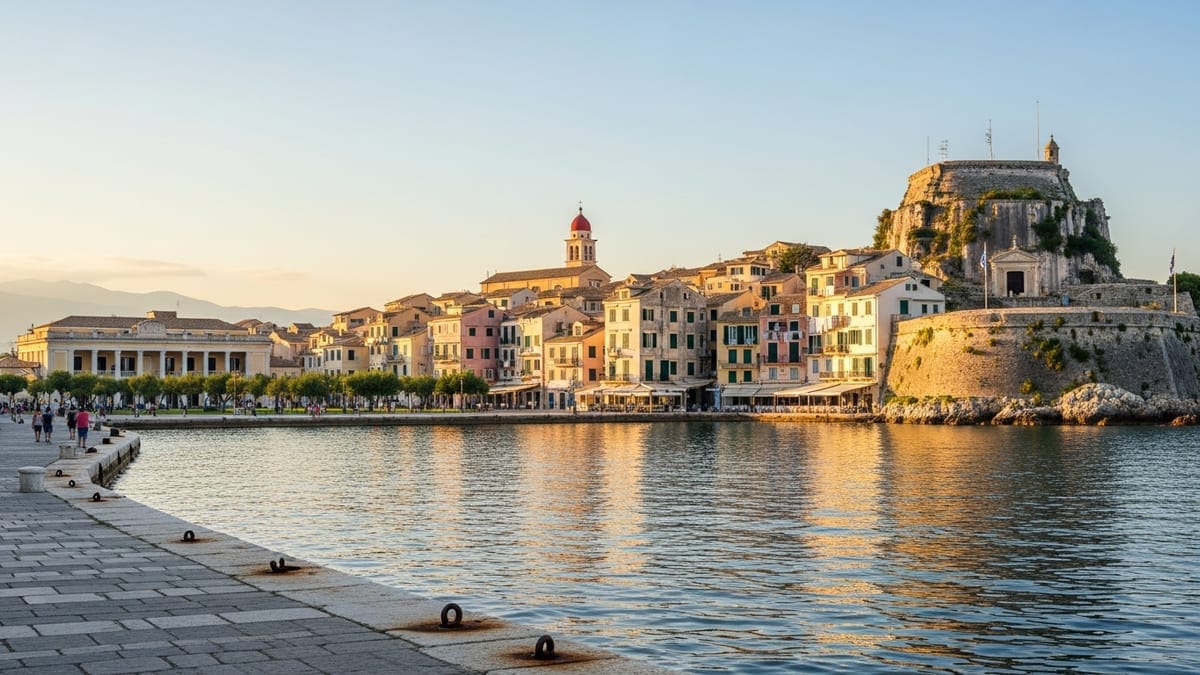
Corfu Town is a place where military history, Venetian elegance and slow Mediterranean living share the same sunlit stage. Its twin fortresses still loom over a tight maze of alleys and pastel houses, while a waterfront promenade curves past café terraces, bobbing fishing boats and moored yachts. Whether you arrive by ferry, plane or cruise ship, the island’s capital is where Corfu’s layers of Greek, Venetian, French and British heritage come together in a compact, walkable setting that rewards both aimless wandering and focused exploration.
Getting Your Bearings in Corfu Town
Corfu Town, also known as Kerkyra, sits on the island’s east coast facing the mainland of Greece and Albania. The Old Town occupies a peninsula framed by the Old Fortress on one side and the New Fortress on a hill to the northwest, with the modern port a short walk away. Streets are narrow, curving and often stepped, so you navigate more by landmarks than by grid: the Liston arcades, the towering campanile of Saint Spyridon Church, the neoclassical Palace of St. Michael and St. George, and the open green of the Esplanade.
The city’s historic core is recognized as a UNESCO World Heritage site, celebrated for its intact fortifications and neoclassical housing stock that grew from the 15th century onward. Venetian engineers shaped much of what you see, but later French and British administrations left their own marks in architecture, urban design and civic institutions. Despite this complex past, present-day Corfu Town feels unmistakably Greek, with squares alive into the late evening and laundry strung over cobbled lanes.
For visitors, the town splits naturally into zones. To the east, between the Esplanade and the sea, lie the Old Fortress and the waterfront walk toward Garitsa Bay. To the west and north of the Esplanade, alleys packed with shops, bakeries and tiny bars twist toward the New Fortress and the old harbor. South of the Esplanade, broader streets lead past residential neighborhoods and toward the airport. With most key sights within a 15 to 20 minute walk of each other, you can comfortably explore on foot if you are prepared for some stairs and uneven paving.
Orientation is easier if you think in viewpoints. The Old Fortress, New Fortress and coastal walk each offer different perspectives of the town and bay. Plan at least a half day to get your bearings, then allow more time if you want to explore museums, churches or simply linger in cafés and watch the town at work and play.
Inside the UNESCO-listed Old Town
Corfu’s Old Town grew up around fortifications that once placed the island on the front line between Western Europe and the Ottoman Empire. Today, that military role has faded but the urban fabric remains remarkably intact. Narrow kantounia, or lanes, thread between tall houses in ochre, cream and faded pink, their shutters painted deep green or blue. Many buildings date from the 18th and 19th centuries and still carry traces of Venetian coats of arms or carved stone portals beneath newer plaster.
Life in the Old Town follows a familiar rhythm. Mornings see residents shopping at small grocers and bakeries or catching up over a coffee in tiny corners that seem barely big enough for a counter and a couple of stools. By late morning and early afternoon, day trippers arrive, and the main shopping streets fill with browsers. Evenings belong to locals again, as children play in squares and friends gather at wine bars and ouzeries tucked into side streets. Staying overnight in the Old Town lets you experience all these phases rather than only the midday rush.
Key religious landmarks are woven into this residential fabric. The Church of Saint Spyridon, with its distinctive red-domed bell tower, houses the relics of Corfu’s patron saint and draws both worshippers and visitors. Interiors across town tend to be lavish, with gilded iconostases and painted ceilings revealing the prosperity Corfu once enjoyed as a maritime hub. Many churches keep fairly regular opening hours, but they also function as active places of worship, so modest dress and quiet behavior are essential.
One of the charms of Corfu Town is that you rarely need to walk far to shift mood. A lane packed with cafés and souvenir shops may open suddenly onto a quiet square with a single café and a cluster of orange trees. Around each bend, you might find a hidden well, an old stone arch or a balcony overflowing with bougainvillea. It is worth allowing at least an hour simply to wander with no agenda, letting the town’s textures and sounds guide you.
The Old Fortress: History, Views and Sea Breezes
The Old Fortress rises from a rocky promontory east of the Esplanade, separated from the rest of the town by a seawater moat known as the Contrafossa. Originally fortified in Byzantine times, it was extensively redesigned and strengthened by the Venetians from the 15th century onward, then later adjusted under British rule in the 19th century. Its twin peaks gave Corfu its Western name, derived from the Greek for “peaks,” and still dominate many views of the city skyline.
Today the Old Fortress is open to visitors, with an entrance fee that in recent years has been around 10 euros for adults, with concessions and free entry for many younger EU residents. Opening hours typically start in the morning and run into late afternoon or early evening, with seasonal variations, so it is wise to confirm current times locally before you go. Tickets are usually available on site without advance booking, but on busy summer days it can be helpful to arrive early to enjoy the site in cooler, quieter conditions.
Inside the walls, you will find a complex of bastions, tunnels, barracks and open spaces, many adapted for new uses. Part of the former British barracks now houses Corfu’s public library and cultural venues. As you climb toward the highest points, views open out across the town, the Esplanade, the coast of mainland Greece and the open Ionian Sea. On clear days you can trace ferry routes slicing across the water and watch aircraft descending toward the island’s runway.
Allow at least 60 to 90 minutes for a meaningful visit, more if you are interested in the details of military engineering or photography. Surfaces can be uneven and some paths quite exposed, so comfortable footwear, water and sun protection are important, particularly in summer. The site rewards slow exploration, from the cool interior corridors and ammunition magazines to the open bastions where you can stand in the same positions that gunners once used to protect the town from repeated Ottoman sieges.
The New Fortress and Corfu’s Defensive Story
While the Old Fortress embraces the sea, the New Fortress crowns the hill of Saint Mark above the old harbor on the town’s northern flank. Built by the Venetians beginning in the late 16th century to strengthen the city’s defenses, it guarded approaches by land and by water and helped secure Corfu as a key outpost on routes into the Adriatic. From the waterfront, its walls and bastions appear imposing, layered in stone above lanes of old warehouses and fishermen’s houses.
Access to the New Fortress is via steep lanes that wind up from the harbor and from the market area. The complex includes multiple levels, bastions and underground galleries, some of which have been adapted for exhibitions and cultural events. As with the Old Fortress, parts of the site reflect later British modifications, including barracks buildings that now sometimes host art shows and performances. Opening patterns can vary over time, with some sections occasionally closed for restoration or events, so it is sensible to check current public access once you are in town.
The New Fortress offers one of the best panoramas of Corfu Town. From its higher bastions, rooftops spread out in an intricate pattern of tiles and chimneys, punctuated by church towers and the line of the Liston arcades backing the Esplanade. Beyond lie the harbor, ferries and the distant mountains of the mainland. The viewpoint helps make sense of how the Old Town fits together and shows why the Venetians invested so heavily in its defenses.
Walking up to the fortress has its own rewards. En route you pass everyday corners of Corfu life that many short-stay visitors miss: neighborhood cafés where older residents linger over backgammon, small workshops and glimpses into courtyard gardens. Plan for a slower climb if the day is hot, and consider visiting in the morning or late afternoon when temperatures and light are gentler.
Waterfront Walks: From Esplanade to Garitsa Bay
Corfu Town’s waterfront invites walking at almost any time of day. The most formal stretch runs along the Esplanade, a broad green space between the Old Town’s eastern edge and the sea. Once a defensive glacis kept clear of buildings, it is now a mix of lawns, trees, a bandstand and cricket pitches, with the elegant Liston arcades lining its western side. Under the Liston’s arches, cafés set out rows of tables looking toward the sea, perfect for people watching and lingering over coffee or an evening drink.
From the southern end of the Esplanade, a paved path leads along the low seafront walls toward Garitsa Bay. This waterfront walk is one of the town’s great simple pleasures, especially in the cooler light of morning or at sunset. On one side, the bay curves in a gentle arc lined with small hotels, tavernas and trees. On the other, you see the Old Fortress from new angles, its stone bastions dropping directly into the water. Local residents use this route for exercise, strolling, dog walking and socializing, giving it a relaxed, lived-in feel.
As you continue around the bay, the perspective shifts repeatedly. Looking back, Corfu Town’s skyline rises behind the fortress and Esplanade, while ahead the runway and coastal hills frame the water. Small beaches and rocky bathing spots appear at intervals, some with ladders or rough steps down to the water, and certain sections are especially popular at sunrise and sunset with swimmers and photographers. It is possible to walk most of the way to the Kanoni area, but even a shorter out-and-back stroll offers a sense of openness that contrasts with the tighter streets of the Old Town.
North of the Esplanade, the waterfront is busier with harbor activity. Here you find the old port, modern marina facilities, excursion boats and ferries plying routes to nearby islands and the mainland. The promenade in this direction is less continuous but still walkable in sections, revealing workaday aspects of Corfu, from fishermen tending nets to mechanics working on small vessels. Combining a circuit from the Esplanade through the Old Town to the New Fortress and back along the harbor gives a varied overview of Corfu Town in a single extended walk.
Corfu Town by Day and Night
By day, Corfu Town offers a steady rhythm of sights and activity. Shops and markets open in the morning, with local produce, cheese, olives and seafood drawing residents alongside visitors. Museums such as those within the Palace of St. Michael and St. George, itself a landmark of British-era neoclassical architecture completed in the early 19th century, provide context on everything from Asian art to local history. Churches and monasteries welcome a mix of pilgrims and curious travelers, especially on weekends and Orthodox feast days.
Midday in high summer can be hot and bright, and many locals retreat indoors for a rest. This is a good time to seek shaded cafés, quiet museums or your accommodation for a break. The narrow streets of the Old Town offer more shade than the open waterfront, so you may find it more comfortable to explore lanes and arcades during the early afternoon, leaving longer walks for morning and evening when sea breezes moderate the heat.
After sunset, Corfu Town changes character. The Esplanade and Liston fill with families, couples and groups of friends on their volta, the traditional evening promenade. Children ride bicycles or play ball games on the grass while adults socialize over drinks. The Old Town’s lanes glow with softer light as shops stay open late in season and bars spill gentle music into the streets. Dining tends to start later than in some Northern European countries, with many locals sitting down after 9 p.m., especially on weekends.
Nighttime also shows a different face of the fortresses and waterfront. The Old Fortress is often illuminated, turning its stone walls and bastions into a dramatic backdrop against the dark sea. Reflections in the bay and harbor add to the sense of theatre, while cooler temperatures make it easier to stroll long distances. Walking routes feel lively in the central areas well into the evening, although quieter side streets empty earlier, so standard urban awareness is advisable as in any small city.
Practical Tips for Exploring on Foot
Corfu Town rewards travelers who are willing to walk. Many streets in the Old Town are too narrow for vehicles, and even where cars and scooters are allowed, pedestrian traffic dominates. Comfortable walking shoes are essential, as surfaces range from smooth stone slabs and cobbles to worn steps and sloping lanes polished by centuries of use. Sandals with good grip can work in summer, but avoid thin soles that transmit every irregularity of the pavement.
The town’s compact nature can be deceptive. Distances on a map may seem short, but you will often zigzag up and down slopes, detouring around staircases or pausing to let local life flow past in very narrow sections. Plan less than you think you can cover in a day and allow time for unplanned stops, whether that is a shaded bench on the Esplanade, a courtyard café or a sea-level viewpoint along the waterfront. A typical relaxed day might include one fortress visit, an hour or more of unscripted wandering and two or three significant café or meal breaks.
Weather plays a significant role in how you experience Corfu Town. Summers are warm to hot, with strong sun reflecting off pale facades and paving. Carry water, use sunscreen, wear a hat and seek shade during the brightest hours. Shoulder seasons in spring and autumn can be ideal for walkers, with milder temperatures and less crowded lanes, although sudden showers are possible. Winter brings a quieter town and cooler, sometimes rainy conditions, but on clear days the light can be particularly crisp and the atmosphere more local.
For navigation, a simple offline map or app is helpful, but do not worry about straying from a precise route. The Old Town is ringed by larger streets and the sea, so you are unlikely to get truly lost for long. If you need to regain your bearings, look for familiar landmarks such as the Old Fortress, the bell tower of Saint Spyridon or the open expanse of the Esplanade. Many residents speak at least some English and are used to giving directions, especially in areas frequented by visitors.
The Takeaway
Corfu Town is more than a gateway to beaches and resorts. It is a fully formed destination in its own right, where centuries of strategic importance have left a dense concentration of architecture, culture and stories within an easily walkable area. The Old and New Fortresses chart the island’s role in Mediterranean power struggles, while the UNESCO-listed Old Town, Esplanade and Liston preserve the urban elegance of a prosperous port city. Along the waterfront, promenades and bays turn everyday strolls into sequences of views and encounters with local life.
Whether you have a single day from a cruise ship or several nights in a town hotel, investing time in Corfu’s capital pays off. Start with the basics: one fortress, an unhurried wander through the Old Town and a waterfront walk around Garitsa Bay. Add layers as your schedule allows, from museum visits and church interiors to quiet cafés in back alleys. The town invites you to slow down, look up at facades and bell towers, listen to the mix of languages in the streets and feel the underlying continuity of a place that has adapted to changing empires while retaining a clear sense of itself.
In a region filled with picturesque island towns, Corfu’s capital stands out for the completeness of its historic core and the way its fortresses, streets and waterfront remain woven into daily life. Come with curiosity, comfortable shoes and enough time to let the town reveal its patterns, and you will find that Corfu Town’s old stones and sea breezes linger in memory long after you leave the island’s harbor behind.
FAQ
Q1. How much time do I need to explore Corfu Town properly?
Most visitors are satisfied with one full day to see a fortress, wander the Old Town and enjoy a waterfront walk, but staying one or two nights allows you to experience the town at quieter morning and evening hours and explore more museums, churches and viewpoints.
Q2. Which fortress should I visit if I only have time for one?
If you must choose, the Old Fortress is generally the better option for a first-time visitor, thanks to its waterfront setting, extensive walkable ramparts and sweeping views over the town, Garitsa Bay and the mainland; it also illustrates the longest span of Corfu’s defensive history.
Q3. Are the Old Town and fortresses suitable for travelers with limited mobility?
Parts of Corfu Town are challenging, with cobblestones, steps and steep sections, particularly inside the fortresses and in older residential alleys, but the Esplanade, Liston arcades and some main streets are relatively level; travelers with limited mobility may wish to focus on these flatter areas and consider a taxi or transfer to reduce uphill walking.
Q4. Do I need to book tickets for the Old Fortress in advance?
For most of the year, tickets for the Old Fortress can be purchased at the entrance without advance booking, although in peak summer mornings can be busiest; checking current opening hours and any special restrictions once you arrive in Corfu is still recommended.
Q5. What is the best time of day for a waterfront walk around Garitsa Bay?
Early morning and late afternoon into sunset are the most comfortable and atmospheric times, with softer light, cooler temperatures and more locals out walking, while midday in summer can be hot and exposed along some sections of the bay.
Q6. Is Corfu Town safe to walk around at night?
Corfu Town is generally considered safe, and the central areas around the Esplanade, Liston and main Old Town lanes remain active into the evening in season, but standard urban precautions still apply, especially in quieter side streets and late at night.
Q7. What should I wear when visiting churches in the Old Town?
As active places of worship, churches in Corfu Town expect modest dress, meaning shoulders and knees covered where possible, hats removed inside and quiet behavior, particularly if a service is in progress.
Q8. Can I combine Corfu Town with a beach visit in the same day?
It is possible to mix Old Town exploration with a nearby beach visit using taxis or local buses, but trying to fit in multiple out-of-town stops can leave little time to appreciate Corfu Town itself, so many travelers find it more satisfying to dedicate a full or half day solely to the town.
Q9. Are guided walking tours worthwhile in Corfu Town?
Guided walking tours can add depth to your visit by highlighting architectural details, explaining Corfu’s Venetian and British periods and orienting you efficiently, especially if you have limited time or a particular interest in history and fortifications.
Q10. When is the best season to visit Corfu Town for walking and sightseeing?
Spring and autumn are often the most comfortable seasons, with milder temperatures and somewhat fewer crowds than midsummer, while summer offers lively street life but hotter conditions, and winter brings a quieter, more local atmosphere with a higher chance of rain but lower visitor numbers.