

More news on this day
Getting rid of business class cabins and accelerating the shift to more efficient aircraft could cut global aviation emissions by as much as 75 percent, according to a striking new analysis that challenges industry assumptions about how quickly flying can be decarbonised.
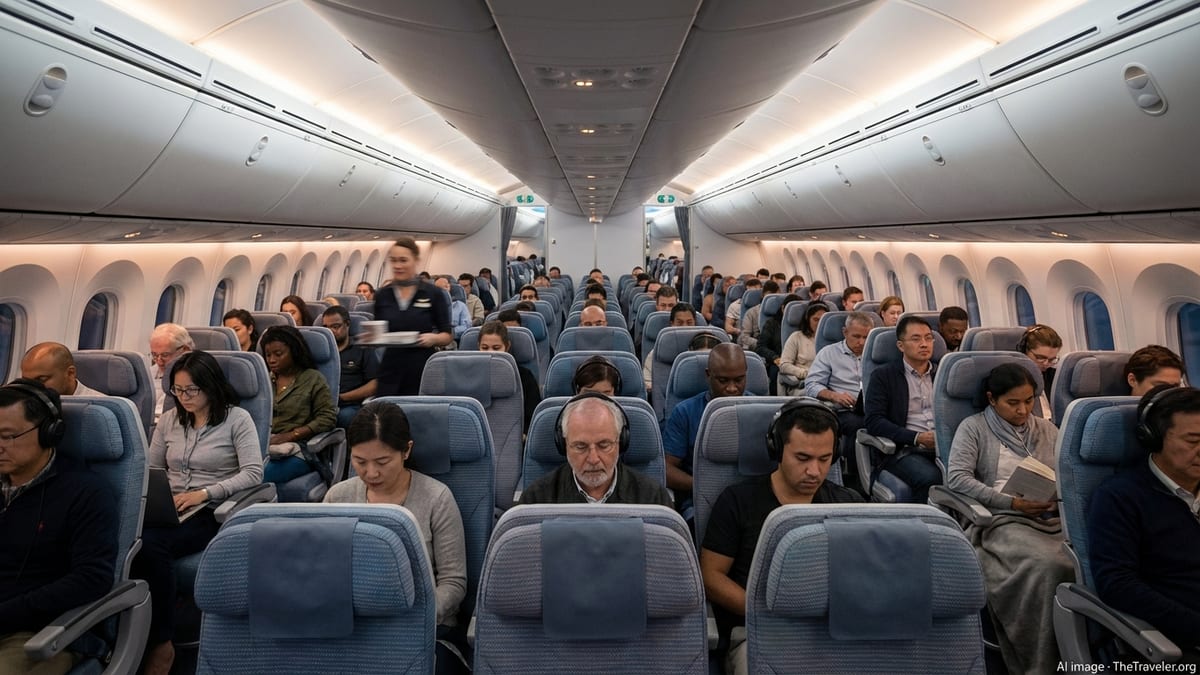
A Data Deep Dive into 27 Million Flights
The new study, published in the journal Nature Communications Earth & Environment, examines more than 27 million commercial flights operated worldwide in 2023, spanning around 26,000 city pairs and nearly 3.5 billion passengers. By reconstructing each route, aircraft type and seating layout, researchers created one of the most detailed real-world pictures yet of how airline design choices translate into climate pollution.
On average, the team found that commercial aviation generated 84.4 grams of carbon dioxide per passenger per kilometre in 2023. That figure masks huge variation between flights, driven not only by aircraft age and technology but also by how carriers configure their cabins and how full they fly their planes.
Instead of focusing on future fuels or breakthrough propulsion systems, the authors asked how much could be achieved using technologies and planes already in service. Their conclusion is that smarter use of existing fleets, coupled with tougher policies on efficiency, could deliver deep cuts in the sector’s warming impact far sooner than many policymakers expect.
The findings land as governments and regulators search for credible pathways to rein in emissions from flying, which currently account for roughly 2 to 3 percent of global carbon dioxide output and are climbing fast as air travel rebounds.
Business Class in the Climate Spotlight
Among the study’s most eye-catching results is the impact of premium cabins. Because business and first class seats are much larger and spaced farther apart, they dramatically reduce the number of people sharing the emissions from each flight. The analysis shows that reconfiguring aircraft to remove business class entirely, switching to all-economy layouts, could cut per-passenger emissions by between 22 and 57 percent on many routes.
The wide range reflects how differently airlines use the same jets. A long-haul widebody such as the Boeing 777-300ER, for example, can legally carry more than 500 passengers. Some carriers install dense economy-focused cabins with 400 or more seats, while others opt for fewer than 300 by dedicating large sections to lie-flat business suites. The carbon consequences of those choices, the study suggests, are far greater than is commonly recognised.
Premium cabins have been under growing scrutiny from climate campaigners, who point out that a small minority of frequent flyers, often travelling in business or first class, are responsible for a disproportionate share of aviation’s climate impact. The new research gives that critique sharper numbers, quantifying the extent to which generous legroom and in-flight privacy translate into a higher per-passenger carbon footprint.
For airlines, any move to shrink or scrap business class would collide with powerful commercial incentives. Premium cabins generate a large share of long-haul profits, supported by corporate travel budgets and high-spending leisure passengers. The study’s authors argue, however, that governments and regulators may need to consider measures that curb the most carbon-intensive forms of flying if aviation is to align with global climate goals.
Filling Seats and Flying Smarter
Cabin layout is only part of the story. The analysis finds that how efficiently airlines fill those seats has a significant effect on emissions. In 2023, global passenger load factors averaged about 79 percent, meaning more than one in five seats flew empty. On some routes and seasons, occupancy dipped as low as 20 percent.
Raising the global average load factor to 95 percent would cut emissions a further 16 percent, the researchers estimate, because more passengers would share each flight’s fuel burn. That would require airlines to adjust schedules, upgauge or downgrade aircraft on particular routes and potentially trim marginal frequencies, especially where half-empty flights are used primarily to maintain market presence.
The authors also examined what could be achieved simply by deploying the most efficient aircraft that airlines already own on the most heavily trafficked routes. They identify modern twin-engine jets such as the Boeing 787-9 on long-haul sectors and the Airbus A321neo on short and medium-haul flights as among the best performers, at around 60 grams of CO2 per passenger kilometre. At the other end of the spectrum, older and less efficient models were found to emit up to 360 grams per passenger kilometre.
Switching more flying to these newer, lighter and more aerodynamic types, while retiring the worst performers, could cut fuel use by around 25 to 28 percent on many networks, according to the study. Combined with denser seating and higher load factors, that brings the potential total reduction to between 50 and 75 percent, without relying on future technologies such as hydrogen propulsion or large-scale sustainable aviation fuel production.
Regulators Weigh New Incentives and Penalties
The scale of the potential savings is already prompting discussion about what kind of policies might push airlines to act. The study’s authors point to a mix of incentives and penalties, from tighter carbon intensity caps for carriers to emissions rating labels for flights, similar to efficiency scores on household appliances.
One option floated by climate policy experts is to restructure air passenger duties and landing fees so that cleaner aircraft with denser cabins pay less, while older, more carbon-intensive jets and premium-heavy configurations are charged more. Another is to tie access to valuable airport slots at congested hubs to demonstrated improvements in emissions per passenger kilometre.
Several European countries are also exploring taxes that specifically target premium flying. France and Spain have joined a coalition of nations calling for levies on private jets and first and business class tickets, billed as a way both to curb high-emitting luxury travel and to raise funds for climate and development projects. The new research adds analytical weight to those proposals by quantifying just how much additional warming impact premium cabins create.
Industry groups caution that any abrupt clampdown on business class could disrupt airline finances and ultimately lead to fewer routes and higher fares across the board. They argue that long-term decarbonisation will depend on a portfolio of solutions, including sustainable aviation fuel, more direct routing and next-generation aircraft designs, alongside operational efficiency measures.
What It Means for Travelers and the Future of Flying
For passengers, the study hints at a future where the experience of flying could change substantially. If governments and airlines take the findings seriously, travellers may see fewer sprawling business cabins and more high-density economy layouts, particularly on routes where rail or other lower-carbon alternatives already compete.
Corporate travel policies could come under renewed pressure, with companies encouraged to downgrade staff from business to economy on shorter flights or to cut back on non-essential trips altogether. Some sustainability officers are already rethinking travel budgets in light of corporate net-zero pledges, and the new evidence on emissions from premium seating is likely to sharpen those debates.
At the same time, airline planners are watching closely how quickly passengers return to pre-pandemic travel patterns and how tolerant they might be of tighter cabins in exchange for lower fares or a smaller climate footprint. Surveys consistently show rising concern about the environmental impact of flying, but behaviour has not yet shifted at the scale needed to bend the sector’s emissions curve.
The authors of the new study stress that their scenarios are not forecasts but demonstrations of what is technically and operationally possible today. Whether aviation actually achieves cuts of 50 to 75 percent from such measures will depend on how quickly regulators move, how forcefully investors and customers push for change and how willing airlines are to rethink the lucrative world at the front of the plane.