

More news on this day
Long marketed as a sun‑safe alternative to the troubled Middle East, Cyprus now finds itself under an intensified US travel warning as climate‑driven wildfires and regional conflict push one of America’s favorite Mediterranean getaways into an uncomfortable global spotlight.
US Raises Cyprus to ‘Reconsider Travel’ as Risk Map Shifts
The US State Department quietly but decisively redrew its risk map of the eastern Mediterranean this week, updating its Cyprus advisory on March 3, 2026, to Level 3: Reconsider Travel. The change moves the island into the same broad risk category as several Middle Eastern states at a time when Washington is urging Americans to think carefully about nonessential trips across the wider region.
The updated advisory follows a separate regional alert from US officials urging citizens in parts of the Middle East to consider leaving due to escalating conflict involving Iran, Israel and the United States. While Cyprus is not itself a battlefield, its proximity to military operations and its role as a logistical hub mean that a conflict once perceived as distant now feels significantly closer to the island’s beaches and resorts.
US officials have also authorized the voluntary departure of non‑essential government personnel and eligible family members from Cyprus, a step that signals Washington’s concern about deteriorating regional security. The move underscores that the new warning is driven less by day‑to‑day crime or local instability and more by the risk that fast‑moving events in the surrounding region could suddenly alter Cyprus’s risk profile for visiting Americans.
That recalibration presents an unwelcome challenge for a country that has built much of its post‑crisis economic recovery on tourism, with US visitor numbers forming a growing and lucrative segment of its market.
From Buffer Island to Front‑Line Neighbor in a Wider Conflict
For decades, Cyprus has styled itself as a neutral bridge between Europe and the Middle East, hosting peace talks, humanitarian flights and offshore energy negotiations while keeping a careful distance from flashpoints on its doorstep. But the latest round of regional escalation has brought that strategy under strain.
The island lies less than 200 miles from the coasts of Israel and Lebanon, and hosts two British sovereign military bases at Akrotiri and Dhekelia that have long been used for surveillance and air operations in the Middle East. Recent Iranian strikes targeting those facilities, part of a broader confrontation with Israel and the United States, have thrust Cyprus into headlines as a potential staging ground and, in the eyes of some regional actors, a legitimate target.
Although the Republic of Cyprus insists it is not a party to the conflict and continues to emphasize its role in humanitarian corridors to Gaza and the wider region, the island’s geography is inescapable. Sirens, intercepted drones and heightened military activity around the British bases are reminders that the island sits on a strategic crossroads where miscalculation or spillover could have direct implications for civilian airspace and maritime routes.
For US travelers, the scenario officials are most concerned about is not a drawn‑out ground conflict on Cypriot soil, but sudden disruptions: temporary airspace closures, diversions of commercial flights, or localized security incidents that could complicate evacuations and consular support, especially in areas close to the bases or to the island’s divided buffer zone.
Wildfires Turn High Season Into Hazard Season
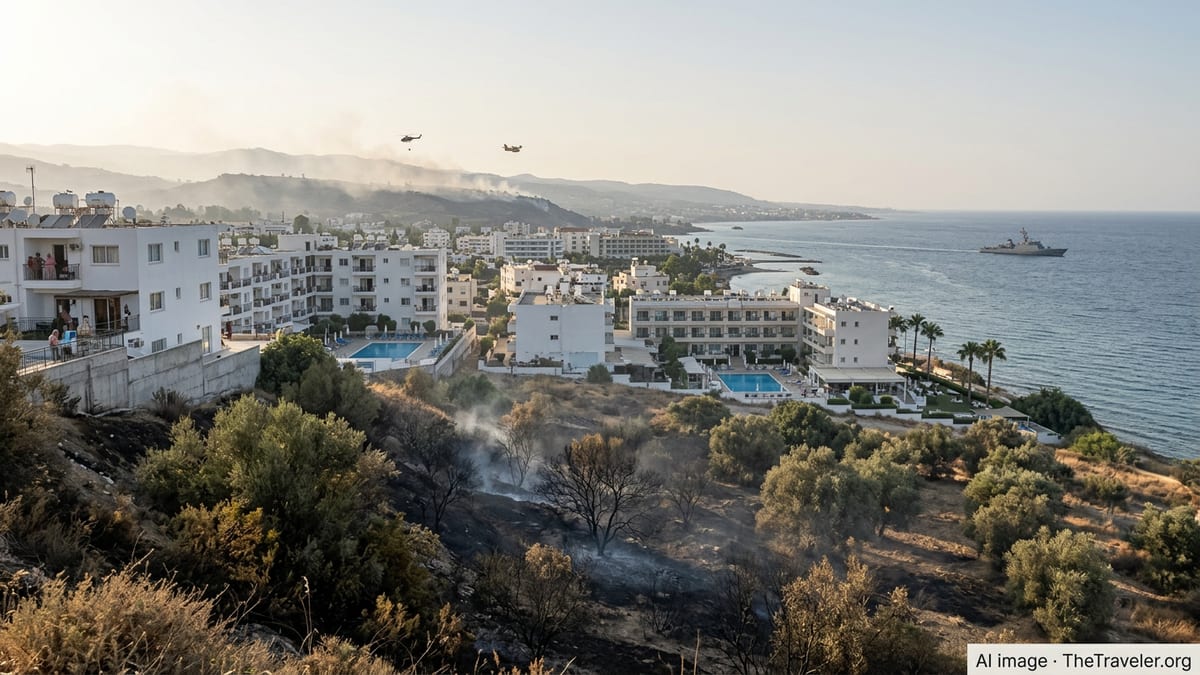
Even as geopolitics darken the horizon, it is climate that has brought the most immediate, visible danger to Cyprus’s tourist heartlands. The island has emerged as one of Europe’s wildfire hotspots, with 2025 marked as the continent’s worst recorded year for blazes and Cyprus among the hardest‑hit countries. A deadly wildfire near Limassol in 2025 destroyed homes, orchards and pine forests, and forced evacuations from villages popular with visitors seeking respite from the coastal heat.
Scientists and monitoring groups say the weather patterns that fed those fires were made roughly ten times more likely by human‑driven climate change. A cocktail of record summer temperatures, prolonged drought, strong winds and parched vegetation has turned swathes of the eastern Mediterranean into what one research team called a “fire‑prone corridor,” where even a single discarded cigarette can spark a major incident.
Cypriot authorities have responded by tightening fire bans, ramping up early‑season patrols and investing in new aircraft and ground crews. The island was recently chosen to host a regional firefighting hub under an expanded European Union scheme, positioning it as both a frontline victim of and a bulwark against the new era of mega‑fires.
For holidaymakers, the practical implications are stark: more frequent red‑flag days when barbecues and outdoor activities are curtailed, the possibility of smoke and ash affecting coastal resorts during peak season, and the real risk that access roads to mountain villages, hiking trails and even some archaeological sites may be temporarily closed as fires are brought under control.
Tourism Industry Caught Between Record Demand and Rising Anxiety
Until recently, Cyprus was preparing for what industry leaders hoped would be a record tourism run, fueled by pent‑up European and American demand for Mediterranean escapes and the island’s reputation as a safe alternative to destinations more directly affected by unrest. Bookings from the US had been trending upward, aided by improved air links and aggressive marketing campaigns in major American cities.
The geopolitical turn and the new US travel advisory have now introduced an element of hesitation into that optimism. Tour operators report a noticeable uptick in queries about cancellation terms, evacuation plans and the proximity of hotels to military facilities or high‑risk forest areas. Some prospective visitors are asking whether itineraries that combine Cyprus with Israel, Jordan or Egypt should be postponed altogether.
Local hoteliers and tourism boards are pushing back, emphasizing that day‑to‑day life in major resorts such as Ayia Napa, Paphos and Limassol remains largely normal, with beaches, restaurants and cultural sites open and operating. They point out that, unlike destinations directly involved in conflict, Cyprus continues to function as a European Union member state with robust infrastructure and emergency services.
Yet the combination of climate and security concerns is clearly reshaping expectations. Industry insiders say they are bracing for a shift toward more last‑minute bookings, shorter stays and a greater focus on travel insurance and flexible policies, especially from US visitors who are weighing Cyprus against other European beach destinations perceived as less exposed to regional shockwaves.
What US Travelers Are Being Told to Do Differently
The US government is not banning leisure travel to Cyprus, but its shift to a Level 3 advisory signals that Americans are expected to take a more deliberate, risk‑aware approach to visiting the island. Officials are urging travelers who do go to enroll in the Smart Traveler Enrollment Program so that embassies can reach them quickly in the event of sudden airspace disruptions, security incidents or major wildfires.
Prospective visitors are also being advised to monitor local media and weather alerts, pay close attention to fire warnings in rural and mountain areas, and remain flexible about itineraries that might be affected by smoke, evacuations or temporary closures. In practical terms, that can mean choosing accommodation with multiple road access routes, confirming evacuation procedures with hotels, and avoiding unauthorized exploration of forests and scrubland during the hottest, driest weeks of the year.
For now, Cyprus remains open and eager for tourists, and many American visitors will likely still view the island as a manageable risk compared with destinations deeper inside the conflict zone. But the convergence of climate shocks and regional tensions has eroded the easy assumption that the island is insulated from the turmoil around it. With Washington’s latest advisory, US travelers are being explicitly asked to trade in sun‑drenched complacency for a more sober calculation of what a Mediterranean holiday now entails.