

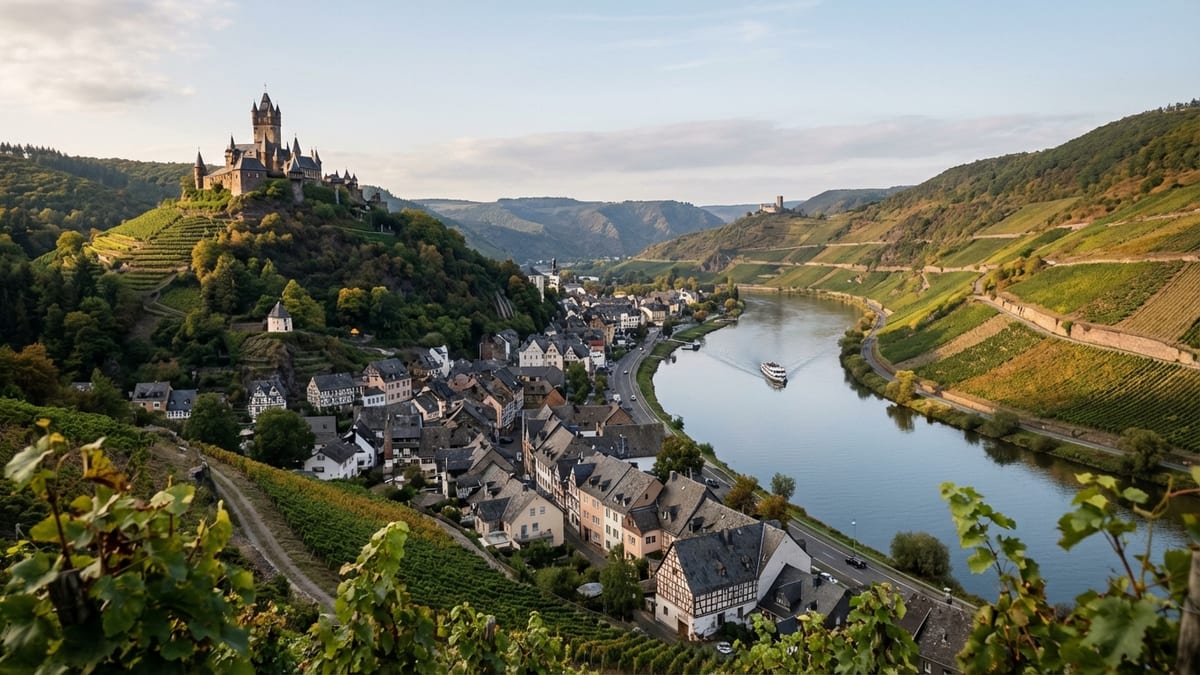
The riverside town of Cochem is one of the most atmospheric bases in Germany’s Moselle Valley, surrounded by vineyard slopes, half-timbered villages and a string of storybook castles. While many travelers are content to wander Cochem’s medieval lanes and climb to the Reichsburg above town, the real magic of the region reveals itself on day trips.
Within an hour by car or public transport you can reach some of the Moselle’s prettiest wine villages as well as Burg Eltz, often described as one of Germany’s most beautiful castles. This guide focuses on the most rewarding day trips from Cochem, with practical advice on what to see and how to get there. Most day trips work best after covering the main things to do in Cochem.
Burg Eltz: The Fairytale Castle in the Forest
If you make only one day trip from Cochem, consider Burg Eltz. Hidden in a wooded side valley above the Elzbach stream, this medieval stronghold seems to float above the trees, with pointed towers and slate roofs rising from a rocky spur. It has been in the same family for more than 850 years and escaped destruction through wars that damaged many Rhine and Moselle castles, so what you see today is largely authentic rather than a 19th-century reconstruction. The interior showcases furnished rooms, a knights’ hall, richly carved woodwork and one of the country’s notable private treasure collections of gold, silver and armor.
For 2025 the official opening season for going inside the castle is from April 1 to November 1, with daily visiting hours typically from 9:30 a.m. to 5 p.m. and the last admission at the castle gate in late afternoon. Guided tours of around 35 to 40 minutes are mandatory for the residential areas and usually depart at regular intervals throughout the day. Standard adult tickets are in the mid-teens in euros, with reduced rates for students and children and a family ticket that covers two adults and their children under 18. You can walk up to the castle exterior year-round, even in winter, but access to the interior and shuttle buses only runs in the main season.
Reaching Burg Eltz from Cochem without a car is quite manageable, especially in season. Take a regional train along the Moselle to Hatzenport or Moselkern. From Hatzenport, a seasonal RegioBus 365 usually runs several times an hour between April 1 and November 1 and brings you directly to the Burg Eltz parking area in about half an hour. Combined train and bus fares are typically sold as a through ticket for the day, with single and group options. From Moselkern, many hikers prefer the signed walking trail along the Elzbach valley, which takes around 1.5 to 2 hours from the station and delivers a cinematic first glimpse of the castle as it appears above the treetops.
If you are driving from Cochem, Burg Eltz lies roughly 25 to 30 kilometers away and the journey takes about 35 minutes. Follow local signs to the Burg Eltz Parkplatz near Wierschem. Parking is paid but reasonably priced and valid for the day. From the parking area, it is a 15 to 20 minute walk down a paved road through the forest, with several outstanding viewpoints of the castle. In season there is also a shuttle bus that runs every 10 to 15 minutes for a small fee per person, convenient if you have limited mobility or are traveling with young children, though queues can build at peak times.
To enjoy Burg Eltz without crowds, aim to arrive at opening time or later in the afternoon after the main tour buses have departed. Weekdays outside the peak school-holiday weeks of July and August are noticeably quieter. The valley can be cool and misty in the morning even in summer, so bring a light layer and comfortable walking shoes, as the approach and castle courtyards are cobbled. Photography is normally restricted inside the residential rooms but you are free to shoot the exterior views and surrounding forest paths.
Beilstein: The Sleeping Beauty of the Moselle
Downriver from Cochem, Beilstein is often nicknamed the Sleeping Beauty of the Moselle, and it makes for one of the gentlest and most charming day trips in the region. With its tight cluster of half-timbered houses, cobbled alleys and balconies draped in flowers, the tiny village feels like a living film set. Despite its popularity with day trippers, Beilstein has preserved a quietly timeless atmosphere, especially early or late in the day.
The village is dominated by the ruins of Metternich Castle on the hill above. A short but steep path winds up through vineyards to the ruined keep and curtain walls, with wide views of the Moselle’s sweeping bend at Beilstein and the terraced vineyards that climb the valley sides. There is usually a small entrance fee, and in good weather a simple café or kiosk operates in season where you can pause with a drink before descending. The ruins themselves are relatively modest but atmospheric, with enough surviving stonework to convey the scale of the medieval stronghold.
In the village streets, look for the historic market square framed by gabled houses and the whitewashed Carmelite monastery church with its richly decorated baroque interior. Many of the inns and wine taverns have been run by the same families for generations and serve local Riesling and regional dishes on shaded terraces. A slow coffee or glass of wine overlooking the riverfront promenade is one of Beilstein’s great pleasures, especially in late afternoon when the light on the opposite vineyards turns golden.
From Cochem, Beilstein can be reached in about 15 minutes by car along the Moselle road. Riverboats operate between Cochem and Beilstein from spring through autumn, turning the journey into a scenic mini-cruise that threads between vineyards and castle-topped hillsides. Public buses also run along the valley, though schedules can be less frequent outside peak season. Many visitors combine Beilstein with a stop at another village such as Ernst or Bruttig-Fankel, or with a return on the water if they drove out in the morning.
Bremm and the Calmont Vineyard Slopes
For travelers keen to mix landscape, wine and a touch of adventure, Bremm is a compelling day trip from Cochem. This small village sits beside one of the most dramatic loops in the Moselle, ringed by the Calmont, a steep slope of slate terraces widely advertised as one of the steepest vineyard sites in Europe. Standing in the village and looking up at the near-vertical rows of vines gives a vivid sense of how heroic Moselle viticulture can be.
The signature experience here is hiking the Calmont Klettersteig, a secured trail that traverses the slope high above the river. Although parts of it are classed as a via ferrata, most reasonably fit walkers with a good head for heights can tackle sections without specialist climbing gear, provided they wear sturdy shoes and take care in wet weather. Metal ladders, handrails and steps support you across the more exposed sections. In return you gain some of the finest views anywhere in the Moselle Valley, with the river looping in a tight horseshoe below and trains and boats looking toy-like in the distance.
If a steep trail is not appealing, there are also gentler vineyard walks and viewpoints higher on the plateau, often signposted from the village or nearby car parks. Several wineries in Bremm offer tastings and sales, particularly focused on Riesling grown on slate, which tends to produce nervy, mineral wines that capture the character of the slope. Tasting at the source, with the Calmont rising outside the window, can make the winemaking story particularly tangible.
The drive from Cochem to Bremm takes around 25 to 30 minutes along the river, either via the south bank through Valwig and Ediger-Eller or via the north bank and bridge crossings, depending on closures and traffic. Public buses also run but may involve changes and limited service on weekends. For hikers, one rewarding option is to take a train to Ediger-Eller or Neef and pick up signposted paths that link these villages with Bremm along the hillside, allowing you to enjoy a linear walk and return by train or bus.
Bernkastel-Kues: Timbered Houses and Wine Culture
Farther down the Moselle, Bernkastel-Kues rewards travelers who are prepared for a slightly longer day trip from Cochem. Allow just over an hour by car, following a river road that threads through a series of vineyard villages and wide meanders. The town is effectively a twin settlement on either bank of the river: Bernkastel on one side, with its medieval core, and Kues on the other, home to a historic hospital foundation and more recent wine estates.
The old town of Bernkastel is centered on a storybook market square framed by some of the Moselle’s most elaborate half-timbered houses. The Spitzhäuschen, a strikingly narrow, top-heavy house leaning into the square, is a favorite photography spot. Narrow lanes radiate out between crooked gabled facades, with wine taverns, weinstuben and specialty shops occupying the ground floors. The atmosphere is lively in summer and during wine festivals, yet the tangle of alleys means you can still find quiet pockets away from the central square.
Above the town, the ruins of Landshut Castle crown the hillside, with a panoramic terrace overlooking the river and terraced vineyards. A steep but straightforward walking path leads up from the old town in 20 to 30 minutes, or you can ride a seasonal shuttle. At the top, a restaurant and viewing platforms allow you to linger with a glass of local wine as you look down on the zigzag roofs of Bernkastel and the broad curve of the Moselle.
On the Kues side of the river, you can visit the St Nikolaus-Hospital, a 15th-century charitable institution founded by the scholar and churchman Nicholas of Cusa. The complex houses a small museum and library as well as a wine estate that still cultivates vines on the surrounding hills. This connection between scholarship, charity and viticulture runs deep in the Moselle, where monasteries and religious foundations historically played a major role in developing high-quality vineyards.
Traben-Trarbach: Belle Époque Architecture and Underground Cellars
Traben-Trarbach, about an hour’s drive from Cochem, offers a different flavor from the half-timbered medievalism that dominates many Moselle towns. At the turn of the 20th century, this settlement enjoyed a boom as a major trading hub for Moselle wine, and the wealth of that era is still visible in its art nouveau and Belle Époque architecture. Grand villas and former wine merchants’ houses line the riverfront, lending an almost spa-town atmosphere to parts of Traben-Trarbach.
The town straddles the river, with Traben on one bank and Trarbach on the other, linked by a bridge with distinctive turreted towers. Walking the quay and climbing the gentle slopes behind town reveal elegant facades, oriels and decorative stonework, quite unlike the wood-framed houses of Bernkastel or Beilstein. Several hotels and guesthouses occupy restored villas from this period, and even as a day trip visitor you can appreciate the scale and optimism of the wine trade at the time.
One of Traben-Trarbach’s most unusual attractions lies underground. A network of historic wine cellars honeycombs the ground beneath parts of town, remnants of the era when thousands of barrels of Moselle wine were stored here before export. Guided tours, particularly popular during the winter wine and Advent season, take visitors into some of these vaulted spaces, where temperatures remain cool and stable. Even outside special events, some cellar complexes can be visited on scheduled tours, often ending with a tasting of local Riesling.
From Cochem, you can reach Traben-Trarbach by car via Zell and the river road, or by a combination of regional trains and buses, usually with a change in Bullay. The journey itself traces a picturesque section of the Moselle, and many travelers choose to stop en route in smaller villages to break up the drive. Traben-Trarbach pairs well with Bernkastel-Kues for a full-day circuit if you are willing to devote a long summer day to the lower Moselle.
Treis-Karden and the Twin Castles Above the Valley
Closer to Cochem, Treis-Karden is an underappreciated day trip choice that rewards visitors interested in a quieter, more contemplative side of the Moselle. The town effectively comprises two historic settlements on either side of the river. Karden is known for its Romanesque collegiate church of Saint Castor, whose towers dominate the skyline and reflect the area’s importance as an early Christian and later medieval religious center.
Above Treis, to the east of the river, stand the neighboring castles of Treis and Wildburg on a wooded spur between two side valleys. Wildburg in particular is a restored hill castle whose origins date back to the early 12th century. Unlike some larger tourist sites, this complex remains relatively low key and retains a sense of seclusion. The setting, surrounded by streams and woodland, appeals to walkers and cyclists who prefer smaller sites woven into longer routes rather than blockbuster attractions.
Walking trails link the riverside settlement with the castles and continue into the Hunsrück hills beyond, offering opportunities for circular hikes that combine forest, vineyards and historical landmarks. The climbs can be steep in places but are generally manageable for reasonably fit walkers with good shoes. From the ridge paths and castle precincts you can look back over the Moselle valley, tracing the river’s course and the clustering of villages along its banks.
Treis-Karden lies roughly 15 to 20 minutes from Cochem by regional train or car, making it a convenient choice for a half day when you want to avoid longer journeys. Unlike the more polished tourism infrastructure of towns such as Bernkastel or Traben-Trarbach, services here are modest, so check restaurant opening times in advance, particularly outside peak season or on midweek afternoons. The reward is a more intimate experience of the Moselle, where village life and historic structures feel closely intertwined.
Practical Tips for Day Trips from Cochem
When planning day trips from Cochem, seasonality matters. The main visitor period in the Moselle Valley typically runs from late April through October, with the most reliable sunshine and warm temperatures generally between May and September. Many riverboats, castle interiors and seasonal bus services operate only during this window. If you are traveling in early spring or late autumn, verify whether boats, shuttles and guided tours are running on your intended dates and be prepared for cooler, changeable weather. Trip planning often depends on whether Cochem is worth visiting for more than one night.
Public transport along the Moselle is generally good but can be less frequent on weekends and in low season. Regional trains follow the river and stop at a string of villages, often on alternating banks, so pay attention to which side of the river your destination lies and whether a bridge crossing or bus connection is required. For remote castles such as Burg Eltz, a combination of train and seasonal bus or a hiking approach is standard if you are not driving.
Driving remains the most flexible way to explore multiple villages and viewpoints in a single day. The roads parallel to the Moselle are scenic, with traffic typically light outside holiday weekends. However, expect narrow streets and tight parking in older villages, especially on sunny weekends and during wine festivals. Arriving early in the day or aiming for shoulder-season visits can ease parking and crowding pressures. Some travelers base themselves in Cochem but rent a car for one or two key days when they want to explore more widely.
Footwear is important in the Moselle, even if you do not plan long hikes. Castle approaches are often cobbled or steep, vineyard paths can be uneven, and riverside towns mix smooth promenades with ancient stone lanes. Light hiking shoes or sturdy trainers are ideal. Also carry a light waterproof or windbreaker, as showers can roll along the valley quickly. Finally, keep in mind that many wineries and small restaurants close for one fixed day a week, often Monday or Tuesday, so it is wise to check ahead or be flexible in your eating plans.
The Takeaway
Using Cochem as a base opens up a wide variety of day trips that showcase the Moselle Valley’s character: fairytale castles tucked into forested side valleys, hillside ruins above sleepy riverside villages, and towns that reveal different chapters of the region’s wine-driven story. Burg Eltz delivers the archetypal German castle experience, seemingly untouched by time. Beilstein and Bremm present contrasting visions of village life, one quietly picturesque, the other framed by dramatic vineyards. Farther afield, Bernkastel-Kues and Traben-Trarbach combine historic charm with robust wine and cultural scenes, while Treis-Karden and its hilltop fortifications reward those seeking calmer paths.
Whether you travel by boat, train, bus, car or on foot, the distances from Cochem are short enough that you can immerse yourself in each place without rushing. Plan around the seasons, give yourself room to linger in a wine tavern or along a riverside promenade, and allow a little space in your schedule for detours to viewpoints that catch your eye. In doing so, your day trips from Cochem become more than a checklist of villages and castles; they turn into a sequence of slow, memorable encounters with one of Germany’s most distinctive river landscapes.
FAQ
Q1. How many days should I base myself in Cochem to enjoy day trips?
Most travelers find that three full days in Cochem strikes a good balance. This allows one day for the town and Reichsburg Cochem itself, one day for Burg Eltz and nearby villages, and another day for a farther outing to places such as Bernkastel-Kues or Traben-Trarbach. With four or five days you can travel at a slower pace and add hikes or extra wine tastings.
Q2. Can I visit Burg Eltz as a half-day trip from Cochem without a car?
Yes, in season it is very feasible. A regional train to Hatzenport combined with the RegioBus 365 to the castle parking area typically takes around 90 minutes each way, leaving you a few hours for the castle tour and forest walk. If you catch an early train and return in the late afternoon, you can still enjoy dinner in Cochem the same evening.
Q3. Is it worth visiting Burg Eltz in winter when the interior is closed?
It can still be rewarding if you value atmosphere and photography over interior tours. The approach paths remain accessible, and the castle often looks particularly striking framed by bare trees or light snow. However, there are no shuttle buses or guided tours inside in the off-season, and services in nearby villages are limited, so dress warmly and bring snacks and water.
Q4. Are Moselle riverboats useful for day trips from Cochem?
Riverboats are a scenic and relaxing way to reach nearby villages such as Beilstein, and on some routes they continue to Zell or beyond. For longer distances, boats are usually slower than buses or cars, so many travelers combine a cruise in one direction with a quicker return by road or rail. Schedules vary by season, so always check departure and return times before committing.
Q5. Do I need to reserve wine tastings in advance in Moselle villages?
In smaller villages, many family-run wineries welcome walk-in visitors during posted opening hours, especially in the afternoon and early evening. That said, advance reservations are advisable if you want a structured tasting, are traveling with a group, or are visiting during busy festival weekends. Larger estates and more formal tasting rooms in towns like Bernkastel-Kues are more likely to require or strongly recommend bookings.
Q6. What is the best time of year for hiking around Cochem and Bremm?
Late spring through early autumn is generally best, roughly from May to October, when trails are dry, temperatures are comfortable and vineyard slopes are green. July and August can be warm on exposed paths like the Calmont Klettersteig, so start early in the day and carry plenty of water. In shoulder seasons, some higher trails can be muddy, but crowds are thinner and views remain impressive.
Q7. Is it realistic to combine Bernkastel-Kues and Traben-Trarbach in one day from Cochem?
It is possible, especially by car in long summer daylight, but it makes for a full day. Many visitors drive from Cochem to Bernkastel-Kues in the morning, explore the old town and Landshut Castle, then continue downriver to Traben-Trarbach for a late afternoon stroll and dinner before returning. Using only public transport requires more careful timing and may be better split into two shorter excursions if your schedule allows.
Q8. Are the Moselle villages suitable for travelers with limited mobility?
Riverside promenades in towns like Cochem, Bernkastel-Kues and Traben-Trarbach are relatively flat and accessible, and many riverboats and larger attractions offer step-free options. However, historic centers often feature cobblestones, narrow alleys and some steep approaches. Castles such as Burg Eltz involve gradients and stairs, although the shuttle from the parking area reduces walking distance. If mobility is a concern, choose a few key sites and verify access details in advance.
Q9. How early should I start a day trip to avoid crowds at major sites?
For headline attractions like Burg Eltz or Bernkastel’s market square, aiming to arrive within the first hour of opening, typically around 9:30 or 10 a.m., makes a noticeable difference, especially in July and August and on sunny weekends. Alternatively, planning your main visit for late afternoon, after 3:30 p.m., can also work well, though this offers less margin for transport delays and last-entry times.
Q10. Is it necessary to speak German to enjoy day trips from Cochem?
It is not essential. In most tourist-facing businesses, staff speak at least basic English, and printed information for major attractions like Burg Eltz is available in several languages. Learning a few simple German phrases for greetings and thanks is appreciated, but you can comfortably navigate trains, buses, restaurants and wineries with a mixture of English, signage and a bit of patience.