


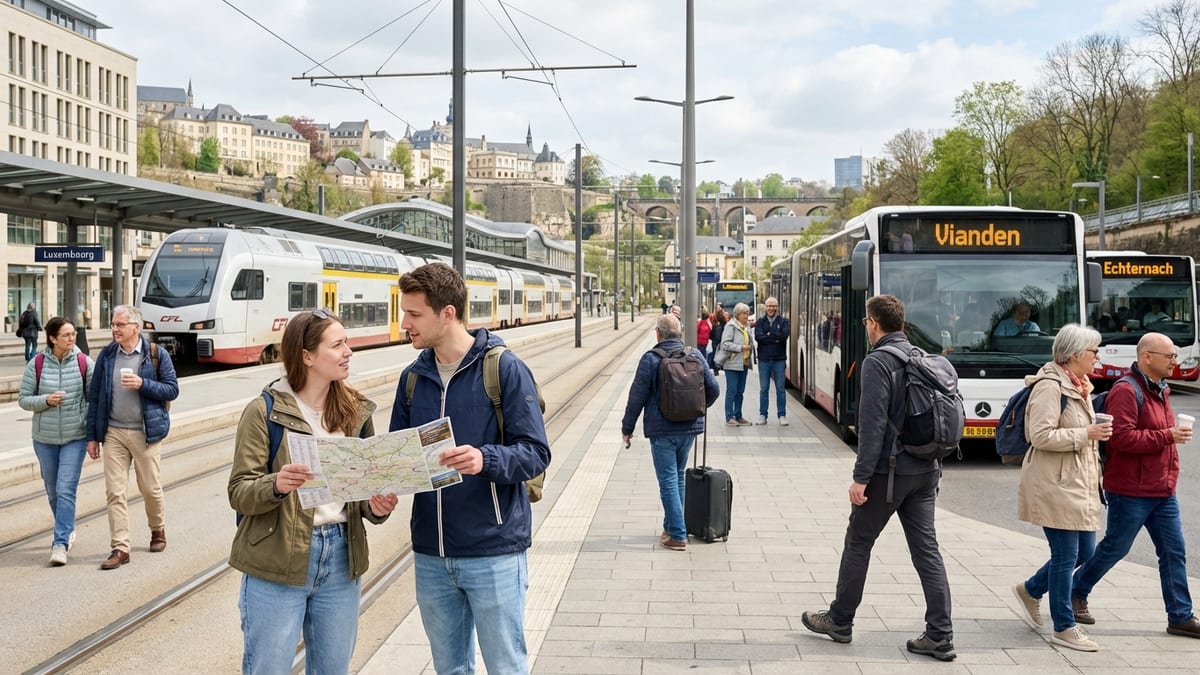
Luxembourg may be one of Europe’s smallest countries, but its capital is an outstanding base for day trips. With free nationwide public transport inside the country, compact distances, and three international borders within an hour or so, you can breakfast in Luxembourg City, explore forests, castles or Roman ruins by lunch, and be back in time for dinner in the Grund. The following guide highlights the most rewarding day trips from Luxembourg City, balancing classic sights with quieter corners and practical tips on how to reach them.
Planning Your Day Trips from Luxembourg City
Before diving into specific destinations, it is worth understanding how easy it is to get around. Since 2020, all public transport within Luxembourg second class on trains, trams and buses has been free for residents and visitors alike, which makes spontaneous day trips extremely appealing.
Cross-border journeys to Germany, France and Belgium still require a ticket, but fares are modest and connections are generally smooth. Most day trips make sense only after covering the main things to do in Luxembourg City.
Most domestic trips begin at Luxembourg Gare Centrale or at key bus interchanges like Hamilius and Luxexpo. Distances are short. Even the far north can usually be reached in about 90 minutes, while popular destinations such as Vianden and Echternach are closer. Border cities Trier and Metz are roughly an hour away by train or bus. This means you can comfortably plan one major destination per day, with time for a relaxed lunch and a walk. Trip planning often depends on whether Luxembourg is worth visiting beyond a quick stop.
In the sections below, you will find ideas grouped by theme: fairy-tale castles, storybook old towns, nature escapes, wartime history and quick cross-border hops. Each H3 destination can comfortably be done as a stand-alone excursion, and several can be combined if you have a car or join an organized tour.
Fairy-Tale Castles and Storybook Towns
Luxembourg and its neighbors are dotted with hilltop fortresses and romantic ruins, many less crowded than Europe’s more famous strongholds. From Luxembourg City, you can be gazing up at medieval walls or strolling through cobbled lanes in less than an hour. These trips are ideal for first-time visitors who want a classic Old World atmosphere without long journey times.
Vianden: Iconic Castle Above the Our Valley
Vianden is the quintessential Luxembourg day trip and often cited as the country’s most impressive castle setting. The village straddles the Our River, a tangle of steep lanes and slate-roofed houses huddling beneath a fortified ridge. Towering above is Vianden Castle, which dominates travel photography of Luxembourg for good reason: its restored Romanesque and Gothic halls look lifted straight from a storybook.
Inside the castle, reconstructed chambers give a sense of daily aristocratic life, with vaulted banquet rooms, a chapel and ramparts overlooking the valley. Audio guides and exhibits trace the site’s evolution from Roman fort to medieval stronghold and later ruin before a major restoration campaign in the late 20th century. Even if you do not tour every room, the views from the terraces justify the visit in themselves.
Back in the village, allow time to wander the narrow streets, pause by the river, and, in warmer months, ride the historic chairlift for broad panoramas of the castle and surrounding hills. Cafés and traditional restaurants line the main street, making it easy to linger. From Luxembourg City, direct buses typically reach Vianden in around 75 to 90 minutes, or you can pair a train to Ettelbruck with a short connecting bus. Driving takes about 45 minutes.
Echternach: Luxembourg’s Oldest Town
Echternach, about 35 to 45 minutes by bus from Luxembourg City, is widely considered the country’s oldest town. It sits near the German border on the Sûre River and serves as a gateway to the Mullerthal region, known as Luxembourg’s Little Switzerland. At its heart is a graceful market square flanked by gabled townhouses and the imposing Basilica of St Willibrord, part of a monastic complex whose roots extend back to the 7th century.
The town’s Benedictine abbey, cloisters and museum spaces evoke Echternach’s historical status as a spiritual and cultural center for the region. Walk a few streets away from the main square and you encounter remnants of the medieval walls and towers, along with quiet corners that feel far removed from city life. Around the nearby artificial lake, families picnic, cycle and paddle in warm weather, while wooded trails tempt walkers year-round.
Echternach is an excellent choice if you want a mix of architecture, gentle walking and café time without the steeper hills found around some other destinations. Regular buses depart from Luxembourg City, and journeys within the country are free, making this an easy and economical outing.
Beaufort: Twin Castles in the Countryside
For a quieter castle experience, set your sights on Beaufort. The village, roughly an hour from Luxembourg City by bus or car depending on the route, is best known for its pair of castles: a medieval ruin and a later Renaissance residence built alongside it. The crumbling keep, moats and towers form one of the country’s most atmospheric fortified sites, especially evocative in misty or winter light.
Guided tours typically cover the ruined castle, taking in the old kitchens, dungeons and ramparts, while the more recent chateau can sometimes be visited on special occasions. After exploring the complex, you can sample the local blackcurrant liqueur, a specialty produced on site. Surrounding forests and meadows offer additional walking options for those who want to turn the visit into a more active day.
Beaufort is often combined with Vianden and the Mullerthal in organized “nature and castles” day tours that depart from Luxembourg City, which is convenient if you prefer not to manage bus schedules. Independent travelers can use a combination of regional buses, all included in the country’s free public transport system.
Nature Escapes and Luxembourg’s Little Switzerland
One of the biggest surprises for many visitors is how quickly the urban core of Luxembourg City gives way to dense forests, sandstone gorges and quiet river valleys. The Mullerthal region, northeast of the capital, is particularly renowned for its walking trails, while northern Luxembourg offers lakes and protected nature parks. These destinations suit travelers who want fresh air and light hiking rather than purely urban sightseeing.
The Mullerthal & Schiessentümpel Waterfall
The Mullerthal region, colloquially called Luxembourg’s Little Switzerland for its rock formations and undulating landscapes, is arguably the country’s premier hiking destination. The famed Mullerthal Trail weaves through mossy ravines, past overhanging cliffs and along streams fringed with beech forest. One of the area’s most photographed spots is the Schiessentümpel waterfall, where three streams tumble under a stone bridge straight out of a fairy tale illustration.
Day trippers from Luxembourg City do not need to tackle the full multi-day trail. Instead, you can focus on a short circuit around Schiessentümpel or choose one of the signed local loops near Berdorf, Consdorf or Mullerthal village. Trails vary in difficulty but many are accessible to moderately active visitors with good footwear. The sandstone passages and rock corridors can be slippery after rain, so take care, particularly in shoulder seasons.
Buses connect Luxembourg City with Echternach and smaller villages in the region, making independent hiking feasible without a car. In addition, seasonal guided bus tours with fixed stops at Schiessentümpel and Beaufort run from the capital, bundling transport and basic commentary into one package.
Upper Sûre Lake and the Ardennes
In the northwest of the country, the Upper Sûre Lake is a reservoir surrounded by forested hills, tucked within the wider Ardennes landscape. It is quieter than the Mullerthal and feels far from the capital, even though it is only around 60 to 90 minutes away by a combination of train and bus or by car.
In warmer months, the lake is a hub for swimming, paddleboarding and sailing, with designated bathing areas and rental outlets. There are also marked trails along the shore and through adjacent nature reserves that appeal to hikers and birdwatchers. In autumn and winter, when the recreational facilities are quieter, the lake region is ideal for contemplative walks and scenic drives through misty valleys and small villages.
Public transport connections usually involve traveling by train from Luxembourg City to Ettelbruck or another regional hub and then transferring to a local bus. Check timetables in advance, especially on weekends and outside summer, when frequencies may drop.
Our Nature Park and Clervaux
North of Vianden, Our Nature Park protects a broad swathe of river valley and rolling hills rich in walking and cycling routes. The park encompasses traditional villages, wooded slopes and meadows that showcase rural Luxembourg. While it is possible to hike directly from some villages, many visitors prefer to base themselves in a town like Clervaux and add short forays into the surrounding countryside.
Clervaux itself is worth a visit in its own right. The town clusters beneath a whitewashed castle that hosts the celebrated “Family of Man” photography exhibition, a UNESCO-recognized collection curated by Luxembourg-born photographer Edward Steichen. An abbey on a nearby hill, churches and a tranquil valley floor complete the scene. The combination of cultural content and nature access makes Clervaux an appealing day trip for those who want more than pure hiking.
Regular trains from Luxembourg City reach Clervaux in roughly an hour and a quarter, with onward buses and marked walking paths leading into the wider park. It is easy to spend a full day here without feeling rushed.
Border-Hopping to Germany: Trier and Saarburg
One of the joys of staying in Luxembourg City is how quickly you can step into neighboring countries. To the east lies Germany’s Rhineland-Palatinate region, where the Moselle and Saar rivers carve picturesque valleys studded with Roman ruins and vineyards. Trier and Saarburg are two of the most appealing and accessible options, both reachable within about an hour to 90 minutes using a mix of Luxembourg’s free domestic transport and low-cost German tickets.
Trier: Ancient Rome on the Moselle
Trier markets itself as Germany’s oldest city and offers a density of Roman monuments unmatched elsewhere in the country. Key sights include the imposing Porta Nigra gate, parts of the original city walls, a sprawling set of Imperial Baths and the ruins of an amphitheater. The city’s UNESCO-listed ensemble also encompasses early Christian churches and the architectural complex around the cathedral and Liebfrauenkirche.
A day trip from Luxembourg City typically starts with a train from Gare Centrale or a regional bus via the Kirchberg or Luxexpo area. Within Luxembourg, travel is free; a modest cross-border supplement covers the German section of the route. Once in Trier, the main attractions are largely walkable from the station or linked by local buses. Visitors can easily craft their own walking circuit from Porta Nigra through the pedestrianized center, past the cathedral square and down to the Moselle riverfront.
Trier is also a pleasant place to sample regional cuisine and wines. Cafés and wine taverns pour local Riesling and other Moselle varietals, while bakeries and restaurants serve hearty Rhineland dishes. If time allows, a short boat excursion on the Moselle offers a different perspective on the city’s setting.
Saarburg: Waterfall Town Above the Saar
Smaller and more intimate than Trier, Saarburg makes for a relaxed cross-border excursion. The town sits atop and around a steep hill overlooking the Saar River, its lower quarter bisected by a small canal that plunges over a waterfall right in the center. Old mill buildings, timber-framed houses and terrace cafés cluster around this dramatic water feature, giving Saarburg a distinctive character.
Above the town, a ruined castle offers sweeping views over the Saar valley, vineyards and wooded hills. Steep lanes and stairways lead up to the fortress, while more level strolls along the river and through the lower town suit those who prefer gentler walking. Wine tasting is a highlight in season, with several producers and wine bars showcasing Saar Rieslings and other varietals.
Reaching Saarburg from Luxembourg City usually involves a combination of train routes via Trier or other regional hubs, plus occasional bus links, so the journey time can be a little longer than to Trier alone. However, visitors who appreciate atmospheric small towns and scenic river landscapes often find Saarburg worth the extra effort, especially in spring and summer.
French Flair: Metz and Beyond
To the south, the French city of Metz offers a different cultural flavor, with grand 19th-century districts, medieval lanes and a striking Gothic cathedral. Frequent train and bus services connect Luxembourg City and Metz, enabling travelers to experience another language, cuisine and architectural style in a single easy day trip.
Metz: Cathedrals, Markets and Riverfront Strolls
Metz lies in France’s Grand Est region and serves as a regional hub with a rich history. Its centerpiece is the Saint-Étienne cathedral, whose soaring Gothic interior is bathed in colored light from extensive stained glass, including modern works by artists such as Marc Chagall. The surrounding old town features golden Jaumont stone façades, arcaded squares and a mix of medieval and Renaissance buildings.
Visitors from Luxembourg City often begin with a walk from the train station, itself an imposing historic structure, toward the historic center and cathedral. Along the way, you pass through broad boulevards laid out during the city’s imperial German period before entering narrower streets and market areas. The covered market near the cathedral and weekly open-air markets showcase regional produce, cheeses and baked goods that make easy picnic fare.
Metz also has appealing green spaces along the Moselle and Seille rivers, where footbridges, quays and gardens invite leisurely strolls. Cultural institutions, including museums devoted to modern art and local history, can round out a full day, particularly in cooler or rainy weather. Regular trains from Luxembourg usually take under an hour, with buses providing a slower but often cheaper alternative.
Nancy: Art Nouveau and Elegant Squares
Although slightly farther than Metz, Nancy is still feasible as a long day trip from Luxembourg City for travelers who do not mind more time on the train. Known for its harmonious 18th-century squares and Art Nouveau heritage, the city rewards those with an interest in architecture and design.
The focal point is Place Stanislas, an ensemble of classical buildings and ornate gilded gates that has become an emblem of Nancy and a UNESCO World Heritage site. Radiating streets and adjoining squares host cafés, boutiques and patisseries, making this one of eastern France’s most atmospheric spots for people-watching. Elsewhere in the city, the legacy of the École de Nancy art movement is visible in façades, glasswork and museum collections.
From Luxembourg City, most itineraries route through Metz with a change of train, so planning ahead is essential to maximize your time on the ground. Nancy is best for visitors who have already explored closer day-trip options and want to add a more specialized cultural destination to their itinerary.
Wartime History and Memorials
The Ardennes and surrounding regions were central to major episodes of 20th-century conflict, especially during the Second World War. Visitors based in Luxembourg City have access to several important museums and memorials that explore these events in depth. These destinations can be emotionally intense but offer powerful insights into European history.
Bastogne: Remembering the Battle of the Bulge
Bastogne, across the border in Belgium, is synonymous with the Battle of the Bulge, the last major German offensive on the Western Front in the winter of 1944 to 1945. Today the town is home to the Bastogne War Museum and the Mardasson Memorial, which together form one of the region’s most comprehensive commemorative sites.
The museum combines personal testimonies, artifacts, immersive exhibits and carefully curated narratives to help visitors grasp the battle’s scale and human toll. Outside, the star-shaped Mardasson Memorial honors American soldiers who fought in the Ardennes. Nearby woods and small villages still bear remnants of foxholes and battle positions, some of which can be visited on guided tours.
From Luxembourg City, reaching Bastogne generally requires a car or a combination of buses via towns such as Arlon or Ettelbruck. Journey times vary but typically range from 60 to 90 minutes by road. A full day is advisable, especially if you plan to explore both the museum and outlying historic sites.
Luxembourg’s National Military and Resistance Memorials
For travelers who prefer not to cross borders, Luxembourg itself hosts several sites linked to wartime history, particularly in the north and along the Our valley. Smaller local museums, resistance memorials and military cemeteries provide a more intimate look at how the conflicts of the 20th century affected this small nation.
These destinations are often best explored with a rental car or organized tour, as they are scattered across rural communities and may not be directly served by frequent public transport. However, for those with a strong interest in history, combining a day in Vianden or Clervaux with nearby memorial sites can create a rich and moving itinerary.
Family-Friendly Day Trips Close to the Capital
Not every day trip needs to revolve around castles or cathedrals. Families and travelers seeking a slower pace will find plenty of options near Luxembourg City, from animal parks to lakeside recreation areas. Because distances are short, these destinations are particularly convenient for half-day outings or for visitors with young children who benefit from flexible schedules.
Parc Merveilleux in Bettembourg
Parc Merveilleux, located just east of Bettembourg in southern Luxembourg, is a long-established amusement and animal park tailored mainly to families with children. Open seasonally from around Easter to early October, it combines small animal enclosures and aviaries with playgrounds, miniature trains, fairy-tale themed houses and gentle rides.
The park’s manageable size means that even young children can experience a variety of activities without becoming overwhelmed. Parents appreciate the mix of shaded paths, picnic areas and on-site dining options, which make it easy to spend several hours without leaving the grounds. Educational panels and themed exhibits introduce children to different species and habitats, supporting a light-touch learning element alongside the fun.
From Luxembourg City, Bettembourg is only a short train or bus ride away, followed by a brief local connection or walk to the park entrance. This makes Parc Merveilleux an excellent choice when you want a low-stress outing that does not require a long commute.
Lake Echternach and Outdoor Activities
Just outside Echternach, an artificial lake has been developed into a versatile recreational area with walking and cycling paths, water-based activities in season and ample space for picnics. Families can rent pedal boats, explore the surrounding trails or simply relax on the grassy banks while children play.
The lake is close enough to the town that you can easily combine a few hours of outdoor fun with a stroll through Echternach’s historic center. This dual nature and culture combination is especially useful for mixed groups where some members want more active pursuits while others prefer sightseeing or café time.
Getting here is straightforward: buses from Luxembourg City drop you in Echternach, from where you can walk or take a short local connection to the lakeside. As with other domestic journeys, transport within Luxembourg is free, keeping overall costs down for families.
The Takeaway
Luxembourg City may be compact, but it opens the door to a remarkably diverse set of day trips. Within an hour or so, you can stand beneath the towers of Vianden Castle, wander the monastic precincts of Echternach, hike through sandstone gorges in the Mullerthal, or sip wine beside the Moselle in Trier. Head south for French cathedrals and café culture in Metz, or north and west for lakes, nature parks and poignant wartime memorials.
The combination of free public transport within Luxembourg, short distances and easy cross-border links makes it simple to experience at least one or two of these excursions even on a relatively brief stay. Whether your priorities are history, landscape, family entertainment or cross-cultural exploration, Luxembourg City’s strategic position ensures that an engaging day trip is never far away.
FAQ
Q1. Do I need a car to take day trips from Luxembourg City?
While a car offers additional flexibility, it is not essential for many of the most popular day trips. Destinations such as Vianden, Echternach, the Mullerthal region, Bettembourg and Clervaux are all reachable by a combination of trains and buses, which are free within Luxembourg. For more remote rural sites or complex multi-stop itineraries, a rental car or organized tour can be useful.
Q2. Are public transport journeys really free in Luxembourg?
Yes, standard second-class travel on most trains, trams and buses within Luxembourg is free for residents and visitors. You do not need to buy a ticket for domestic journeys. However, once you cross the border into Germany, France or Belgium, you must pay for the foreign section of your trip, usually via a simple regional ticket.
Q3. What is the best day trip from Luxembourg City if I only have time for one?
If you can only choose one outing, Vianden is often recommended as the most representative experience. The combination of a striking medieval castle, a charming village, river scenery and manageable travel time makes it an excellent introduction to Luxembourg beyond the capital.
Q4. Can I visit the Mullerthal and Echternach in a single day?
Yes, many visitors combine a short hike in the Mullerthal region with time in Echternach on the same day. A typical plan is to focus on a manageable trail section around Schiessentümpel or nearby villages in the morning, then head to Echternach in the afternoon for a walk through the old town and perhaps a stop by the lake.
Q5. How long does it take to reach Trier from Luxembourg City by public transport?
The exact journey time varies depending on whether you take a direct regional bus or a train connection, but it is typically around one hour to 90 minutes. Part of the trip within Luxembourg is free, and you pay only for the German segment. Trains are generally comfortable and frequent, while certain buses can be quicker depending on schedules.
Q6. Are these day trips suitable in winter?
Most of the destinations mentioned can be visited year-round. Castles and some outdoor attractions may have reduced opening hours or seasonal closures in winter, so it is wise to check in advance. Urban destinations such as Trier and Metz, as well as museums and memorials, remain good options in colder months, while forest hikes and lakeside recreation are more appealing from late spring to early autumn.
Q7. Is it easy to join organized tours from Luxembourg City?
Yes, a number of local operators and tourism bodies offer day tours that depart from central Luxembourg City. Popular options include combined itineraries covering Vianden, Beaufort and the Mullerthal, as well as themed tours focusing on castles, nature or wartime history. Organized tours are especially convenient if you are short on time or prefer not to navigate timetables on your own.
Q8. What should I wear and bring for a day trip into the countryside?
For nature-focused destinations like the Mullerthal, Our Nature Park or Upper Sûre Lake, comfortable walking shoes with good grip are essential. Weather in Luxembourg can change quickly, so pack layers, a waterproof jacket and sun protection depending on the season. A reusable water bottle, snacks and a fully charged phone with offline maps are also recommended.
Q9. Can I easily find food and drink in smaller towns and rural areas?
Most of the towns mentioned, including Vianden, Echternach, Clervaux and Saarburg, have cafés, bakeries and restaurants catering to visitors. In more rural locations around lakes and hiking areas, options may be fewer, especially outside peak season or in the evening. For peace of mind, many travelers bring a simple picnic or snacks, then supplement with local food when available.
Q10. How many day trips should I plan during a short stay in Luxembourg City?
For a three to four day stay, planning one or two day trips is usually ideal, leaving time to enjoy Luxembourg City itself. A longer visit of a week or more allows you to explore a broader mix of themes, such as one castle-focused outing, one nature day, and one cross-border excursion to Germany or France. Balancing excursions with unstructured time in the capital helps prevent your itinerary from feeling rushed.