


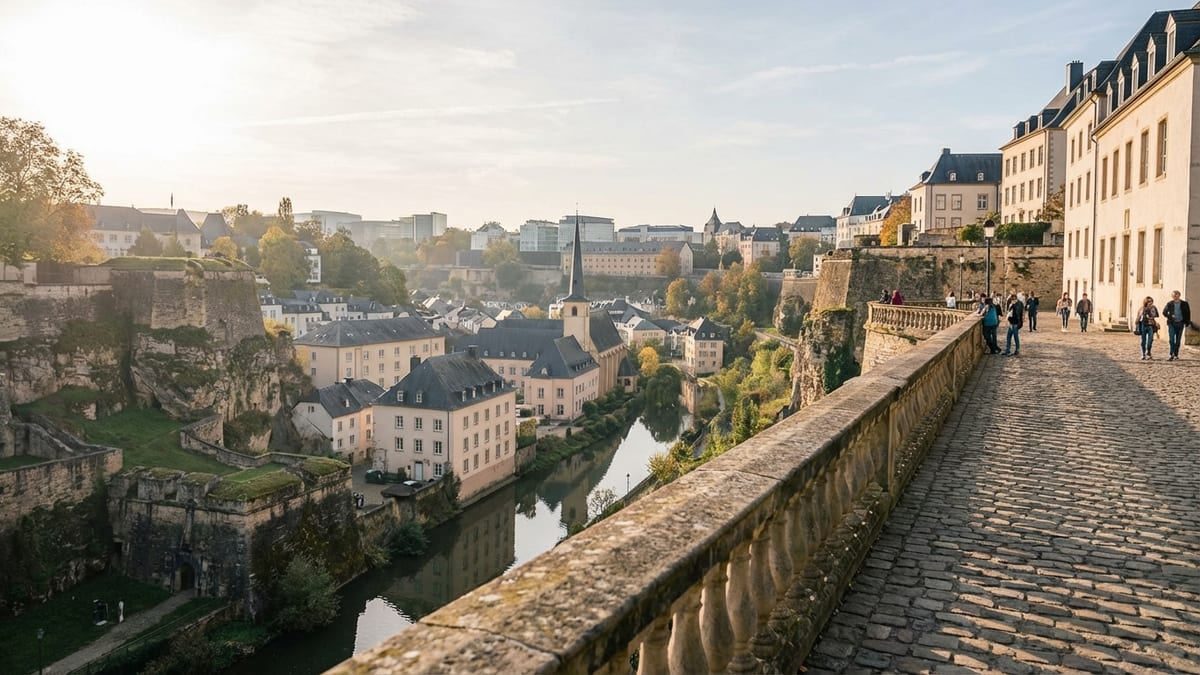
Luxembourg City is one of Europe’s smallest capitals, but it delivers an outsized mix of medieval drama, cliffside views and contemporary culture. Perched on a rocky plateau above two river gorges, it is a place where fortress walls meet glass-fronted banks, and quiet cobbled lanes sit minutes from sleek museums and major EU institutions. With free public transport across the country and a compact historic core, it is straightforward to explore in a couple of days, provided you know what deserves a spot on your itinerary and what you can confidently skip.
Getting Oriented: Old Town, Valleys and Modern Districts
Luxembourg City’s appeal lies in how its different quarters interlock. The upper town holds the main squares, shopping streets and many official buildings. Below, the Alzette and Pétrusse valleys shelter quieter neighborhoods, riverside walks and fragments of fortress walls. Travelers short on time often compare Luxembourg vs Brussels before finalizing plans.
To the northeast, the Kirchberg plateau is a showcase of contemporary architecture and the city’s cultural big hitters. Knowing where attractions are located helps when picking from the best hotels in Luxembourg City. Some sights are best experienced through well-chosen Luxembourg City tours.
Distances are short, but elevation changes are not. Public lifts, funiculars and frequent buses smooth out the hills, and since public transport is free nationwide for residents and visitors alike, hopping between the upper town, the historic Grund and Kirchberg costs you nothing but time. For a first visit, it is worth concentrating on the UNESCO-listed old quarters and fortifications, then adding a museum or two and a circuit through the parks. If you are unsure about prioritizing sights, this overview of Luxembourg worth visiting provides context.
Upper Town: Ville Haute and the Main Squares
The upper town, known as Ville Haute, is the most obvious starting point. This is where you will find Place d’Armes, long used as a parade ground and now lined with cafés, restaurants and a central bandstand that hosts regular concerts in the warmer months. Nearby, Place Guillaume II and the adjacent streets form the commercial heart of the city, mixing boutiques, international chains and weekly markets.
It is worth lingering here, especially in the late afternoon when terraces fill and the golden light catches the façades. That said, many visitors spend too long in this compact area. Once you have walked the main squares, stepped into the Notre-Dame Cathedral and taken a look at the exterior of the Grand Ducal Palace, it is time to move on to the sites that make Luxembourg truly distinctive.
The Lower Towns: Grund and Pfaffenthal
Beneath the upper plateau, the river valleys host some of the city’s most atmospheric streets. The Grund quarter, straddling the Alzette, is a jumble of narrow lanes, old houses and stone bridges overlooked by massive walls. It feels worlds away from the business district above, yet is connected by lift and bus in minutes.
Pfaffenthal, to the north, sits in a narrower section of the valley and combines traditional houses with newer residential projects. The neighborhood is reached in dramatic fashion by the Pfaffenthal panoramic elevator, a glass-walled lift built into the cliff, which offers sweeping views and is free to ride. These lower districts reward slow exploration far more than additional time browsing shops in the upper town.
Kirchberg: Contemporary Luxembourg
On the opposite side of the Alzette gorge, Kirchberg is where Luxembourg City shows its modern face. European institutions, major banks and corporate headquarters sit beside cultural venues such as Mudam, the Museum of Modern Art Grand-Duc Jean, and the Philharmonie concert hall. The area’s broad avenues and bold architecture contrast sharply with the medieval tangle of the old town.
Many travelers skip Kirchberg, assuming it is purely administrative. That is a mistake if you have interest in contemporary art, design or urbanism. A combined visit to Mudam and the restored Fort Thüngen next door lays out Luxembourg’s story from fortress to financial hub in a single walk.
Unmissable Historic Sights: Where Luxembourg’s Story Comes Alive
Luxembourg City’s UNESCO designation centers on its dramatic fortifications and old quarters. For centuries, it was one of Europe’s great strongholds, heavily fortified by successive powers. Much of that military architecture was demolished in the 19th century, but enough remains to tell the story. The most rewarding sites weave history with exceptional viewpoints, while a few headline stops are better admired briefly than explored at length.
Bock Casemates: Inside the Fortress
The Bock Casemates are the city’s signature attraction for good reason. This warren of subterranean galleries was carved into the cliffs as part of Luxembourg’s defenses. Walking its tunnels and staircases gives a tangible sense of how impregnable the fortress once was, and the openings cut into the rock frame vertiginous views over the Alzette and lower town.
Today, well-marked routes and safety measures make the casemates accessible to most visitors, though anyone with mobility issues or claustrophobia should be prepared for tight spaces and uneven steps. Tickets are reasonably priced, and audio guides help you understand the layered history beneath your feet. Unlike some attractions, the Bock Casemates fully justify the time and small entry fee.
Pétrusse Casemates: Impressive, but Optional for Short Visits
A second network of tunnels, the Pétrusse Casemates, opened to the public more recently after extensive restoration. Located on the opposite side of the upper town, they explore different sections of the former fortress and include multimedia elements that explain the city’s strategic importance.
They are an intriguing complement to the Bock Casemates, but for travelers with limited time, doing both can feel repetitive. If you are in Luxembourg City for only a day or two, prioritize the Bock for its iconic status and more dramatic setting, and treat the Pétrusse Casemates as a worthwhile extra only if you have a strong interest in military history or architecture.
Chemin de la Corniche: “Europe’s Most Beautiful Balcony”
The Chemin de la Corniche is a pedestrian promenade tracing the top of the cliff edge above the Grund. Often described as one of Europe’s most beautiful balconies, it offers constantly shifting views of stone bridges, towers and riverside houses framed by the sheer walls of the gorge.
The walk is not long, but it is best enjoyed slowly, with frequent pauses for photographs. Early morning and late evening are especially atmospheric, when crowds thin and the light softens. The Corniche is completely free to access and offers some of the best panoramas in the city, making it an essential stop for any itinerary.
Grand Ducal Palace: See the Exterior, Tour Only in Season
The Grand Ducal Palace, official residence of Luxembourg’s monarch for state functions, sits in the upper town amid government and commercial buildings. With its ornate façade and turrets, it is one of the city’s most photographed spots. For most of the year, visitors can only admire it from the outside.
Guided interior tours are usually offered in the summer months, when parliament is not in session. These tours provide access to ceremonial rooms and explanations of the country’s political system. They are well regarded, but tickets can sell out quickly and schedules vary. If your visit falls outside the tour period, do not devote too much time hoping for access. A measured look at the exterior, perhaps combined with a café stop nearby, is sufficient before moving on to more accessible sites.
Notre-Dame Cathedral: Compact but Atmospheric
Luxembourg’s national cathedral stands close to Place de la Constitution and is notable for its trio of slender spires. Originally a Jesuit church, it was later expanded into the country’s primary Catholic cathedral and now houses the crypt of the Grand Ducal family, along with a revered statue associated with the Octave pilgrimage held each spring.
The interior is smaller than the great cathedrals of neighboring countries, but the stained glass, sculpted choir and sense of quiet reverence are compelling. Entry is free, and a short visit fits easily into most itineraries. You do not need to schedule much time here, but stepping inside rounds out your understanding of the city’s religious and civic life.
Views, Parks and Walking Routes Worth Your Time
Luxembourg City rewards walkers with a network of paths that dive into valleys, cross rivers and climb back up to dramatic viewpoints. Its parks soften the edges of the former fortress and offer respite between museum visits. These outdoor spaces are both attractions in their own right and the best way to connect the city’s disparate quarters without constantly boarding buses or trams.
Pfaffenthal Panoramic Elevator and Skyline Views
One of the city’s most memorable short rides is entirely free. The Pfaffenthal panoramic elevator links the upper town near the Pescatore Park with the Pfaffenthal quarter in the valley below, traveling along a glass shaft built into the rock. The observation platform at the top and the lift itself provide broad views of bridges, hillsides and rooftops.
This is a simple experience, but a powerful way to grasp the city’s unusual topography. It also serves a practical purpose, making it easy to walk between the upper town and the valley without a strenuous climb. Aim for clear weather to make the most of the visibility and photographs.
Municipal Park and Kinnekswiss Lawn
Stretching in an arc along the edge of the upper town, the Municipal Park forms part of the former fortress belt. Lawns, paths and clusters of trees replace ramparts and bastions, though fragments of those defenses are still visible. The largest open space, known as the Kinnekswiss, is a popular gathering spot for residents on sunny days.
For visitors, the park offers a gentle contrast to the stone walls and narrow lanes of the historic core. Villa Vauban, an art museum housed in a former mansion beside the park, adds a cultural dimension for those who want to mix greenery with galleries. While not as spectacular as the Corniche or the valleys, the Municipal Park is a pleasant area to walk if you have half a day or more in the city.
Pétrusse Valley and Skatepark: A Different Perspective
The Pétrusse Valley cuts a deep trench below the western edge of the upper town, with paths, lawns and wooded slopes following the course of the river. Bridges soar overhead, including the imposing Adolphe Bridge that has become a visual emblem of Luxembourg City. From the valley floor, you appreciate just how high those structures sit.
In recent years, the city has developed an extensive concrete skatepark here, drawing skaters and BMX riders from across the region. Even if you do not skate, the combination of raw concrete shapes, greenery and cliffside walls makes for a striking urban landscape. The valley paths are also a welcome way to escape traffic while still remaining close to the center.
Wurbosch and Alzette Riverside Walks
Following the Alzette river through the Grund and beyond presents another set of perspectives on the city. Sections of the riverside path lead past old mills, warehouses converted to cultural venues and quiet residential streets. The reflections of fortress walls and church towers on the water add to the appeal.
These walks are especially enjoyable early in the day or toward evening, when the light softens and the neighborhood’s bars and restaurants start to buzz. They are not a headline attraction on their own, but they tie together key sights and offer an easygoing way to explore between more structured visits.
Museums and Culture: What to See and What to Skip
For a city of its size, Luxembourg has a strong roster of museums and cultural events. They range from national collections of art and history to natural sciences and avant-garde contemporary works. Not every institution is essential for first-time visitors, however, especially if your schedule is tight. Here is how to prioritize.
National Museum of History and Art (MNHA): Essential for Context
The National Museum of History and Art, located in the upper town near the old fish market, is the best single stop for understanding the country’s past and artistic heritage. Its collections cover archaeology, decorative arts and fine arts, with a particular strength in works from Luxembourg and neighboring regions.
The building itself descends deep into the rock, with galleries stacked below street level, reflecting the city’s vertical geography. Permanent exhibitions are thoughtfully presented, and rotating shows add contemporary voices. If you visit only one museum in Luxembourg City, make it this one, as it anchors many of the stories you encounter while walking the streets above.
Mudam and Fort Thüngen: Old Walls, New Ideas
On the Kirchberg plateau, Mudam, the Museum of Modern Art Grand-Duc Jean, is a bright, angular building set on the site of former fortifications. Designed with glass roofs and sharp lines, it juxtaposes contemporary art installations with fragments of stone walls and ramparts. The programming leans international and experimental, often featuring large-scale works and immersive pieces.
Beside it, the reconstructed Fort Thüngen houses the Dräi Eechelen museum, which explores the history of Luxembourg’s fortress and its role in European conflicts. Walking between the two, surrounded by earthworks and city views, underlines how quickly Luxembourg evolved from strategic stronghold to cultural capital and financial center. For visitors interested in both art and history, a combined trip to these two sites is highly recommended.
National Museum of Natural History: Best for Families and Curious Visitors
Down in the Grund quarter, the National Museum of Natural History offers exhibitions on geology, ecology and the region’s flora and fauna. It is a manageable size, with hands-on elements that appeal to children, and it benefits from its setting beside the river and close to Neumünster Abbey’s cultural complex.
While it may not be essential for a whirlwind city break focused on architecture and fortifications, it is an excellent rainy-day option or a rewarding stop for families. Combining a visit with a stroll through the Grund and a café break nearby makes for a relaxed half-day.
Luxembourg City History Museum: Good, but Overlaps
The Luxembourg City History Museum, located in historic buildings near the old town, delves into the development of the city from medieval times to the present. It uses models, multimedia and preserved architectural elements to show how the fortress and urban fabric evolved.
The museum is well designed, but for shorter visits, its themes overlap somewhat with what you experience at MNHA and in the streets themselves. If you have a strong interest in urban history and more than two days in the city, it is worth including. Otherwise, you can safely skip it in favor of outdoor exploration and the national-level perspective at MNHA.
Events and Festivals: Time Your Visit if You Can
- In early March, the Luxembourg City Film Festival fills cinemas and cultural venues with screenings and industry events, giving the city a distinctly international, artistic buzz.
- In late summer, the Schueberfouer funfair takes over the Glacis field with rides, food stalls and crowds from across the region.
- In autumn, the annual Museum Night often sees institutions open late with special programs, concerts and performances.
None of these are essential to enjoy the city, but if your dates are flexible, aligning your trip with a major event adds another layer to the experience.
Eating, Drinking and Experiencing Local Life
Luxembourg’s culinary scene reflects its position between France, Germany and Belgium, with local specialties sitting beside French bistros, Italian trattorias and pan-European menus. Prices in the capital can be high, particularly in prime locations in the upper town and Kirchberg, but good value is possible with a little planning.
Traditional Dishes and Where to Try Them
Local favorites include hearty plates such as smoked pork with broad beans, sausages with sauerkraut and potato-based dishes. You will find these on menus across the city, particularly in brasseries and restaurants in the old town and Grund.
For a first taste, look for places that balance traditional recipes with seasonal ingredients rather than venues that present Luxembourgish cuisine purely as a novelty for tourists. Lunchtime set menus often offer better value than evening à la carte options, especially in central areas.
Cafés, Terraces and People-Watching
One of the simplest pleasures in Luxembourg City is lingering at an outdoor table, watching the ebb and flow of daily life. Place d’Armes and Place Guillaume II are obvious choices, though prices reflect their prime positions. Slightly away from the main squares, you will find quieter corners and more local clientele.
In the Grund and Clausen, riverside bars and cafés draw a younger crowd, particularly on weekend evenings. While these districts can get lively, they rarely feel rowdy. For visitors, this is an easy way to experience local nightlife without straying far from the historic core.
What to Skip: Overpriced, Underwhelming Stops
There are few truly poor options in the compact center, but some experiences are skippable:
- Overly themed tourist restaurants in the immediate vicinity of major squares, where atmosphere and location matter more than cuisine.
- Bars or terraces with menus translated into multiple languages and heavy emphasis on cocktails at premium prices, particularly if you are simply looking for a quiet drink.
- Any establishment where staff rely on hard selling or aggressive touting, which is relatively rare but does occur in busy periods.
Opt instead for venues a block or two off the main arteries, or follow the flow of office workers and residents at lunch hour to gauge where locals actually eat and drink.
Practical Tips: Transport, Timing and Common Mistakes
Although Luxembourg City is easy to navigate, a few practical considerations will help you make the most of your visit. The combination of free public transport, altitude changes and seasonal variations in opening hours and events can catch travelers off guard if they assume everything operates like in larger capitals.
Make the Most of Free Public Transport
Luxembourg’s decision to make nearly all public transport free has a direct impact on how visitors explore. Buses, trams and most trains within the country can be used without buying a ticket in standard classes, removing a layer of planning and cost. This makes it particularly convenient to base in the city and take day trips to places like Vianden or the Moselle Valley.
Within the city limits, free transport means you can comfortably stay in neighborhoods slightly beyond the very center and still reach the main sights in minutes. It also reduces the temptation to overpay for centrally located but characterless accommodation.
Allow for Elevation and Walking Time
On a map, Luxembourg City appears compact. In reality, the steep climbs between plateau and valley can be tiring if you are not expecting them. Public elevators, funiculars and bridges ease the challenge, but there is still more up and down than many European city breaks.
When planning your days, cluster sights on similar levels where possible. For example, explore the upper town and Corniche in one block, then descend to the Grund and National Museum of Natural History. Leave Kirchberg and its museums for a separate half-day, using tram or bus to bridge the distance without backtracking through the valleys.
Check Opening Hours and Reservation Requirements
Some of Luxembourg City’s key attractions, such as the Grand Ducal Palace tours and special museum evenings, operate on limited schedules or require advance reservations. Smaller museums may close early on certain days or maintain reduced hours outside the peak season.
Before you set out, confirm hours for the specific day, and if there is a particular experience you do not want to miss, consider booking ahead. Conversely, do not feel compelled to schedule every hour. Leaving space for unplanned walks and viewpoints is essential in a city where much of the charm lies between the marquee attractions.
Common Mistakes to Avoid
- Spending nearly all your time in the upper town and missing the valleys, which hold much of the city’s character.
- Trying to see both casemate systems, every museum and multiple day trips in a single short stay.
- Underestimating restaurant prices in prime locations and being surprised by the bill.
- Skipping Kirchberg entirely, assuming it is only for bankers and officials, and missing Mudam and Fort Thüngen.
By focusing on a balanced mix of history, views and contemporary culture, you can sidestep these pitfalls and experience a more rounded Luxembourg City.
The Takeaway
Luxembourg City is a place where a single glance can take in centuries: Roman foundations beneath medieval walls, 19th-century bridges soaring over valleys and glass facades reflecting it all. The best things to do here lean into that layered complexity. Walk the Chemin de la Corniche, descend into the Bock Casemates, wander through the Grund, and then trade stone for glass at Mudam and Kirchberg.
What you can justifiably skip are the redundant experiences and heavily touristed conveniences: a second set of casemates if time is tight, overly themed restaurants on main squares and any attempt to tick every museum box in a single stay. With free transport, manageable distances and a concentrated set of core sights, this is a city that rewards deliberate pacing more than frantic checklisting.
Leave room for detours into parks and along rivers, for an unhurried coffee on a terrace or a spontaneous ride in a panoramic elevator. In doing so, you will discover that Luxembourg’s small capital offers a surprisingly expansive sense of place.
FAQ
Q1. How many days do I need to see the best of Luxembourg City?
Most travelers can see the main sights in two full days, including the old town, casemates, Grund and at least one major museum. A third day allows you to explore Kirchberg more deeply or add a nearby day trip without feeling rushed.
Q2. Is Luxembourg City expensive to visit?
Accommodation and dining can be relatively costly compared with many European cities, particularly in the upper town and business districts. However, the nationwide free public transport significantly reduces overall expenses, and many top experiences, such as viewpoints, parks and lifts, cost nothing.
Q3. Do I need a car to explore Luxembourg City and surroundings?
No. The city itself is very walkable, and buses, trams and trains cover both urban and rural areas efficiently. Because public transport is free for most journeys, it is often cheaper and simpler to rely on it rather than renting a car, especially for popular day trips.
Q4. When is the best time of year to visit Luxembourg City?
Late spring and early autumn offer mild weather, comfortable walking conditions and a full slate of cultural events without the peak summer crowds. Summer brings longer days and occasional palace tours but can be busier. Winter has fewer visitors and atmospheric views, though some outdoor activities are less appealing in cold or wet weather.
Q5. Are the casemates suitable for children and people with limited mobility?
The casemates involve narrow passageways, uneven floors and multiple staircases, which can be challenging for very young children, strollers and anyone with mobility issues. There are safety measures and lighting, but no step-free routes through the tunnels. Visitors with concerns may prefer to focus on outdoor fortifications and viewpoints such as the Corniche.
Q6. Is English widely spoken in Luxembourg City?
Yes. While Luxembourgish, French and German are commonly used in daily life and official settings, English is widely spoken in tourism, hospitality and retail. Most signage at major attractions appears in multiple languages, and you can generally get by comfortably with English alone.
Q7. What should I prioritize if I only have one day in the city?
With a single day, focus on walking the upper town and main squares, visiting the Bock Casemates, strolling the Chemin de la Corniche and exploring the Grund in the valley. If time allows, add a brief visit to MNHA or a ride on the Pfaffenthal panoramic elevator for additional views.
Q8. Is Luxembourg City safe for solo travelers and evening walks?
Luxembourg City generally has a reputation for safety, including for solo travelers. The central districts, main squares and key walking routes are well lit and frequented into the evening. As in any city, basic precautions apply, but serious incidents in tourist areas are relatively rare.
Q9. Are there good day trips from Luxembourg City using public transport?
Yes. Popular day trips include Vianden with its restored hilltop castle, the Moselle Valley wine region and the northern Ardennes countryside. Regular buses and trains connect these destinations to the capital, and free public transport makes such excursions both economical and straightforward.
Q10. Can I explore Luxembourg City easily without joining a guided tour?
Absolutely. The city’s compact size, clear signage and extensive network of lifts, bridges and paths make self-guided exploration simple. Guided tours can add depth, particularly on topics such as fortress history or contemporary architecture, but they are not essential for finding your way or seeing the main highlights.