

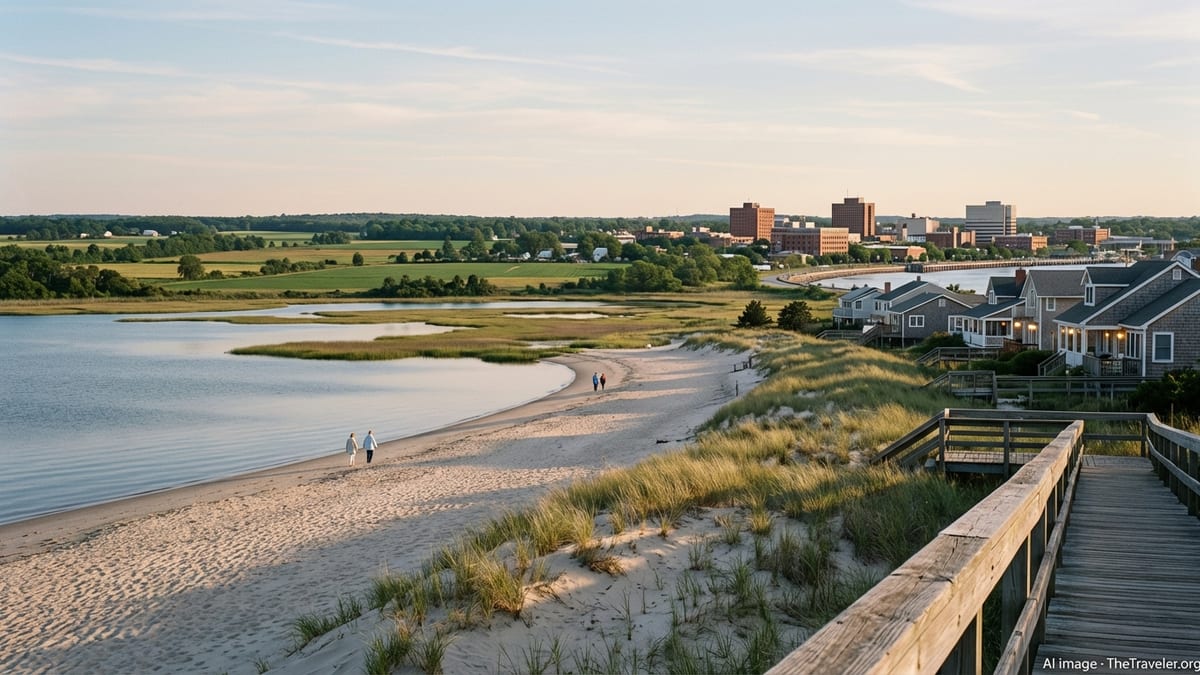
Delaware is one of the smallest states in the United States, but its landscapes and travel experiences feel surprisingly varied. Within an easy drive, you can move from boardwalk-lined Atlantic beaches to walkable historic cities and on to quiet countryside threaded with wildlife refuges, rivers, and farms. Understanding how these three broad regions fit together helps you plan a trip that feels both relaxed and surprisingly rich in contrast.
How Delaware Is Laid Out: A Tiny State With Distinct Zones
Delaware stretches roughly north to south along the Delaware River, Delaware Bay, and the Atlantic Ocean, with just three counties: New Castle in the north, Kent in the center, and Sussex in the south. Travelers tend to experience the state in three main zones that cut across county lines: the beach region along the Atlantic and lower Delaware Bay, the city corridor based around Wilmington and Dover, and the countryside that fills in the spaces between. Distances are short. You can drive from the northern city of Wilmington to the Atlantic beaches in around two hours in light traffic, which makes it realistic to experience multiple sides of Delaware in a single long weekend.
New Castle County in the north is the most urban, anchored by Wilmington and its riverfront, business district, and historic Brandywine Valley. Kent County, including the capital city of Dover, feels more small-town and open, with farmland, air force history, and a cluster of government and cultural institutions. Sussex County in the south is larger and more rural but includes the state’s best-known resort towns such as Rehoboth Beach, Lewes, Bethany Beach, and Dewey Beach along the oceanfront.
Despite its modest size, Delaware also contains several protected natural corridors. State parks, wildlife refuges, and designated nature preserves are scattered from the steep, wooded ravines of White Clay Creek in the north to the dune-backed shoreline of places like Cape Henlopen and Beach Plum Island closer to the Atlantic. These green spaces subtly tie the regions together and offer opportunities to reset between city sightseeing and boardwalk crowds.
The Delaware Beaches: Boardwalks, Bays, and Barrier Islands
The southern stretch of Delaware along the Atlantic and lower Delaware Bay is what many people picture first: a line of resort towns, dunes, and state parks collectively known as the Delaware Beaches. Rehoboth Beach, which markets itself as a classic family beach town, combines a walkable boardwalk, independent restaurants, and a lively but manageable nightlife. Nearby Dewey Beach draws a younger crowd with live music venues and a reputation for watersports on both the ocean and the adjacent Rehoboth Bay. To the north, Lewes faces the Delaware Bay rather than the open ocean and leans historic and residential, with 17th century roots, a compact downtown, and easy access to Cape Henlopen State Park for beaches and trails.
South of the busier northern beaches you reach the quieter “Quiet Resorts” of Bethany Beach and Fenwick Island. Bethany pairs a small-scale boardwalk and bandstand with low-rise condos and cottages, while Fenwick Island feels almost like an extension of coastal Maryland, with a historic lighthouse and a thinner strip of development between the bay and the sea. Between and around these towns, wide segments of shoreline are protected as public land. Delaware Seashore State Park preserves several miles of beach, dunes, and inlet views between Rehoboth and Bethany, while Cape Henlopen anchors the northern end of the beach region near Lewes with miles of ocean and bayfront, a fishing pier, cycling paths, and remnants of coastal fortifications.
The beach region is not just about sunbathing. Rehoboth Bay and Indian River Bay form relatively sheltered waters that are popular for sailing small boats, windsurfing, stand-up paddleboarding, and kayaking through salt marshes. Crabbing, fishing from piers or charters, and birding in estuarine habitats round out the options for visitors who like to mix time on the sand with more active or nature-focused pursuits. Even in high season, you can drive a short distance from a busy boardwalk and find quiet stretches of bay or marsh where herons and ospreys are more common than beach umbrellas.
Wilmington and the Brandywine Valley: Delaware’s Urban Heart
At the opposite end of the state from the beaches, Wilmington serves as Delaware’s largest city and de facto urban hub. It sits at the confluence of the Christina River and Brandywine Creek, a location that supported early industry and now anchors a compact downtown business district, riverfront attractions, and historic neighborhoods. In recent years, the Wilmington Riverfront has been transformed from industrial land into a pedestrian-friendly zone with a paved Christina Riverwalk, landscaped parks, public art, and dining. The riverwalk connects cultural and entertainment stops while also functioning as part of a broader regional trail system, allowing visitors to stroll or bike between the city center and surrounding communities.
Just north and west of the city core, the Brandywine Valley blends culture and scenery. Here you find museums and gardens associated with historic estates, as well as public parks along Brandywine Creek. Urban green spaces like Brandywine Park were laid out in the late 19th century with curving paths, wooded slopes, and views of the creek, and today they still offer a surprisingly bucolic escape within city limits. A short drive away, Brandywine Creek State Park and other conservation areas preserve rolling meadows, forest, and stone walls that recall the region’s agricultural past even as suburbs expand around them.
Wilmington also functions as a practical base, especially for travelers arriving by train. The main railroad station is set near the riverfront, and from there, visitors can walk to hotels, restaurants, and attractions or connect to regional buses that continue south. This makes it easy to begin a Delaware trip with a day or two of city exploring before renting a car and heading for the beaches or countryside. The city’s cultural calendar, including festivals, gallery shows, and seasonal events, provides another layer of interest for travelers who enjoy pairing outdoor exploration with arts and urban energy.
Dover and Central Delaware: Capital City and Crossroads
Roughly halfway down the state, Dover and its surrounding communities form the core of central Delaware. As the state capital, Dover offers a different feel from Wilmington, with a low-rise historic center clustered around Legislative Hall, brick-lined streets, and a concentration of government buildings and museums. Visitors can walk through a preserved district that includes colonial era houses, churches, and the Old State House, gaining a sense of Delaware’s role in early American politics and its status as the first state to ratify the Constitution.
Beyond its political identity, Dover anchors a region of small towns, farmland, and wetlands. Nearby communities such as Smyrna and Milford connect visitors to wildlife refuges, riverfronts, and locally run restaurants. Central Delaware is also known for its mix of tax free shopping and niche attractions, from racing culture to aviation history. The area’s modest size keeps driving times short, while the relative flatness of the landscape and a growing network of trails make it a comfortable place for cycling and casual walks.
For many travelers, central Delaware becomes the connective tissue of a statewide itinerary. It is where coastal visitors detour inland on a rainy beach day to explore museums, or where road trippers pause between Wilmington and the beaches for an overnight in a smaller, less crowded city. Because the capital region bridges north and south, it can be an efficient place to base yourself if you want to mix day trips to multiple corners of the state, returning in the evening to quieter streets and easier parking than you would find in larger metropolitan areas.
The Countryside: Farms, Forests, and Wildlife Refuges
Outside the cities and well known resort towns, most of Delaware looks and feels rural or small town. The countryside varies from the gently rolling, wooded hills of northern New Castle County near the Pennsylvania border to the flatter, more open farm fields and wetlands that dominate Kent and Sussex Counties. Scattered throughout are state parks, nature preserves, and wildlife refuges that protect important habitats and give visitors a way to experience a less developed side of the Mid Atlantic coast.
Delaware is home to dozens of state dedicated nature preserves and natural areas, some with marked trails and public access. In the north, places like White Clay Creek Valley and Brandywine Creek Valley protect steep wooded ravines and fast moving streams. These areas offer loop hikes where you might pass stone remnants of mills, cross covered bridges, and see dense spring wildflowers. Farther south, preserves and coastal natural areas safeguard tidal marshes, barrier spit dunes, and low lying forests that provide crucial habitat for migratory birds and other wildlife.
For travelers, the countryside offers a chance to slow down between more intense days at the beach or in the city. You can combine a morning hike through a quiet nature preserve with an afternoon stop at a roadside farm stand, followed by dinner in a small town where the pace is unhurried and parking lots look out over cornfields instead of high rises. Because the state is compact, many of these rural experiences are no more than a short detour off the main north south routes, making them easy to integrate into an otherwise urban or coastal itinerary.
Where the Regions Meet: Parks, Trails, and Scenic Corridors
One of the most interesting things about traveling in Delaware is how often the regions blend into one another. State parks and multi use trails frequently sit at the transition points between city, countryside, and coast, acting as gateways from one environment to another. For example, near Wilmington, a network of greenways along Brandywine Creek and Alapocas Run allows visitors to walk or cycle directly from city streets into shaded ravines and rocky outcrops. Park visitor centers housed in historic barns highlight both natural and cultural history, underlining how land use has shifted from agriculture and industry to recreation and conservation.
In central and southern Delaware, long, straight roads intersect with wildlife refuges and state parks that link the inland countryside to the coastal zone. Marsh backed beaches, tidal creeks, and low dunes sit just a short drive east of farm fields and small towns. Here, you can start your day watching sunrise over the Atlantic, then turn inland to kayak on a calm river or walk beneath towering pines before returning to the shore in time for an evening boardwalk stroll.
Many of these corridors also carry regional bike routes and paddling trails, giving active travelers alternative ways to experience the transitions between regions. Even if you are not planning a dedicated cycling or paddling trip, short segments are accessible as guided tours or rentals. These experiences can offer a fresh perspective on Delaware’s geography, letting you appreciate how quickly the landscape changes from city to forest to salt marsh as you move across comparatively short distances.
Planning Your Route: How to Combine Beaches, Cities, and Countryside
Because Delaware is so compact, the main planning decisions for travelers revolve less around distance and more around pacing and season. The summer months bring the largest crowds to the beach towns, particularly on weekends, so you may want to arrive on a weekday, use Wilmington or Dover as an entry point, and then drive to the coast after spending a day or two exploring urban and inland sights. In shoulder seasons such as late spring and early autumn, the beaches quiet down, and it becomes easier to divide time equally between oceanfront and countryside activities without contending with peak holiday traffic.
A classic three or four day itinerary might begin with an arrival in Wilmington by train or car, an afternoon exploring the riverfront, and an overnight stay near the city center. The next day, you could visit Brandywine Valley parks or museums in the morning before driving south to Dover, where a walking tour of the historic district offers a contrasting feel. From there, it is an easy onward trip to the beaches for at least two nights, leaving room for both boardwalk time and a side excursion into a nearby state park or wildlife area.
Longer stays lend themselves to deeper exploration of the countryside. You might add a day inland in Sussex County to visit small towns, visit a state park along a bay or river, or time your trip to coincide with a seasonal festival, farmers market, or cultural event. Because lodging options in rural areas are more limited than at the beaches or in Wilmington and Dover, it is wise to plan ahead, especially during popular summer and autumn weekends when demand is higher.
Seasonal Rhythms and How They Shape Each Region
Weather and seasonal rhythms strongly influence how the three main regions of Delaware feel. At the beaches, summer brings warm water, lifeguarded swimming, and a packed calendar of concerts, markets, and family activities. Spring and fall can be especially attractive for travelers who prefer cooler temperatures and less crowded boardwalks, although some seasonal businesses may operate on reduced schedules. Winter along the coast is quieter, with many visitors drawn by off season rates, peaceful beach walks, and storm watching on windy days.
In Wilmington, Dover, and the countryside, spring and fall tend to be especially pleasant, with mild temperatures for walking and hiking and foliage that shifts from early blossoms in the north to autumn color in riparian corridors and wooded hills. Summer can be warm and humid inland, but the presence of rivers, creeks, and shaded trails offers some relief, and evenings can be lively in city centers thanks to outdoor dining and events. Winter is typically more subdued, yet museums, galleries, and indoor attractions continue year round, giving travelers an alternative to outdoor-focused coastal trips.
Because the state’s tourism calendar includes festivals tied to music, history, food, and seasonal changes, it can be helpful to check what is happening in each region when you plan your visit. You might find that a coastal trip aligns with a maritime event or a farmers market in a beach town, while a stay in Wilmington or Dover coincides with a cultural festival or holiday celebration that adds a distinct local flavor to your time in the city.
The Takeaway
For such a small state, Delaware contains a surprising diversity of travel experiences, and understanding its three broad regions makes it easier to design a satisfying trip. The Delaware Beaches deliver classic Atlantic seaside vacations, from busy boardwalks to quiet stretches of dune backed sand and bay. Wilmington and the urban corridor provide culture, history, and a sense of city energy, while central Dover adds a smaller scale capital atmosphere and an easygoing midpoint between north and south.
Between and around these centers, the countryside offers a quieter Delaware of farms, forests, wetlands, and small towns, threaded with parks and nature preserves that invite you to slow down. Because distances are short, you do not have to choose a single version of the state. With a bit of planning, you can watch sunrise from a beach, spend an afternoon in a historic district, and end the day listening to frogs in a marsh or crickets in a farm field.
Whether you are planning a quick coastal escape or a longer regional road trip, thinking in terms of beaches, cities, and countryside will help you balance your time and match each day’s activities to your interests and the season. The reward is a deeper appreciation of how much variety fits within Delaware’s borders, and how easily you can move among its distinct yet interconnected regions.
FAQ
Q1. How long does it take to drive across Delaware from the northern cities to the southern beaches?
Driving from Wilmington in northern Delaware to the main beach towns in Sussex County usually takes around two hours in light traffic, though summer weekends and holidays can add extra time.
Q2. Which Delaware beach town is best for families?
Rehoboth Beach is particularly popular with families thanks to its walkable boardwalk, mix of casual restaurants and attractions, and relatively compact layout, while quieter nearby towns such as Bethany Beach appeal to those seeking a slower pace.
Q3. Are there car free ways to experience Delaware’s regions?
You can arrive in Wilmington by train and explore its riverfront and nearby parks on foot or by bike, but reaching the beaches and most countryside areas realistically requires a car or organized transfers for flexibility.
Q4. When is the best time to visit the Delaware Beaches?
Summer offers warm water and a full slate of activities, while late spring and early fall provide pleasant weather and fewer crowds, though some seasonal businesses may operate with reduced hours outside peak months.
Q5. Is Dover worth visiting if I am mainly interested in the coast?
Dover can be a rewarding stop for travelers heading to or from the beaches, offering a compact historic district, state museums, and a quieter atmosphere that contrasts with busier resort towns.
Q6. Where can I experience Delaware’s countryside and nature?
State parks, wildlife refuges, and designated nature preserves across all three counties protect forests, rivers, and wetlands, giving visitors options for hiking, birding, and quiet scenic drives within easy reach of towns and cities.
Q7. Can I visit both Wilmington and the beaches on a weekend trip?
Yes, it is possible to spend a day in Wilmington exploring the riverfront and nearby valley, then drive to the beaches for another day, though an extra night or two will allow for a more relaxed pace.
Q8. Are Delaware’s beaches open year round?
The beaches themselves are accessible year round for walks and views, but lifeguard services, amenities, and many seasonal businesses primarily operate from late spring through early fall.
Q9. Do I need to pay sales tax when shopping in Delaware’s cities or beach towns?
Delaware is known for having no state sales tax on purchases, which can make shopping in its cities, outlets, and beach town stores especially appealing for visitors.
Q10. How can I see multiple Delaware regions without changing hotels every night?
Staying in a central location such as Dover allows you to day trip north to Wilmington and south to the beaches, while a base in a beach town outside peak traffic periods can still support day trips inland to the capital and countryside.