

More news on this day
A last-minute reshuffle of carnival events in Playa del Inglés on Gran Canaria is being linked to severe overcrowding, as the Maspalomas International Carnival’s expanded 2026 edition draws visitor numbers that appear to have outpaced local planning.
Get the latest news straight to your inbox!
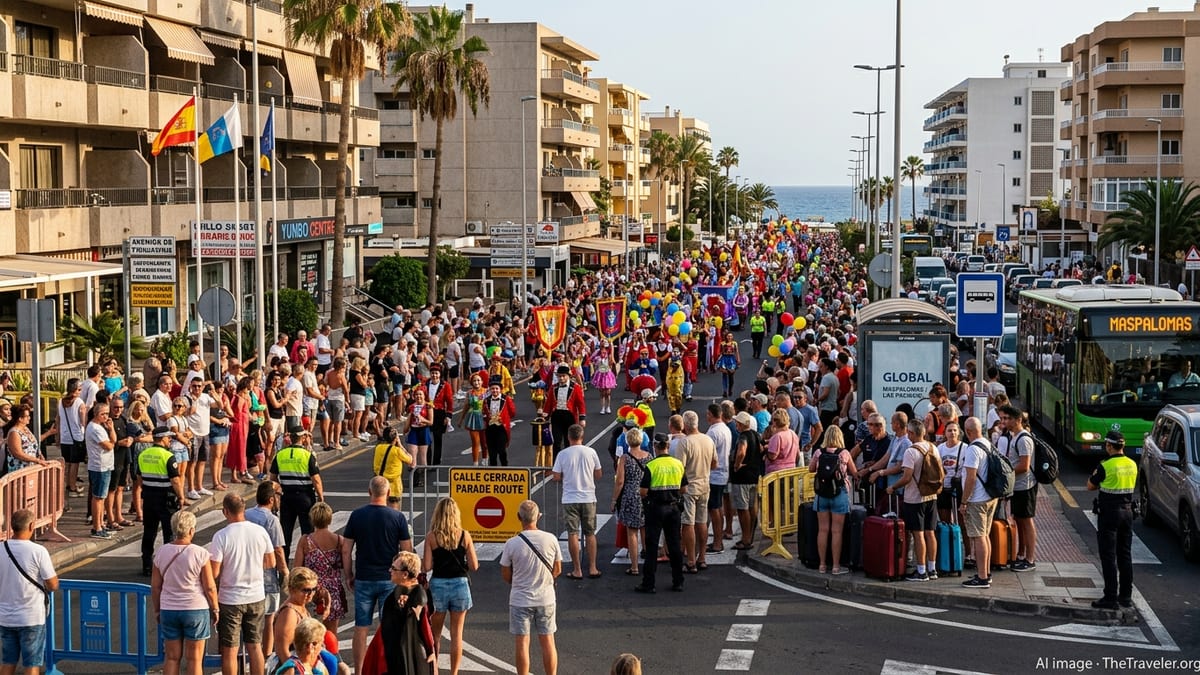
Festival Calendar Shift Fuels Visitor Surge
Playa del Inglés, a resort town in the municipality of San Bartolomé de Tirajana, is once again at the heart of the Maspalomas International Carnival, officially recognised as a Festival of Tourist Interest of the Canary Islands. The 2026 edition, built around a circus theme, stretches across nearly two weeks of parades, concerts and beachside parties, turning the southern coastline into a continuous celebration.
Reports indicate that the core parade schedule has been pushed deeper into the peak holiday period compared with previous editions, concentrating large-scale events into fewer high-demand days. Travel and events information circulating for 2025 and 2026 shows how the flagship Gran Cabalgata grand parade and related street parties effectively seal off access roads into Playa del Inglés, leaving limited time windows for both arrivals and departures.
Tourism advisories for this year’s carnival season across the Canary Islands repeatedly highlight compressed calendars, with major parades migrated to weekday evenings or late-season weekends after earlier postponements in other Spanish cities due to adverse weather. When combined with the long-announced circus theme and the festival’s growing international profile, the revised dates appear to have created a perfect storm of demand focused squarely on Playa del Inglés.
Published guides aimed at international visitors describe the Maspalomas carnival as one of Spain’s most iconic street festivals and emphasise its increasing global reach. In practice, the delayed and condensed flagship events have attracted a higher-than-usual overlap of domestic travellers, foreign holidaymakers and niche festival-goers such as Bear Carnival participants, many of whom plan trips specifically around the parade weekend.
Road Closures and Bus Bottlenecks Around the Grand Parade
Mobility plans publicly released in recent years for the Maspalomas International Carnival outline extensive road closures whenever the grand parade moves through Playa del Inglés. Official documents for the Gran Cabalgata route describe how access along Avenida de Tirajana and key entry points such as El Veril is progressively restricted as floats and marching groups snake through the resort’s main arteries.
Travel companies operating on Gran Canaria have issued specific transfer notices for parade days in nearby seasons, warning that buses cannot enter or leave Playa del Inglés for several hours while the procession is in motion. These advisories instruct guests to board earlier at alternative points or accept longer walks with luggage, signalling how tightly the transport timetable is bound to the carnival route.
Visitor forums and recent trip reports paint a picture of buses arriving full at Maspalomas station and bypassing intermediate stops when capacity is reached. Accounts from February 2026 describe passengers left waiting as services towards Playa del Inglés struggled to cope with crowd spikes, even outside the main parade window. Earlier discussion threads from previous carnival years already warned of disrupted airport connections on the frequently used route between Maspalomas, Playa del Inglés and Las Palmas.
With the 2026 parade sequence landing after weeks of heavy promotion of the circus theme, the knock-on effect has been a sharp mismatch between timetabled services and real passenger numbers. Publicly available transport plans reference added stops and occasional reinforcement of specific lines on parade days, but on-the-ground experiences suggest these measures have not fully absorbed the flows funnelled into the resort during the delayed flagship events.
Accommodation Squeeze and Secondary Events Add Pressure
The carnival calendar in Playa del Inglés does not exist in isolation. Bear Carnival, a separate but overlapping festival marketed internationally to LGBTQ+ travellers, has for several years either coincided with, or closely followed, the Maspalomas celebrations. Organisers now promote a pattern in which Bear Carnival finishes on Palm Sunday, while Maspalomas carnival dates shift within late winter and early spring.
Promotional updates in 2025 framed the 2026 arrangement as a positive outcome, emphasising that the two carnivals would align in the same season without fully colliding. In practice, published guidance for Bear Carnival guests continues to stress that when its opening weekend overlaps the Maspalomas grand parade, public transport to and from Playa del Inglés can become “useless” for several hours, and visitors may face difficulty reaching accommodation near the Yumbo Centre.
This layering of events has intensified pressure on hotel and apartment capacity in and around Playa del Inglés. Travel advisories for festival-goers encourage early booking within walking distance of the Yumbo Centre or Avenida de Tirajana, noting that official partner hotels tend to sell out long before carnival week. As parade dates shifted later and the circus theme drew more international curiosity, remaining beds in secondary areas quickly filled with visitors who then depended on already strained buses and taxis.
Travel discussion boards show that some late-booking visitors have been pushed into outlying parts of Maspalomas, forcing them to navigate both the parade cordon and peak traffic in order to attend headline events. For those arriving or departing on the same days as the rescheduled large-scale festivities, the result has been long transfer times, missed connections and widespread reports of overcrowded streets and squares throughout Playa del Inglés.
Safety, Crowd Control and Visitor Experience Under Scrutiny
As the 2026 edition unfolds, publicly available information from previous years reveals a consistent focus on security perimeters, alcohol controls and emergency access along the parade route. Local plans have historically been drawn up with regional security and emergency services to manage tens of thousands of revelers along the three-kilometre procession corridor and in adjacent nightlife hubs.
However, the apparent gap between anticipated and actual visitor numbers associated with the delayed main events is raising questions about the sufficiency of current capacity assumptions. Reports from travel forums and regional media coverage describe dense crowding in the Playa del Inglés Annex area, where daytime beach parties and the so-called Carnival in the Sun segment channel thousands towards a relatively confined beachfront zone.
Observers note that bottlenecks tend to occur where parade spectators, daytime beachgoers and nighttime party crowds intersect, particularly near commercial centres such as Yumbo and along key junctions on Avenida de Tirajana. When the grand parade is rescheduled or extended into late evening, those pressure points can persist for hours, affecting everyone from families with children to visitors with mobility difficulties.
The emerging picture places renewed emphasis on balancing the economic benefits of “overwhelming success,” a phrase often used in prior festival summaries, with the risk of crowd discomfort and delayed emergency access. The 2026 carnival’s delayed mass events in Playa del Inglés are likely to serve as a case study for how tourism-driven destinations can better integrate transport planning, accommodation policy and crowd management when festivals grow faster than their supporting infrastructure.