

More news on this day
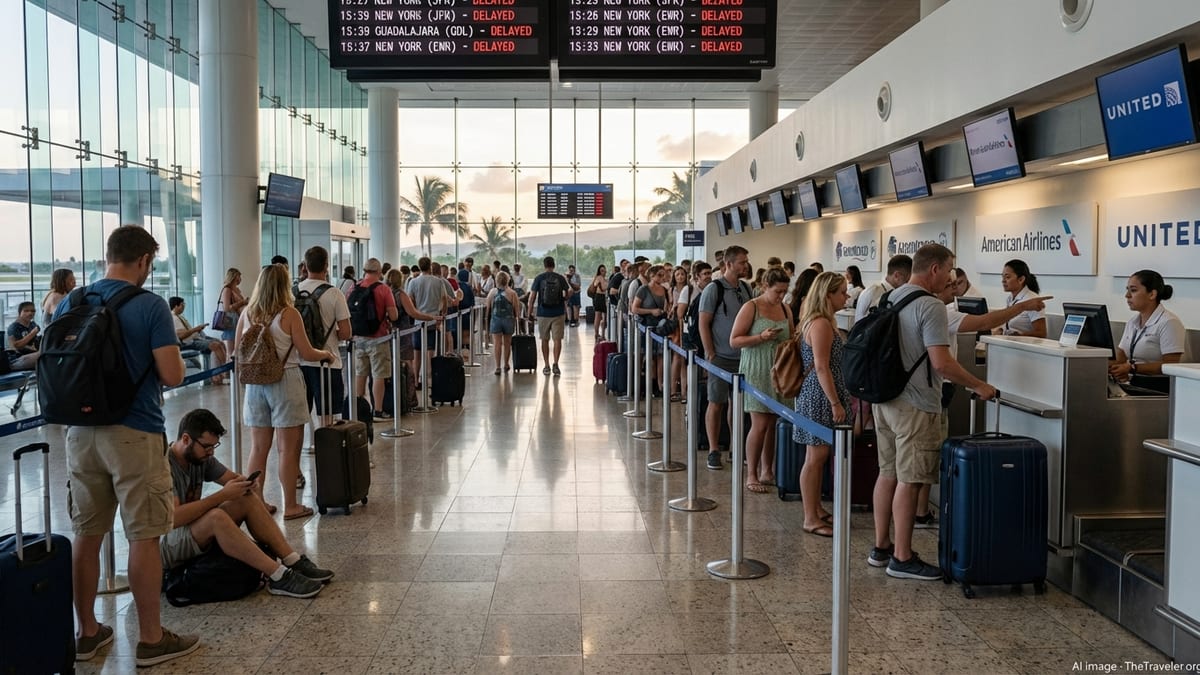
Air travel in and out of Mexico City and Monterrey faced fresh disruption this weekend, with publicly available data indicating 59 delayed flights and 10 cancellations affecting services operated by VivaAerobus, Lufthansa, AeroMéxico, Volaris and several other carriers.
Get the latest news straight to your inbox!
Operational Strain at Mexico’s Busiest Hubs
Mexico City International Airport and Monterrey International Airport, two of the country’s most important aviation gateways, reported a cluster of delays and cancellations spanning domestic and international routes. Flight-tracking dashboards and airport information screens on April 11 and 12 pointed to knock-on delays averaging close to an hour on some services, as aircraft rotations and crew schedules came under pressure.
Mexico City remains the largest and busiest airport in the country, handling a dense schedule of departures that leaves little room to absorb disruption. When irregular operations build up across multiple airlines in a compressed time window, even a relatively small number of affected flights can ripple through the system, pushing back gate availability, aircraft turnarounds and connecting itineraries.
Monterrey, a key industrial and business hub in northern Mexico, functions as both an origin and connection point for domestic routes and several international services. The latest disruption highlights how closely linked operations are between Mexico City and Monterrey, particularly on trunk routes where aircraft shuttle back and forth several times per day.
The affected flights include a mix of point-to-point services within Mexico and long-haul routes connecting to Europe and the United States. According to published schedules, airlines such as Lufthansa serve Mexico City from major European hubs, while Mexican low-cost and full-service carriers connect the capital and Monterrey with a broad network of domestic cities.
VivaAerobus, Volaris and AeroMéxico Among Hardest Hit
Low-cost operators VivaAerobus and Volaris, along with flag carrier AeroMéxico and its affiliates, appear prominently in the list of delayed and cancelled flights. These carriers operate many of the high-frequency routes between Mexico City and Monterrey, as well as onward connections to major leisure destinations including Cancun, Puerto Vallarta and Tijuana.
Publicly available flight histories for routes such as Mexico City to Monterrey show that services operated by VivaAerobus, Volaris and AeroMéxico routinely run multiple times per day. When one sector runs late, the next departure can quickly be affected, particularly if aircraft and crews are tightly scheduled. Over a full operating day, a series of modest delays can accumulate into significant timetable disruption.
Sector statistics compiled by aviation data providers show that, while the major Mexican carriers maintain relatively strong on-time performance across the year, peaks in congestion at key hubs can lead to clusters of irregular operations. Travelers flying on budget airlines in particular often face limited rebooking flexibility compared with full-service carriers, which can compound the impact of cancellations.
The current pattern of 59 delays and 10 cancellations is consistent with a localized operational strain rather than a wholesale suspension of service. Nevertheless, for affected passengers, even short delays can result in missed connections, lost hotel nights or rearranged ground transport, especially when traveling during busy weekends or holiday periods.
Weather, Congestion and Airspace Complexity Cited as Factors
While a single dominant cause has not been identified, aviation analysts frequently point to a combination of weather variability, runway and taxiway congestion, and complex airspace management around the capital as contributing factors when disruption flares up. Mexico City’s elevation and surrounding terrain require careful approach and departure procedures, which can reduce the system’s ability to recover quickly when schedules slip.
Recent commentary on airport performance in the region has also highlighted broader airspace constraints affecting the capital and nearby facilities. The introduction of additional airports serving the Mexico City metropolitan area has added complexity to traffic flows, and at times has made it harder to keep tightly packed timetables running precisely on schedule.
Monterrey’s role as a fast-growing hub further adds to the challenge. Increased frequencies from low-cost carriers, along with new international routes marketed to business travelers and tourists, offer more choice but leave operators with less buffer room when disruptions occur. Airlines must balance competitive schedules with resilience, and the latest wave of delays underscores how sensitive these networks can be.
Industry observers note that external events, from regional security operations to infrastructure works at airports, can periodically tighten constraints on already busy runways and terminals. When these pressures coincide with high seasonal demand or adverse weather, pockets of disruption such as the one seen this weekend become more likely.
Impact on Travelers and Recommended Precautions
For passengers caught up in the latest disruptions, the practical impact ranges from relatively minor schedule shifts to full cancellations requiring overnight stays or re-routed itineraries. Travelers connecting through Mexico City or Monterrey are particularly exposed, as delays on feeder flights can jeopardize onward connections within Mexico or to the United States, Canada and Europe.
Consumer advocates generally recommend that passengers flying routes with a history of congestion build additional connection time into their itineraries and monitor their flights closely on day of travel. Many airlines and third-party providers offer real-time notifications on delays and gate changes, which can be crucial at airports where last-minute operational adjustments are common.
Publicly available guidance from aviation regulators and passenger-rights organizations indicates that travelers affected by significant delays or cancellations may, in some circumstances, be eligible for assistance such as meal vouchers, hotel accommodation or alternative transport. The specific remedies vary by airline and by the reason for the disruption, so passengers are encouraged to review the conditions of carriage and published policies of their chosen carrier.
Given the volume of traffic moving through Mexico City and Monterrey, any period of irregular operations also serves as a reminder of the broader pressures on Mexico’s aviation infrastructure. As airlines continue to add routes and frequencies, maintaining reliability at key hubs will remain a central challenge.
Outlook for Operations in the Coming Days
As of Sunday, available tracking data suggested that most airlines were working to absorb the 59 delays and 10 cancellations into their schedules, with some signs of gradual recovery in departure punctuality. Short-haul routes between Mexico City and Monterrey typically normalize more quickly than long-haul services, since aircraft can be turned around and repositioned within a few hours once congestion eases.
Industry reports indicate that carriers are likely to focus on stabilizing core domestic routes first, including Mexico City to Monterrey and other high-demand city pairs, before adding back operational slack such as spare aircraft or crew reserves. Travelers booked over the next several days are advised, where possible, to reconfirm departure times the day before travel and arrive early at the airport to navigate check-in and security during peak periods.
Although the current level of disruption is significant for those directly affected, it does not point to a systemic shutdown of air travel in Mexico. Flights continue to operate into and out of both Mexico City and Monterrey, and most scheduled services are running close to plan. Nonetheless, the episode highlights the fine margins within which airlines and airports in the region must operate to keep tightly packed schedules on track.
For now, passengers planning trips that involve these key hubs in the coming week may wish to allow extra time in their itineraries and remain attentive to airline communications. The situation underlines how even a relatively contained set of delays and cancellations can pose challenges across an interconnected route network that depends heavily on on-time performance at a small number of critical airports.