

More news on this day
Los Angeles International Airport is grappling with a fresh wave of disruption today, with 126 delayed flights and one cancellation affecting United, Delta, Southwest and several international carriers, leaving passengers stranded and triggering knock-on delays across major cities including New York and Chicago.
Ripple Effects Across Major US Hubs
The operational strain at Los Angeles International Airport (LAX) is reverberating across the national air network, as flights departing and arriving from key hubs such as New York and Chicago absorb rolling delays. Airlines including United, Delta and Southwest are working to rebalance aircraft and crews, but tight winter schedules and residual disruption from recent severe weather in the Northeast are amplifying the impact.
Connections between LAX and airports in the New York area and Chicago O’Hare are particularly affected, with later departures often held to accommodate late‑arriving aircraft and crew duty‑time limits. Passengers booked on onward connections to secondary US cities are seeing missed links and involuntary overnight stays, adding to a growing backlog of displaced travelers.
Airline operations teams say they are prioritizing long‑haul international services and first waves of next‑day departures, which can mean short‑haul domestic flights bear the brunt of rolling delays. That strategy helps prevent the disruption from deepening into tomorrow’s schedule, but leaves many passengers facing multi‑hour waits in crowded terminals at LAX and other major hubs.
Travellers Stranded and Terminals Under Strain
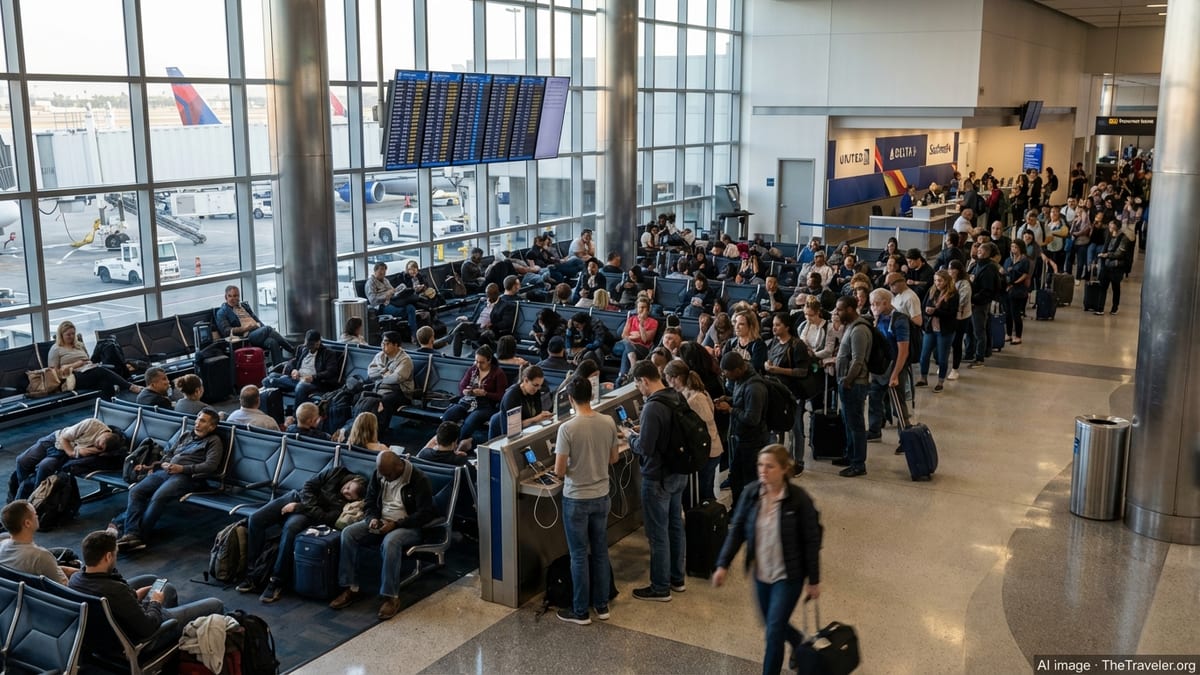
Inside LAX, scenes of weary passengers stretched along concourses underscore the human cost of even a relatively small number of cancellations. With 126 delays and one cancellation recorded, thousands of travelers are stuck in limbo, many clustered near power outlets and information screens as they try to rebook flights or monitor changing departure times.
Customer‑service counters for United, Delta and Southwest have seen intermittent queues as passengers seek meal vouchers, hotel accommodation or alternative routing through less congested hubs. Airline agents are encouraging travelers with flexible plans to voluntarily move to flights later in the week, opening up seats for those with urgent travel needs or tight international connections.
Terminal amenities are also being tested. Food outlets at peak times are reporting longer lines, while airport staff are fielding questions about rest areas, children’s play spaces and accessible seating. While no terminal closures have been reported, some gate changes and last‑minute reassignments are forcing passengers to traverse multiple piers at short notice to make boarding calls.
Weather Legacy and Airspace Constraints
The latest round of delays at LAX comes in the wake of a punishing sequence of winter storms that recently battered the Northeast and parts of the Midwest, snarling operations from Boston and New York to Chicago. Airlines are still repositioning aircraft and rebuilding schedules after thousands of cancellations earlier in the week, leaving little slack in fleets and crew rosters when new issues arise.
Industry analysts note that even when skies above Los Angeles are clear, weather‑related disruption elsewhere can severely limit operational flexibility on transcontinental routes. Aircraft arriving from storm‑hit airports can be hours late, which cascades into late departures from LAX and compresses turnaround times on subsequent sectors.
At the same time, evolving airspace management measures around major hubs are adding complexity. New helicopter restrictions around LAX airspace, introduced to separate rotorcraft from commercial traffic, are part of a broader federal push on safety. While these restrictions are primarily aimed at controlling low‑level airspace, they form another layer of coordination required for an already dense operating environment.
Airline Responses and Passenger Options
United, Delta and Southwest, along with multiple international airlines serving LAX, have activated standard disruption‑management protocols including flexible rebooking policies and, in some cases, fee waivers for same‑day changes when comparable seats are available. Carriers are also leaning on partner airlines and alliance networks to move passengers via alternative routings through other hubs.
Operational teams are closely watching crew duty‑time limits, a critical factor that can quickly turn a long delay into an outright cancellation if pilots or cabin crew time out before a flight can depart. Where feasible, airlines are swapping crews or aircraft to preserve key flights to and from constrained airports such as New York and Chicago, in order to prevent further schedule deterioration.
Passengers already at LAX are being urged to stay close to their gate, ensure contact details are updated in airline apps and sign up for real‑time notifications. Those yet to travel have been advised by carriers to check their flight status repeatedly on the day of departure, arrive early to navigate security and allow extra time for potential gate changes or longer lines at baggage drop.
Broader Impact on Domestic and International Travel
Beyond the immediate disruption at Los Angeles, the 126 delays and single cancellation are a reminder of how tightly interconnected US and international flight networks have become. A delayed departure from LAX can reverberate all the way to Europe or Asia when it involves an aircraft scheduled for a long‑haul rotation, affecting travelers far beyond the West Coast.
Trade bodies representing airlines and airports have been pressing for greater investment in air traffic control staffing and technology, arguing that a combination of intense demand, volatile weather and aging infrastructure is leaving the system vulnerable to repeated bouts of disruption. Recent storms have highlighted how quickly schedules can unravel when several major hubs are simultaneously constrained.
For now, travelers passing through Los Angeles and other major US airports face another day of uncertainty. While airlines expect to gradually stabilize operations as the day progresses and backlogs ease, any fresh operational shock, whether from weather or technical issues, could prolong the disruption and extend the isolation many passengers are experiencing in terminals across the country.