

More news on this day
Thousands of passengers were left sleeping on terminal floors and scrambling for scarce hotel rooms this weekend as Delta Air Lines racked up hundreds of cancellations and delays across the United States, France, Brazil, Spain and other destinations following a major technology failure that crippled its global operation.
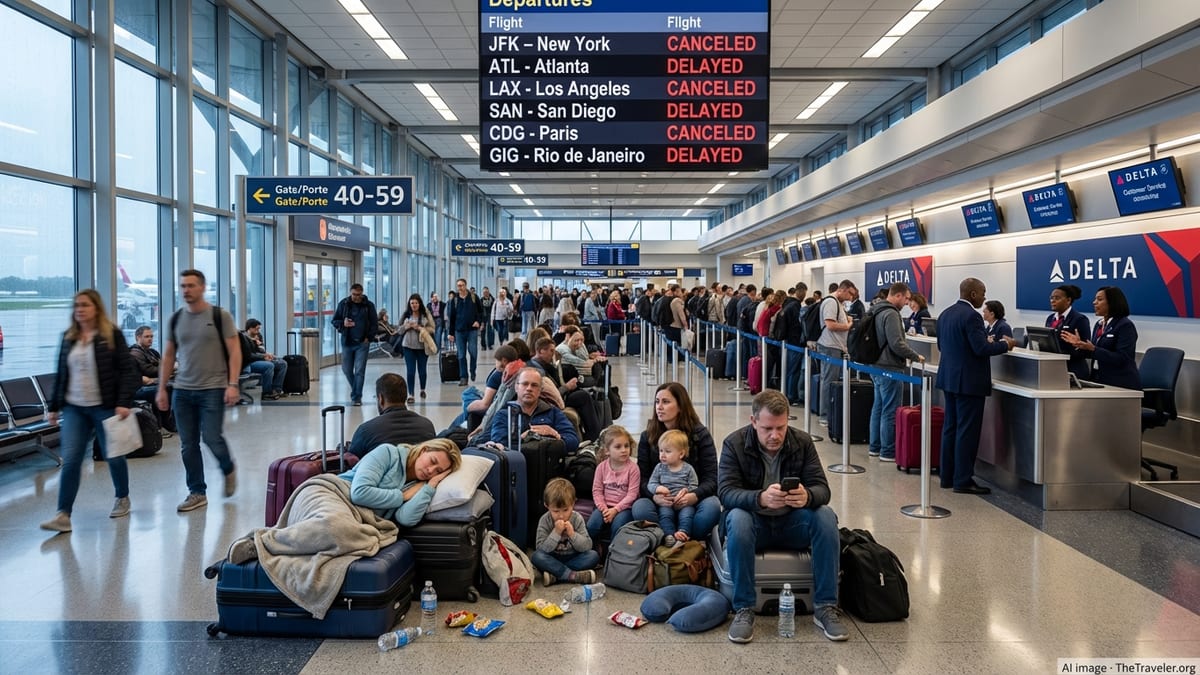
Widespread Disruption Hits Delta’s Global Network
Delta Air Lines passengers faced a cascade of cancellations and delays after a severe technology disruption rippled through the carrier’s worldwide network, snarling operations at key hubs and popular summer destinations. Flight tracking data on the day of the outage and into the following 24 hours showed at least 681 Delta flights canceled and 226 delayed as the airline struggled to bring its systems back online and reposition aircraft and crews.
The disruption struck at some of Delta’s most important airports, including New York, Atlanta, Los Angeles and San Diego in the United States, as well as major international gateways such as Paris and Rio de Janeiro. Travelers reported long lines, system error messages at check in, and repeated gate changes as staff tried, often manually, to rebook passengers and reassign aircraft.
While other global carriers affected by the same underlying technology issue managed to recover operations more quickly, Delta’s size and hub structure meant that problems at one airport rapidly cascaded into others. By the time the worst of the disruption became visible to travelers, the airline was already dealing with misaligned crews, displaced aircraft and a growing customer service backlog.
For many passengers, the raw statistics of cancellations and delays translated into missed weddings, lost business meetings and interrupted holidays, with stranded travelers struggling to find accurate information about what would happen to their flights, bags and bookings.
Scenes of Chaos at U.S. Hubs From New York to Atlanta
In the United States, the most dramatic scenes played out at major Delta hubs and focus cities. At New York’s John F. Kennedy and LaGuardia airports, departure boards filled with red as flights to domestic and international destinations were first delayed, then abruptly canceled. Long queues snaked through terminal corridors as passengers waited to reach customer service desks, often only to be told that the next available seat could be days away.
At Hartsfield Jackson Atlanta International Airport, Delta’s largest hub and the world’s busiest airport by passenger volume, the knock on effects were extensive. As dozens of departures were canceled in quick succession, gates filled with stranded travelers amid a shortage of seats, power outlets and clear information. With hotels near the airport quickly selling out, many passengers resigned themselves to spending the night on terminal benches or the floor, using carry on bags as makeshift pillows.
On the West Coast, Los Angeles International and San Diego International also reported clusters of Delta cancellations and rolling delays. Families bound for summer vacations in Hawaii, Mexico and South America found their plans upended, with some passengers being told they would need to route through multiple hubs to reach their destinations, or accept travel several days later. Frustration grew as social media filled with images of boarding area crowds and complaints about a lack of clear communication.
Further compounding the disruption, ground crews and flight attendants were often out of position as aircraft failed to reach their planned overnight stations. That left Delta with aircraft ready to fly but no legal crew to operate them, forcing further cancellations even after the worst of the initial technology issue had been addressed.
International Travelers Stranded in Paris, Rio and Across Europe
Outside the United States, Delta customers faced particularly acute challenges at international gateways where alternative options were limited and language barriers added to the stress. At Paris Charles de Gaulle Airport, a key transatlantic hub for Delta and its SkyTeam partner Air France, check in areas grew crowded as passengers arriving early for long haul flights discovered their services postponed or scrapped entirely.
Transatlantic travelers reported waiting in lines for several hours to speak with Delta or partner airline agents. Some were eventually rebooked on Air France or other alliance carriers, while others were told that Delta could only guarantee hotel vouchers and rebooking on later dates. With many peak season flights already close to full, even passengers willing to accept circuitous routings via secondary hubs found options limited.
In Brazil, the impact was felt at Rio de Janeiro’s Galeao International Airport, where Delta connects Brazilian travelers to its network via U.S. gateways. Passengers arriving from regional cities to connect onto Delta services were told to collect their bags and rebook, only to find that same day options were unavailable. Nearby hotels quickly filled with transit passengers left in limbo, while others chose to remain in the terminal rather than risk missing rebooked flights.
Reports of disruption also emerged from Spain and other European destinations served by Delta and its partners. Travelers in Madrid, Barcelona and smaller cities described a domino effect as flights to and from U.S. hubs were canceled, leaving aircraft and crews out of position for subsequent legs. Some European travelers attempting to start cruises or escorted tours in North America discovered that their carefully timed itineraries could not be salvaged, even once they were rebooked days later.
Technical Outage Exposes Airline IT Vulnerabilities
Industry analysts say the chaos at Delta highlights the growing vulnerability of global air travel to complex technology systems that underpin everything from crew scheduling to baggage tracking. The disruption was triggered by a faulty update to widely used security software on Microsoft Windows systems, which caused operational computers to crash and reboot repeatedly, rendering them unusable across airports, call centers and back office operations.
While the underlying software issue was resolved relatively quickly for many organizations, airlines faced a particular challenge because they rely on tightly integrated systems to manage aircraft, crew and passengers in real time. Once Delta’s systems were knocked offline during a busy travel period, restoring schedules proved far more complicated than simply restarting affected devices.
Experts note that when an airline’s scheduling and dispatch tools fail, recovery depends not just on technology but also on regulatory limits on crew duty hours, aircraft maintenance requirements and airport capacity. Even a short outage can strand aircraft in the wrong cities, force crews to time out, and overwhelm customer service channels as tens of thousands of travelers simultaneously seek help.
The incident has renewed questions about whether airlines should invest more heavily in system redundancy and disaster recovery plans, particularly for mission critical tools that rely on third party software providers. Some consumer advocates argue that regulators should require airlines to demonstrate greater resilience, given the essential role air travel plays in global commerce and personal mobility.
Passengers Struggle With Rebooking, Refunds and Extra Costs
For affected travelers, the most immediate concern was finding a way to get home or start their trips. Many Delta customers reported that the airline’s app and website were intermittently unavailable or slow to update, making it difficult to understand whether their flights were operating. Automated rebooking often placed passengers on itineraries several days later, with limited ability to search alternatives without speaking to an agent.
Phone wait times stretched to hours as tens of thousands of passengers attempted to reach customer service simultaneously. At airports, passengers formed long lines at ticket counters, sometimes only to learn that agents had access to the same incomplete information. Families traveling with young children or older relatives described a particularly stressful experience as they tried to secure hotel vouchers, meal credits and guaranteed seats on replacement flights.
Out of pocket costs quickly mounted. With airport area hotels selling out, room rates climbed sharply and many stranded travelers were forced to pay out of pocket for accommodation and ground transport while they waited for new flights. Others spent money on replacement tickets with rival carriers in order to reach weddings, cruises or business events on time, hoping to seek reimbursement later.
Consumer advocates urged passengers to keep detailed records of their additional expenses, including hotel receipts, food purchases and transportation costs, and to document all communications with the airline. They noted that while compensation policies vary depending on the cause of disruption and the jurisdiction, passengers may be entitled to refunds for canceled flights, rebooking at no additional cost, and in some cases compensation or reimbursement for reasonable expenses.
Regulatory Scrutiny and Calls for Passenger Protections
The scale of the disruption has drawn the attention of regulators in the United States and abroad, who have been increasingly focused on airline reliability and passenger rights in recent years. U.S. transportation officials said they were monitoring the situation closely and expected Delta to comply fully with existing commitments on refunds and customer care for canceled or significantly delayed flights.
In Europe, the disruption intersected with a strong legal framework for passenger rights that can require airlines operating from or within the European Union to pay compensation for certain delays and cancellations, except in narrowly defined extraordinary circumstances. Consumer groups argued that a preventable technology failure tied to software updates should not be treated in the same way as unavoidable weather events, and pressed for robust enforcement of compensation rules.
The incident also prompted questions about whether current regulations adequately address the growing role of third party technology providers in airline operations. Some lawmakers suggested that software vendors whose products underpin critical infrastructure should share responsibility when failures cause large scale economic damage and disrupt essential services like transportation.
Aviation policy experts said the latest Delta disruption will likely feed into ongoing debates over minimum standards of care for stranded travelers, including access to hotel rooms, meal vouchers and timely information, particularly during peak travel periods when alternative options are scarce.
Delta’s Response and the Long Road to Recovery
Delta executives acknowledged the severity of the operational meltdown and apologized to customers, while emphasizing that safety remained the airline’s first priority throughout the disruption. The carrier mobilized additional staff to airports and call centers, extended waiver policies that allowed passengers to rebook without change fees, and encouraged customers with flexible plans to postpone nonessential travel from the most affected hubs.
To stabilize operations, the airline made the decision to cancel large blocks of flights proactively rather than risk rolling delays across the network. Operations managers focused on restoring reliability at key hubs, gradually rebuilding the schedule as aircraft and crews returned to normal positions. Even so, analysts warned that residual disruptions could persist for several days, as misplaced aircraft and crew schedules were untangled and maintenance checks rescheduled.
Delta also began the process of assessing the financial impact of the disruption, which will include lost revenue from canceled flights, extra costs for crew repositioning and passenger care, and potential compensation or refunds. Industry observers expect the outage to feature prominently in the airline’s next financial disclosures, and to raise questions from investors about the resilience of its technology architecture.
Internally, the incident is likely to trigger detailed reviews of contingency plans, system redundancies and vendor relationships. Executives will face pressure to demonstrate that lessons have been learned and that future disruptions of this scale can be prevented or at least contained more effectively.
What Travelers Should Do Next
For travelers still facing disruption, experts recommend checking flight status frequently through multiple channels, including airport information displays and official airline communications. When possible, passengers are urged to accept rebooking options offered through digital channels to avoid long lines at airport counters, reserving in person assistance for complex cases such as multi city itineraries or group travel.
Passengers whose flights were canceled are generally entitled to a refund if they choose not to travel, even if a voucher or credit is initially offered. Those who accepted rebooking but incurred significant expenses along the way should gather documentation and submit claims to the airline as soon as feasible, while also reviewing applicable passenger rights in the countries where their travel began or ended.
Looking ahead, the Delta meltdown has renewed advice from travel planners to build extra time into critical itineraries, particularly when cruises, tours or major events are involved. Booking the earliest flight of the day, avoiding tight connections and considering travel insurance that covers carrier related disruptions are among the strategies being promoted by industry professionals.
As Delta works to restore normal operations after one of the most visible technology induced meltdowns in recent aviation history, the images of families camped out under departure boards in New York, Atlanta, Los Angeles, San Diego, Paris, Rio de Janeiro and beyond are likely to linger, underscoring how vulnerable modern air travel remains to sudden system failures.