

More news on this day
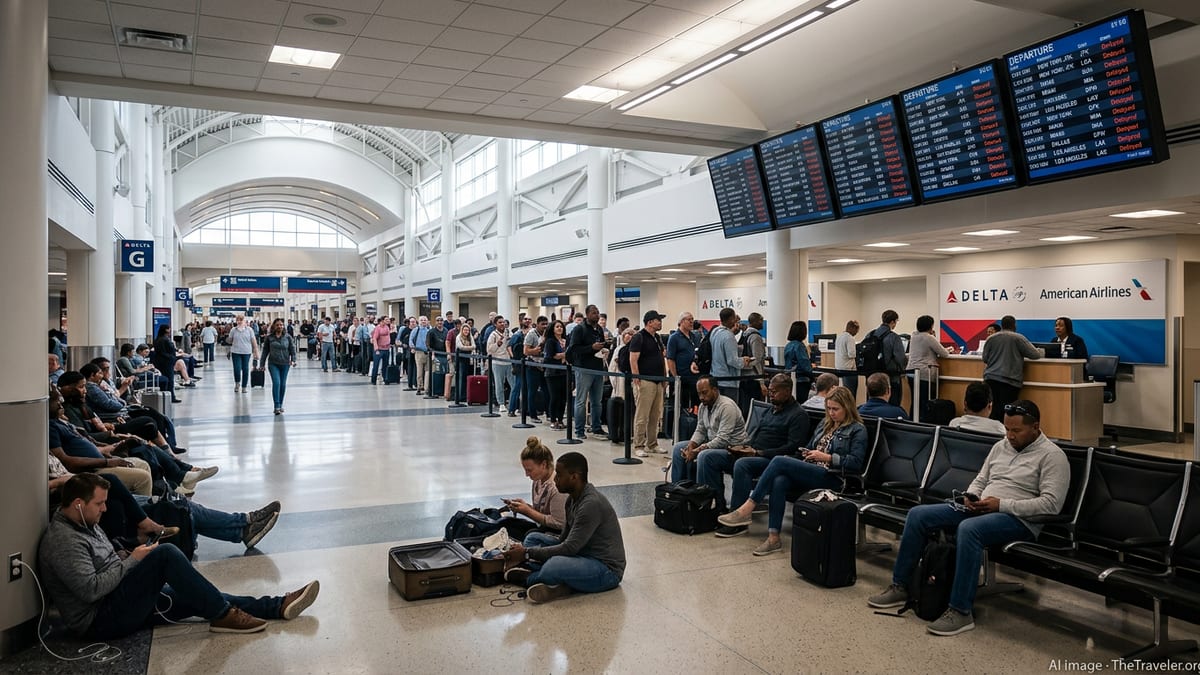
Travelers at Detroit Metropolitan Wayne County Airport faced fresh disruption on April 11 as more than one hundred flights were delayed or canceled, snarling departures on major domestic and international routes and stranding passengers across multiple terminals.
Get the latest news straight to your inbox!
Significant Disruption Across DTW Flight Schedule
Publicly available tracking data for April 11 indicate that Detroit Metro recorded around 116 delayed departures and arrivals alongside seven outright cancellations, marking one of the more disruptive days at the airport so far this spring. The delays span both McNamara and North terminals, affecting early-morning, midday and evening banks of flights.
The disruption is part of a broader pattern of elevated delays across major US hubs reported in recent days, with systemwide statistics showing several thousand delays nationwide and well over one hundred cancellations on peak days. Detroit Metro, a key Midwestern hub, has been flagged as experiencing a high level of day-of-travel disruption in national monitoring dashboards that aggregate airline and airport performance.
The numbers at Detroit are notable when compared with typical historical patterns. Federal aviation statistics for 2024 show that while DTW routinely handles weather-related slowdowns in winter, spring operations tend to stabilize as de-icing activity declines. This week’s figures depart from that seasonal trend, pointing to a combination of operational and weather-related challenges that are once again rippling through airline schedules.
Travel data analysts note that the delayed flights are clustering around key connection waves, magnifying the effect for passengers who rely on Detroit as a transfer point between regional cities and large coastal gateways. Missed connections and rolling pushbacks have contributed to longer-than-usual total trip times for travelers attempting to reach the East Coast, the South and the West Coast.
Delta, Spirit and Other Carriers Hit on Busy Trunk Routes
The latest figures show Delta Air Lines, the dominant carrier at Detroit Metro, absorbing a significant share of the disruption as its connecting banks were slowed by knock-on effects from weather and congestion across the eastern United States. Published operational bulletins from Delta in recent days have highlighted thunderstorms impacting a corridor of airports that includes Detroit, Atlanta and several East Coast hubs, increasing the likelihood of flow-control restrictions and ground holds.
Spirit Airlines, which operates a substantial schedule out of DTW’s North Terminal, has also been affected. Passenger accounts and recent coverage of Spirit’s national performance describe a pattern of schedule tightness in which crew availability and aircraft rotations leave limited buffer when delays cascade through the system. When multiple DTW departures are pushed back, recovery options on high-demand routes such as New York and Orlando narrow quickly, raising the risk of cancellations.
Other large US airlines with a presence at Detroit, including American Airlines and United Airlines, have reported elevated delay figures nationwide this week, and those systemwide pressures are reflected in Detroit’s boards. Flights operating under regional affiliates have been particularly exposed, as shorter-haul sectors into Chicago, New York and Toronto feed into congested airspace and slot-limited airports.
Industry observers point to the cumulative effect of these overlapping pressures. Even when Detroit itself is not experiencing severe local weather, disruptions at other hubs can propagate into DTW as arriving aircraft and crews reach the airport late, forcing airlines to reschedule or trim their outbound operations.
Key Destinations Affected: New York, Atlanta, Chicago, Toronto and Los Angeles
The impact of Saturday’s disruptions has been especially visible on major trunk routes linking Detroit with New York, Atlanta, Chicago, Toronto and Los Angeles. These corridors form the backbone of both business and leisure travel from southeastern Michigan, and they function as crucial connection points onward to Europe, Latin America and the US West Coast.
Flights between Detroit and New York area airports, already operating in some of the most crowded airspace in the country, registered a mix of moderate and extended delays as traffic management initiatives around New York constrained arrivals and departures. Even modest slowdowns at LaGuardia and John F. Kennedy International can ripple back to Detroit, prompting airlines to space out flights or hold aircraft on the ground.
On the Detroit to Atlanta route, a primary connection for Delta’s network, late-arriving aircraft from other parts of the country contributed to a series of rolling delays. Recent weather advisories for the southeastern United States have led to more conservative routing and spacing of flights in the region, meaning flights into and out of Atlanta may depart behind schedule, with Detroit services adjusting accordingly.
Chicago, Toronto and Los Angeles services have not been spared. Chicago’s own congestion has produced measurable delays in recent days, and flights between DTW and Chicago’s O’Hare and Midway airports have been forced to operate within tight air traffic control windows. Toronto flights contend with cross-border coordination and customs processing, and even relatively short holdups can cause passengers to misconnect. Detroit to Los Angeles services, which are typically long-haul and high-demand, have seen schedule pressures whenever aircraft required for those rotations arrive late from earlier segments.
Operational and Weather Factors Behind the Disruptions
Recent coverage of national aviation performance suggests that the latest round of disruptions has multiple causes rather than a single precipitating event. Weather in the eastern half of the United States has continued to pose challenges into early April, with lingering storm systems and unsettled conditions leading to episodic ground stops and reroutes. Detroit, situated at a crossroads of several busy air corridors, often feels the secondary effects of such systems even when local skies appear relatively clear.
Operational constraints are also playing a role. Industry analyses over the past year have pointed to staffing tightness in certain specialized roles, including pilots, flight attendants and maintenance personnel. When daily schedules are finely tuned around available crews and aircraft, even a small disruption early in the day can propagate into late-night departures. Reports on airline performance have highlighted instances in which crew duty-time limits required last-minute cancellations or substitutions when delays pushed operations beyond allowable work windows.
Infrastructure limits at other airports compound the problem. Major hubs like New York, Chicago and Atlanta operate near capacity during peak hours, so air traffic control responses to thunderstorms or low visibility often involve metering arrivals and departures. These flow constraints can force Detroit-bound flights into holding patterns or delayed pushbacks, effectively shifting the bottleneck onto DTW’s schedule.
Analysts further note that passenger demand has remained robust through early 2026, with many airlines running full or near-full flights on popular routes. High load factors can lengthen boarding and deplaning times, while leaving fewer empty seats across the network to re-accommodate passengers when cancellations occur. As a result, each disruption at Detroit has translated into a relatively larger pool of displaced travelers seeking alternatives.
Impact on Passengers and Guidance for Upcoming Travel
The immediate effect for travelers at Detroit Metro has been longer waits at gates, crowded departure areas and a marked increase in same-day rebooking activity. Passengers on multi-leg itineraries through Detroit to cities such as Los Angeles, Toronto and New York have faced elevated risks of missed connections, frequently resulting in involuntary overnight stays or diversions through alternative hubs.
Consumer travel outlets and aviation tracking services emphasize the importance of proactive planning on days like this. Guidance commonly includes arriving at the airport earlier than usual, monitoring airline apps closely for gate and schedule changes, and, when possible, selecting morning departures that are less exposed to the cumulative impact of rolling delays. Travelers with tight connections through Detroit are encouraged to build in additional buffer time, particularly when flying into congestion-prone airports.
Passenger experiences documented across social platforms and in local reporting underscore the uneven nature of the disruption. Some travelers have been able to depart with only modest delays, while others on the same airline have encountered cancellations or multi-hour holdups, depending on crew and aircraft availability. The variability can be especially frustrating for those traveling for events with fixed start times, such as conferences, family gatherings or international connections.
As the day progresses, airlines operating at Detroit Metro are expected to continue adjusting schedules in an effort to recover normal operations by late evening or early the following day. Observers following real-time tracking dashboards will be watching to see whether the number of delayed flights begins to taper, or whether complications at outstation airports extend the disruption window for Detroit travelers into the remainder of the weekend.