

More news on this day
What began as a sun-soaked Gulf cruise has ended in anxious limbo for passengers aboard Mein Schiff 5 in Doha, Qatar, after sudden airspace closures across the region halted flights and left thousands of travelers stranded.
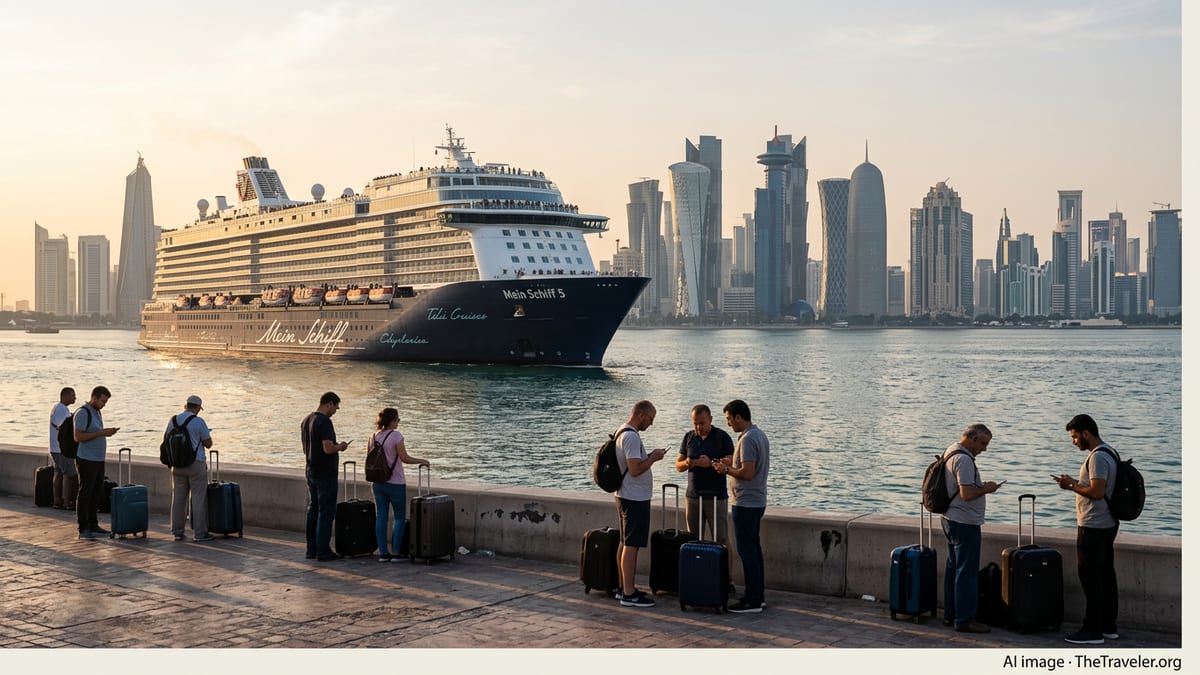
Cruise Finale in Doha Becomes a Dead End
The TUI Cruises vessel Mein Schiff 5 arrived in Doha this week expecting a routine turnaround at the end of a relaxing itinerary through the Gulf. Instead, guests disembarking into the Qatari capital quickly discovered that the skies above them were effectively closed. With flights suspended and onward connections cancelled, what was supposed to be the final, easy leg of a winter voyage has abruptly become a travel nightmare.
Images from Doha show the 295-meter ship sitting idle off the city’s glittering waterfront, a symbol of a much wider disruption now rippling through the region. Local media report that major carriers have halted most operations to and from Qatar as authorities respond to an escalating conflict that has prompted precautionary airspace restrictions in multiple Gulf states.
Doha’s normally efficient Hamad International Airport, a key hub linking Europe, Asia and Africa, has seen passenger traffic grind to a halt. Cruise guests who had planned tight same-day departures are now scrambling for information, temporary accommodation and alternative routes home, often with little clarity on when normal services might resume.
For many on board Mein Schiff 5, the emotional whiplash has been intense. Hours after celebrating the end of a successful voyage, they now face an open-ended wait in an unfamiliar city, tracking airline apps and social media for any sign that flights out of Doha will restart.
Airspace Closures Across the Gulf Ripple Through Travel Networks
The sudden stranding of cruise passengers in Doha is one of the most visible consequences of a broader aviation shutdown impacting much of the Gulf. Since late February, airspace restrictions linked to a fast-moving Middle East conflict have forced airlines to cancel or reroute thousands of flights, upending journeys for travelers across multiple continents.
Qatar’s airspace remains closed to regular commercial traffic, forcing flag carrier Qatar Airways to suspend departures from its Doha hub and explore limited relief operations from airports in neighboring countries. Other regional gateways, including in the United Arab Emirates and Kuwait, have also seen severe disruption as authorities tighten safety measures and airlines adjust routings to avoid sensitive air corridors.
Industry data indicate that tens of thousands of flights have been affected since the crisis began, with the Gulf’s role as a major transfer bridge between East and West magnifying the impact. Long-haul services that would typically pass through Doha, Dubai or Abu Dhabi have been diverted over alternative corridors or cancelled outright, stranding transit passengers far from their final destinations.
For Mein Schiff 5 guests, that systemic shock has translated into very personal consequences. Many had booked their cruise as part of carefully choreographed flight-and-sea packages, counting on the reliability of Gulf hubs that, until now, have built a reputation on seamless international connectivity.
Confused Cruise Guests Navigate Patchy Communication
On the ground in Doha, stranded travelers describe a patchwork of information as cruise operators and airlines grapple with a fluid security situation. While TUI Cruises has emphasized that passenger safety remains the overriding priority, guests say the lack of clear timelines for flight resumptions has made planning nearly impossible.
With airport operations curtailed, some cruise passengers remain on board Mein Schiff 5 under an extended stay arrangement, while others have been transferred to city hotels to await news of outbound options. For those with urgent commitments back home, including work, school or medical appointments, the uncertainty is particularly stressful.
Travel advisors note that cruise lines typically coordinate closely with airline partners during major disruptions, working to secure group allocations on any available services. In this case, however, simultaneous closures and capacity constraints across multiple Gulf hubs mean that even well-resourced operators face limited room to maneuver.
Social media forums frequented by affected passengers paint a picture of frayed nerves but also emerging solidarity, as travelers share tips on contacting airlines, tracking potential relief flights and managing extended stays in Doha. Many, however, remain frustrated by long call center waits and rapidly shifting guidance.
Limited Relief Flights Offer Only Partial Hope
Regional carriers have begun sketching out modest lifelines for the most severely affected travelers, but these efforts currently fall far short of the sheer number of people trying to leave the Gulf. Qatar Airways has announced plans for limited relief flights operating from alternative gateways such as Muscat and Riyadh, with seats prioritized for customers whose original itineraries were cancelled during the airspace closure.
The move offers a glimmer of hope for stranded tourists, including Mein Schiff 5 guests, yet logistical hurdles remain significant. Travelers first need to be transported overland from Doha to these secondary airports, a journey of many hours across international borders that itself depends on evolving security assessments and regulatory approvals.
Other Gulf-based airlines have cautiously resumed a handful of services from their own hubs, but with constrained schedules and strict capacity management. Long-haul travelers attempting to rebook around the affected region are finding that seats on alternative routings via Europe, North Africa or South Asia are being snapped up quickly, often at steep last-minute prices.
Analysts warn that even once the current emergency phase passes and airspace begins to reopen, it could take days for airlines to clear backlogs, reallocate aircraft and reposition crews. Cruise lines, which plan itineraries many months in advance, will also face hard decisions about whether to alter or cancel upcoming Gulf sailings until the security picture stabilizes.
Questions Raised Over Risk Management in Emerging Cruise Markets
The sudden stranding of Mein Schiff 5 in Doha is likely to prompt fresh scrutiny of how cruise operators assess and communicate geopolitical risk in newer, fast-growing regions like the Gulf. In recent years, winter itineraries out of ports such as Doha and Abu Dhabi have been marketed heavily to European travelers as a sunny, hassle-free alternative to traditional Caribbean or Mediterranean routes.
Industry experts say the current crisis underlines the vulnerability of such itineraries to rapid shifts in regional security dynamics, particularly when they depend heavily on a small number of air hubs for passenger turnarounds. While war and airspace closures remain statistically rare compared with everyday travel disruptions, the sheer scale of the current shutdown highlights the need for robust contingency planning.
Travel advocates argue that passengers booking complex air-and-sea packages should be given clearer information about what happens if critical transit hubs are suddenly taken offline. That includes transparency around refund policies, rebooking rights and emergency evacuation plans, as well as practical guidance on travel insurance coverage for conflict-related disruption.
For now, the focus in Doha remains firmly on getting stranded travelers home safely. As passengers from Mein Schiff 5 wait out the uncertainty in hotel lobbies, cruise cabins and airport lounges, the glittering promise of a Gulf escape has given way to an anxious vigil, one that will shape how many view cruising in the region long after the skies eventually reopen.