

More news on this day
A narrowly controlled safe air corridor over Doha is reshaping air traffic across the Gulf, with Qatar Airways and IndiGo adjusting schedules, routings and passenger options as regional conflict keeps Qatar’s wider airspace effectively constrained.
Get the latest news straight to your inbox!
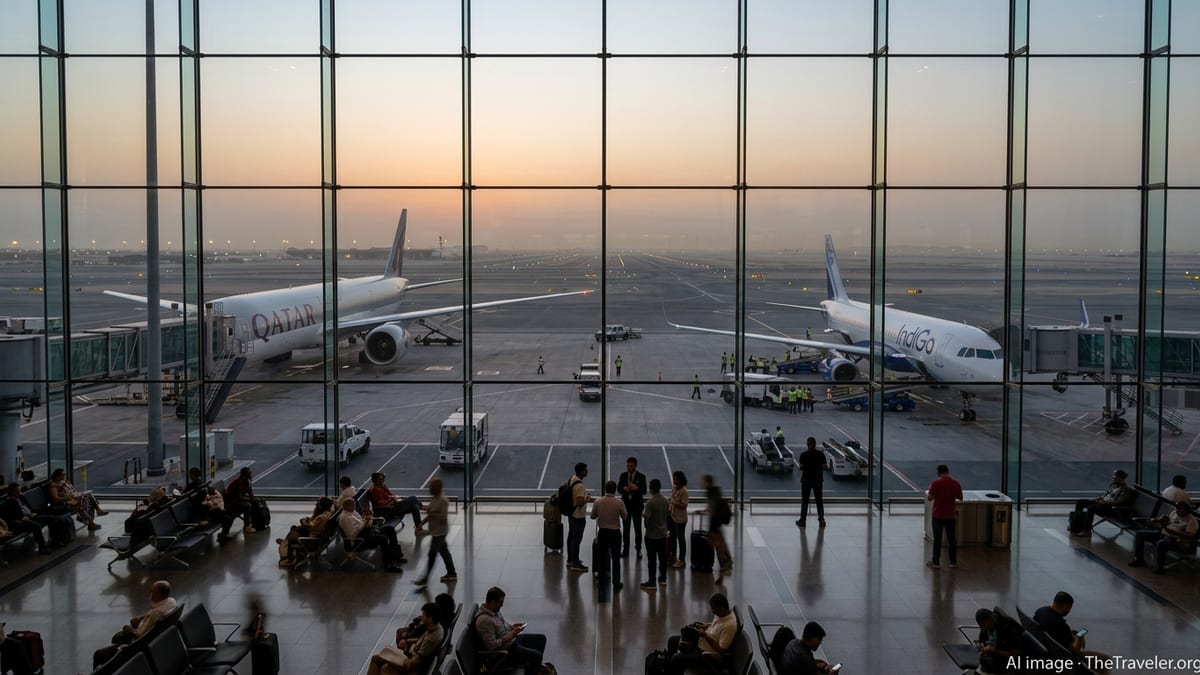
Safe Corridor Keeps Doha Connected, But Only Just
Publicly available notices from Qatar’s aviation regulators and airline travel alerts indicate that Qatari airspace, fully closed on 28 February after strikes linked to the Iran war, has only partially reopened through tightly managed contingency routes. These routes, described as a safe corridor, allow a limited number of arrivals and departures at Hamad International Airport while avoiding higher-risk areas of the Doha Flight Information Region.
Travel advisories circulated in early March describe the safe corridor as designed primarily for repatriation, essential passenger movements and cargo, rather than a full commercial restart. Operations are framed around reduced capacity and shorter notice scheduling, with airlines urged to treat every flight as contingent on evolving security assessments. The result is a skeletal but symbolically important airborne link keeping Doha on the global route map.
The emergency configuration reflects the broader security picture in the Gulf, where hostilities involving Iran, the United States and regional states have intensified pressure on both airspace and maritime chokepoints, including the Strait of Hormuz. Aviation analysts note that while navigation through a defined corridor can reduce exposure to certain threats, it also funnels traffic into narrow tracks that are more vulnerable to disruption if the conflict escalates again.
Passengers transiting Doha report longer ground times, limited onward connections and short-notice schedule changes, all symptomatic of an airport hub trying to function with only a fraction of its usual airspace flexibility. Industry observers suggest that this constrained mode of operation could persist for weeks if diplomacy fails to deliver a broader de-escalation.
Qatar Airways Balances Repatriation Needs and Network Viability
According to airline-focused travel updates, Qatar Airways has oriented its short-term strategy around selective use of the safe corridor for repatriation-style flights to major long-haul markets. Initial departures in early March were concentrated on key European hubs such as London, Paris, Madrid, Rome and Frankfurt, illustrating a priority on high-demand trunk routes that can move stranded passengers and critical cargo in both directions.
Published coverage of the carrier’s customer policies shows that tickets for travel in the immediate aftermath of the airspace closure, particularly from late February through mid March, have been granted expanded flexibility. Options typically include free date changes or refunds within a defined window, reflecting an effort to preserve customer goodwill while acknowledging that many flights cannot yet operate on their original timings or routings.
Network-wide, the airline continues to advertise Doha as its core hub, but schedules into and out of Qatar remain significantly thinned compared with normal operations. Capacity has been pivoted where possible to points outside the affected airspace, with some passengers rerouted over alternative hubs in the region or Europe. Industry analysts point out that each additional diversion or technical stop compounds costs through extra fuel burn, crew hours and airport charges.
Qatar Airways’ approach appears to prioritise a gradual, corridor-led ramp-up rather than a rapid restoration of its pre-crisis network. Aviation consultants note that such a strategy may help the airline avoid abrupt reversals if the security situation deteriorates again, but it also means that connecting traffic, long a pillar of Doha’s role as a global transit hub, will take longer to recover.
IndiGo Feels the Strain on a Critical Gulf Corridor
For IndiGo, India’s largest carrier by market share, the safe corridor squeeze around Doha intersects with a broader pattern of disruption across West Asia. Previous episodes of Iranian airspace restrictions and missile activity in the region prompted the airline to reroute certain services and, at times, suspend flights into key Gulf destinations. Business media reports in recent weeks highlight that the latest wave of tensions is again weighing heavily on Indian carriers’ revenues and schedules.
IndiGo’s network includes hundreds of weekly flights to Gulf cities, with Doha serving both labour traffic and leisure flows between India and Qatar. When Qatari airspace closed, IndiGo was among several Indian airlines to temporarily halt or sharply curtail operations to Doha and neighbouring markets. Subsequent partial reopenings have not yet restored the predictability that carriers rely on for high-utilisation short-haul operations.
Public statements from the airline during earlier phases of the crisis emphasised the use of alternative routings and technical stops when Iranian and adjacent airspace became unusable. These measures added block time and fuel costs, reducing aircraft productivity and tightening crew rostering margins. With Doha now accessible only through a restricted corridor, similar trade-offs are reappearing, and scheduling buffers are being stretched once more.
Industry estimates suggest that prolonged disruption across West Asian corridors could amount to hundreds of crores of rupees in lost or deferred revenue for Indian airlines, with IndiGo particularly exposed because of its scale in the region. Frequent flyers between India and Qatar are already facing higher fares on remaining services, longer journey times and an increased risk of last-minute changes.
Geopolitical Tensions Turn the Gulf into an Aviation Bottleneck
The safe corridor around Doha is only one manifestation of a wider regional crisis that has squeezed both air and sea routes. The 2026 Strait of Hormuz crisis has sharply curtailed tanker traffic through one of the world’s most important energy chokepoints, and has fed through into higher insurance premiums and freight rates. For aviation, overlapping restrictions and risk advisories over parts of Iran, Iraq and adjacent waters have forced airlines to concentrate traffic into narrower, ostensibly safer pathways.
Logistics and risk-analysis publications describe how this concentration effect can paradoxically heighten systemic vulnerability. When most carriers are pushed onto a limited set of tracks or corridors, any new incident or miscalculation has the potential to strand a large volume of passengers and cargo simultaneously. The airspace around Qatar, once a busy crossroads, is now emblematic of this problem: theoretically open in a controlled sense, but practically fragile.
Gulf Cooperation Council states have responded with a mixture of military posturing and diplomatic outreach aimed at preserving freedom of navigation while avoiding a direct clash with Iran. In the aviation domain, this has translated into enhanced coordination between civil aviation authorities, temporary route clearances and more conservative risk modelling for flight paths near contested zones.
For airlines like Qatar Airways and IndiGo, the geopolitical overlay has converted what is normally a straightforward regional corridor into a dynamic risk environment. Each new advisory or reported strike can trigger overnight schedule rewrites, adding to operational costs and uncertainty. Travel demand has by no means disappeared, but its fulfilment has become contingent on daily security calculations far beyond the control of carriers.
Travellers Face Uncertainty as Airlines Prioritise Flexibility
For passengers, the safe corridor crisis is most visible in disrupted itineraries. Many travellers with tickets routed through Doha have been rebooked on later flights, diverted via alternative hubs or offered refunds instead of travel. Airlines are advising customers to monitor their bookings closely and to allow additional time at airports, as security procedures and congestion around limited corridor slots create further delays.
Travel industry commentary indicates that flexible booking policies have become a critical tool for managing expectations. Both Qatar Airways and IndiGo, alongside other regional carriers, are publicising options for free date changes, credit vouchers or partial refunds, especially for journeys scheduled during the peak of airspace closures. While these measures soften the immediate impact, they also signal that timetable reliability cannot yet be guaranteed.
Some corporate travel managers are temporarily routing staff away from Doha and other high-risk waypoints, even when the safe corridor technically permits flights. This risk-averse approach reflects concerns about sudden closures, as seen on 28 February, and about the logistical complexity of extracting travellers if the situation worsens. Leisure travellers are likewise reassessing plans that rely heavily on tight connections through the Gulf.
Industry observers suggest that the current pattern of safe-corridor operations, partial resumptions and rolling advisories may become a feature of Gulf aviation for some time. For Qatar Airways, IndiGo and their passengers, Doha’s constrained gateway illustrates how quickly a global hub can turn into a bottleneck when geopolitical tensions encircle its skies.