


Choosing between Drimsim and Airalo is less about which eSIM provider is “better” and more about which one fits the way you actually travel. A month backpacking across Southeast Asia, a five-day city break in Paris, and a year of digital nomad life in Mexico all place very different demands on your mobile data. This guide breaks down how Drimsim and Airalo work in the real world in 2026, with concrete examples, current pricing snapshots and use cases so you can match the provider to your travel style instead of gambling at the airport.
Get the latest updates straight to your inbox!
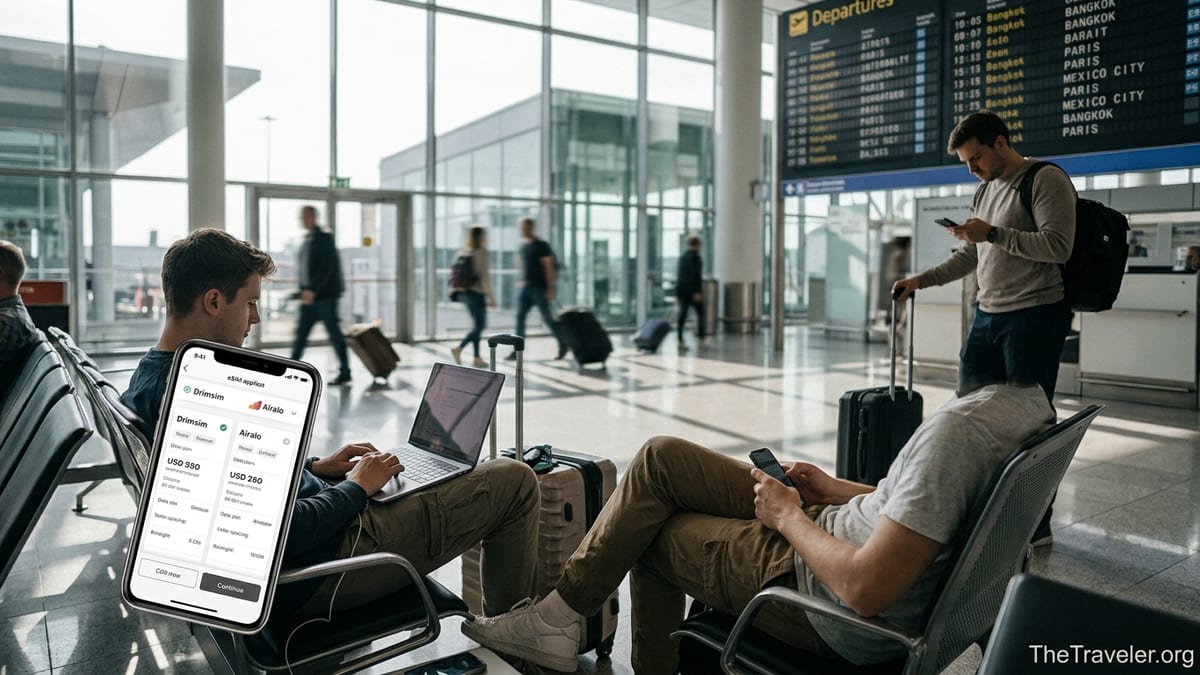
How Drimsim and Airalo Work in Practice
Drimsim and Airalo both let you sidestep traditional roaming, but their models are different. Airalo is essentially a giant eSIM marketplace. You open the app, choose a local, regional or global plan for your destination, pay in advance for a bundle of data, and install the eSIM by scanning a QR code. Most plans are data only, and you use apps like WhatsApp, FaceTime or Skype for calls. Coverage now extends to more than 200 countries and regions, and in many major destinations you can choose between multiple plans from different underlying carriers.
Drimsim historically started as a physical SIM you could top up and use almost anywhere, charging you per megabyte rather than selling fixed bundles. Today it also offers eSIM, but the philosophy is the same: one number, one account, and pay-as-you-go data that works across roughly 197 countries without having to swap plans every time you cross a border. You top up a balance, then Drimsim deducts what you consume at the local per‑MB rate in each country.
In practical terms, that means Airalo feels more like buying a transport pass: you pick, for example, a 5 GB, 30‑day Thailand eSIM for a fixed price and know that as long as you stay within that allowance, you will not pay more. With Drimsim, you keep an eye on your credit balance instead. Your spending grows in proportion to the number of megabytes you actually use, which can be very efficient for light data users but can add up quickly if you stream video or tether a laptop.
Both providers are app driven. With Airalo, you do almost everything inside the app: browsing plans, purchasing, installing, and topping up. With Drimsim, you manage your balance and see real‑time usage, but the core idea is that you do not need to think about which country you are in. That difference in philosophy sits at the heart of which service will suit you better.
Pricing Snapshots: What You Actually Pay in 2026
Prices move frequently, but sample 2026 rates highlight how different the two models feel when you are on the road. Airalo’s country plans often start at a few dollars for short trips. A typical example is a 5 GB, 30‑day Thailand eSIM at around 8 US dollars, which many backpackers now treat as a standard pre‑departure purchase. For broader coverage, Airalo’s Discover Global plan starts at roughly 8.50 US dollars for 1 GB valid 7 days and goes up to about 89 US dollars for 20 GB plus a small bundle of calls and texts valid for a full year. Global plans currently support about 169 countries inside Airalo’s wider 200‑plus destination footprint.
Regionally, you see similar patterns. Travelers heading to Europe for two weeks can buy multi‑country eSIMs that cover most of the European Union plus countries like Switzerland and the United Kingdom on a single profile, with tiered data options. While prices vary by country and promotion, the per‑GB cost on these regional and global bundles is usually higher than the absolute cheapest local SIMs, but below what many US carriers still charge for international roaming, especially for heavier users who need several gigabytes.
Drimsim publishes a per‑country rate table, charging by the megabyte instead of bundles. In many European countries, the cost per MB is modest enough that checking maps, ride‑hailing and messages stays affordable for casual use. However, real‑world reviews from 2025 and 2026 underline the risk for heavier users. One customer describes paying around 25 US dollars just for the eSIM and another 25 dollars in top‑ups, only to burn through that balance in half a day of what they considered “normal” smartphone use. The lesson is clear: Drimsim’s model rewards strict data discipline but can punish background app activity or streaming.
It is also important to note that data‑bundle pricing across the eSIM industry has inched up in some destinations. In late 2025, frequent users of Airalo were already noticing that some long validity plans, especially in Europe, had become noticeably more expensive than a year before. For a budget‑sensitive traveler, that makes it even more important to compare not just headline prices but how much data you realistically need per day, and how much risk you are willing to take on surprise charges if you underestimate your usage.
Coverage, Speed and Reliability on Real Trips
On coverage, Airalo has a slight edge on paper, with access to over 200 countries and regions. Independent testers in 2026 consistently highlight Airalo’s breadth: from popular destinations like Japan, Italy and Mexico to less‑visited countries in Africa and Central Asia, there is usually at least one plan available. However, the global plan does not always include every country that Airalo covers with local eSIMs, so a traveler bound for more remote islands or niche destinations may still need to pair a global plan with occasional local top‑ups.
Drimsim lists close to 200 countries across Europe, Asia, Africa, the Americas and Oceania, including smaller markets like the Faroe Islands or Andorra that can trip up other providers. Because it roams on partner networks, speeds and latency mirror those of local carriers in each country. Reviews from long‑term users who tested Drimsim across more than 20 countries mention that, when it works, it behaves like any other roaming SIM: it connects quickly and is fine for maps, emails and browsing, though it is seldom the fastest option for large downloads or video streaming.
Reliability is where user experience diverges sharply from person to person, especially with Airalo. On one end of the spectrum, technology reviewers and many frequent travelers report that Airalo “just works” across multiple continents, delivering stable data connections sufficient for work calls, social media and navigation. On the other end, some travelers post highly critical accounts of eSIMs failing to activate, data plans not provisioning correctly, or support being slow when things go wrong. In a typical story, a traveler buys a 1 GB global eSIM for about 9 dollars upon landing, waits for activation that never happens, and then ends up buying a cheap local SIM card at an airport kiosk instead.
Drimsim’s reliability complaints tend to be less about outright failure to connect and more about billing shock or confusion over how quickly credit drains under modern app usage. Because background app updates, auto‑playing videos on social media and tethering are all charged per megabyte at roaming rates, it is very easy for a traveler who is not watching their usage to spend more in a single day than they would on an entire fixed‑data eSIM plan. For travelers used to unlimited data at home, that mental shift can be jarring.
Ease of Use Before and During Your Trip
For most casual travelers, ease of use is as important as price. Airalo has invested heavily in polishing its app, and it shows. Setting up a plan typically involves three steps: select your destination and data package, pay with a card or digital wallet, and install the eSIM using the QR code or in‑app instructions. For many devices, especially recent iPhones and Android flagships, the eSIM installs directly with a tap, without even needing to print or screenshot the QR code. Travel tech reviewers who tested Airalo in a dozen or more countries report setup times of under five minutes in most cases.
That said, the simplicity is not universal. A recurring pattern in user complaints is confusion over device compatibility, dual‑SIM settings, or the need to disable the primary SIM’s data while leaving it active for calls and texts. In markets where the Airalo app is restricted, such as parts of India or Turkey, travelers occasionally have to purchase or manage their eSIM via the website before departure instead of using the app on local networks. That adds a layer of preparation many casual travelers will not anticipate unless they read the fine print.
Drimsim’s process is conceptually straightforward but operationally different. You obtain the SIM or eSIM once, top up a balance, and then simply let it roam in each new country. There is no need to buy a new package for Spain after leaving France, or for Vietnam after Thailand; the same profile keeps working. This greatly appeals to people who find the idea of planning and switching eSIMs for each leg of a long itinerary stressful. However, it places more responsibility on the user to monitor usage. The Drimsim app helps by showing balances and local rates, but it does not prevent your phone’s operating system from consuming data in the background if you have not locked down automatic updates or cloud backups.
In both cases, the biggest technical hurdle remains the same: knowing your phone’s eSIM capabilities and settings before you fly. Travelers with older devices that support only one eSIM at a time need to think through whether they are comfortable turning off their domestic line for the duration of the trip or if they want voice and SMS on their home number alongside data on the travel eSIM. Those considerations apply equally to Drimsim and Airalo, though Airalo’s per‑country plans require a bit more management if you are hopping across borders frequently.
Which Provider Fits Different Types of Travelers?
To decide between Drimsim and Airalo, it helps to think in terms of real travel scenarios rather than abstract pros and cons. Consider a two‑week holiday in Italy and France for a couple from the United States. They mainly need maps, restaurant searches, a bit of social media and occasional video calls with family back home. In this case, a regional Airalo plan for Europe with a moderate data bundle, perhaps 5 to 10 GB across 15 days, gives them predictable costs and one installation that covers both countries. Drimsim would work too, but unless they micro‑manage background data, they risk spending more than the cost of a simple bundle.
Now imagine a digital nomad spending a year ping‑ponging between Lisbon, Tbilisi, Bali and Chiang Mai. They do not know in advance exactly how long they will stay in each location and will likely leave and re‑enter the Schengen Area or particular regions several times. For them, Drimsim’s pay‑as‑you‑go model can be attractive if they mainly work from coworking spaces or apartments with Wi‑Fi and only need mobile data for navigation and occasional tethering. Instead of buying a new eSIM every time they cross a border, they keep one Drimsim active and top up a modest amount that stretches across multiple countries.
Frequent short‑haul travelers, like consultants who do three‑day trips around Europe every month, may find Airalo’s global or regional bundles more efficient. Buying a 365‑day global plan with a comfortable allowance of data, calls and texts provides a single, predictable communication backbone they can rely on for a full year of trips without worrying about individual country rates. Similarly, fans traveling to the 2026 football World Cup in North America, who might land in Mexico City, then fly to Los Angeles and Toronto, could either grab a North America regional eSIM from Airalo or lean on Drimsim’s unified coverage. The choice will come down to whether they prefer flat upfront pricing or flexible, metered usage.
Finally, there are ultra‑budget backpackers and students. Many in this group already make a point of hunting for local prepaid SIMs from brands like AIS in Thailand, Orange in France or Telcel in Mexico, which often undercut both Drimsim and Airalo on price for heavy data use. For them, Airalo or Drimsim might be a backup option for the first 24 hours after landing or for countries where buying a local SIM is complicated. In that role, Drimsim is handy for occasional data across multiple borders, while Airalo’s smallest bundles let them get online to book a hostel or check directions before they have time to visit a local shop.
Support, Transparency and Risk Management
Customer support is a key differentiator that does not show up in a simple price table. Airalo has round‑the‑clock support and generally earns above‑average marks from large numbers of users, reflected in high ratings on major app stores. When things fail, however, travelers sometimes report slow back‑and‑forth conversations, difficulty escalating issues, or being caught between Airalo and the underlying local carrier when diagnosing technical problems. That can be particularly stressful if your only connection in a new country depends on the eSIM working.
Drimsim does not currently market full 24/7 live support in the same way, and feedback suggests response times can vary depending on the channel and time of day. On the upside, its billing model is relatively transparent: you can see exactly how much each MB costs in your current country and how much you have spent. On the downside, there is no hard ceiling the way there is with a prepaid bundle. Unless you manually disable data or set operating system‑level limits, your phone can keep consuming credit in the background while you sleep or commute.
From a risk management perspective, Airalo feels safer for travelers who want cost certainty. Once you buy a 10 GB package, you cannot accidentally spend more; the worst‑case scenario is simply running out of data and needing to buy another bundle. Drimsim appeals more to those who prioritize flexibility and do not mind manually policing their own usage. If you are someone who already turns off background data for most apps, downloads offline maps ahead of time, and rarely streams away from Wi‑Fi, Drimsim’s pay‑as‑you‑go structure can be very economical.
For cautious travelers, a hybrid approach can work well. Some use Airalo or a similar provider for their main data bundle, then keep a Drimsim with a small top‑up as an emergency backup in case the primary eSIM fails or coverage is weak in a particular rural area. This is overkill for most vacations but can make sense for journalists, remote workers with mission‑critical calls, or overland travelers moving through regions where networks are patchy.
The Takeaway
For most short‑term leisure trips, Airalo will fit more travelers more often. Its destination‑specific and regional bundles deliver predictable pricing, wide coverage and a generally smooth app experience. If you are heading to Japan for two weeks, or taking a multi‑city tour through Western Europe, choosing a 5 to 10 GB Airalo plan tailored to your route gives you enough data for maps, social media and light streaming without worrying about meter‑style billing.
Drimsim, by contrast, shines when flexibility is more important than raw price per gigabyte, or when your travel plan spans dozens of borders over many months. Digital nomads, overlanders and travelers who strongly prefer a single, persistent number and profile across nearly 200 countries may find Drimsim’s one‑SIM‑everywhere model worth the discipline it demands. It is also a reasonable backup solution if you already rely on local SIMs or other eSIM providers but want a universal fallback.
Whichever provider you choose, the most important step is to align the product with your own habits. Estimate how many gigabytes you really use away from Wi‑Fi, check that your phone supports eSIM and dual SIM in the way you expect, and decide how comfortable you are with either topping up a meter or prepaying for fixed bundles. Once you have answered those questions honestly, the choice between Drimsim and Airalo usually becomes obvious.
FAQ
Q1. Is Drimsim or Airalo cheaper for a one-week city break? For a typical one-week city break where you use several gigabytes of data, Airalo’s fixed bundles are usually cheaper and more predictable than Drimsim’s per‑MB billing. With Drimsim you pay only for what you use, but casual streaming or heavy social media can burn through credit faster than expected.
Q2. Which provider is better if I am visiting multiple countries on one trip? If your trip spans a handful of countries in the same region, such as several European Union members, an Airalo regional eSIM is often the easiest choice. If you are traveling through many regions over several months, Drimsim’s single SIM that roams across almost 200 countries can be more convenient, provided you keep a close eye on your data usage.
Q3. Do either Drimsim or Airalo offer truly unlimited data? Neither Drimsim nor Airalo offers unlimited global data. Airalo sells some destination‑specific “unlimited” plans, but they usually have fair‑use caps or speed throttling after a certain amount of high‑speed data. Drimsim charges per megabyte in every country, so there is no unlimited option; your total cost depends entirely on how much data you consume.
Q4. Can I use Drimsim or Airalo for work video calls? Yes, both can support video calls through apps like Zoom, Teams or Meet, but your experience will depend on local network quality and how much high‑speed data you have. With Airalo, you can buy a larger bundle if video calls are essential. With Drimsim, frequent video conferencing can become expensive because you pay for every megabyte the call consumes.
Q5. What happens if my Airalo eSIM does not activate when I land? If an Airalo eSIM fails to activate, the recommended steps are to restart your phone, double‑check that mobile data is enabled for the eSIM line, and verify that your home SIM’s data is turned off if required. If it still does not work, you need to contact Airalo support from Wi‑Fi, such as at your accommodation or an airport lounge. Some travelers keep a backup plan, like a local SIM or a second eSIM provider, in case of activation issues.
Q6. How can I avoid bill shock with Drimsim’s pay-as-you-go model? To avoid surprises with Drimsim, disable automatic app updates, cloud backups and video autoplay on mobile data before your trip. Use offline maps where possible, keep streaming to a minimum away from Wi‑Fi, and monitor your balance frequently in the Drimsim app. Treat your top‑up like cash in your pocket and assume that anything data‑heavy will deplete it quickly.
Q7. Is it worth getting both Drimsim and Airalo? For many travelers, one provider is enough. However, if you are a frequent traveler or rely heavily on mobile data for work, carrying both can add redundancy. You might use an Airalo regional bundle as your primary connection and keep a small balance on Drimsim as a backup that works across borders if your main eSIM fails or coverage is spotty.
Q8. Which service is better for digital nomads? Digital nomads who stay months at a time in destinations with affordable local SIMs may use Drimsim or Airalo mainly between long‑term stays or as an emergency backup. For constant movement across borders, Drimsim’s single roaming profile is attractive, but many nomads still prefer Airalo’s regional or global bundles because they cap costs and can be easier to budget for alongside other monthly expenses.
Q9. Are Drimsim and Airalo more expensive than local SIM cards? In many countries, especially in Asia and parts of Europe, walk‑in prepaid SIM cards from local operators are still cheaper per GB than either Drimsim or Airalo, particularly for heavy data users. What you are paying for with eSIM providers is convenience, the ability to set everything up before you land, and not having to navigate local shops or language barriers to stay connected.
Q10. How do I know if my phone is compatible with these eSIMs? Most recent iPhones and higher‑end Android phones support eSIM, but not all models do. Before buying from Drimsim or Airalo, check your phone settings for an eSIM or digital SIM option and confirm support on the manufacturer’s website. If your device is not eSIM compatible, you may still be able to use Drimsim’s physical SIM option, while Airalo requires an eSIM‑capable device.