

Arizona was made for road trips. From cactus-lined interstates to high-country pine forests, the state rewards anyone willing to get behind the wheel and explore. But driving here also means navigating intense summer heat, sudden dust storms, long distances between services and some rapidly changing highway corridors. If you are planning a road trip in Arizona, a little advance knowledge about local rules, conditions and habits can make the difference between a smooth adventure and a stressful drive.
Understanding Arizona’s Roads and Driving Culture
Arizona’s road network is built around a few major interstates and long state highways that knit together its desert cities, mountain towns and national parks. Interstate 10 connects Phoenix and Tucson and continues west toward California and east toward New Mexico. Interstate 17 climbs from the low desert up to the cooler elevations of Prescott Valley, Sedona and Flagstaff, while Interstate 40 runs east west across the high plateau. These corridors are generally well maintained, with active construction and improvement projects under way in busy areas, especially around Phoenix and along I 17.
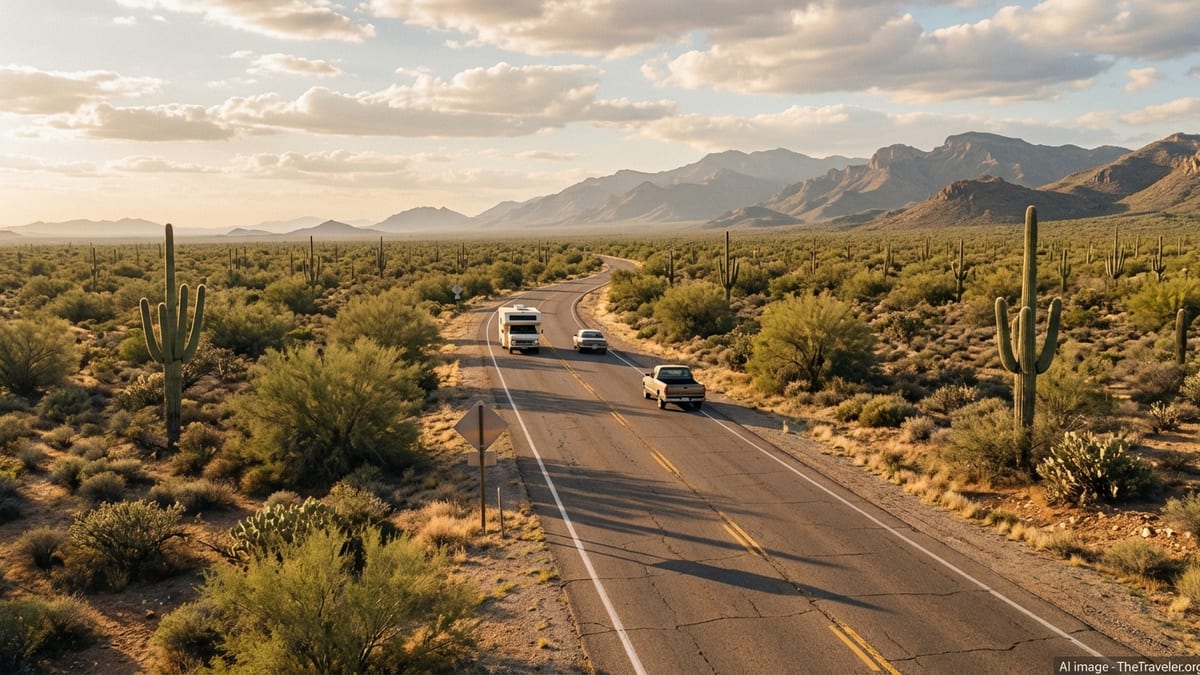
Outside cities, roads can feel surprisingly remote. It is common to drive 50 or more miles between fuel stops in parts of northern and western Arizona. Cell service can be spotty in canyons, on tribal lands and along more rural stretches of highway. Drivers should not assume services every few exits the way they might in more densely populated states. Topping off your tank and carrying extra water is not paranoia here, it is basic planning.
Driving culture in Arizona blends local commuters with visitors and long haul traffic. In metro Phoenix and Tucson, you will encounter multi lane freeways, frequent lane changes and drivers who are accustomed to heavy traffic and high speeds. In rural areas, most people drive at or just above the speed limit but slow moving RVs and trucks are common, especially on grades. Patience is important: tailgating or aggressive passing on two lane highways is both dangerous and heavily policed.
Signage is generally clear, although exit numbers and mileposts arrive quickly at freeway speeds. Many destinations are signed only at the last moment, particularly smaller trailheads and scenic byways. If you are relying on navigation, preview your route before driving and avoid last second lane changes. Periodic dynamic signs from the Arizona Department of Transportation highlight travel times, crashes ahead, dust storm warnings and closures, which are particularly important during summer monsoon season.
Key Traffic Laws and Rules Every Visitor Should Know
Arizona follows standard United States driving rules, but there are state specific laws that road trippers should understand. Seat belt use is mandatory for front seat occupants and for children and teens aged 8 to 15 in any seating position. Adults in the rear seats are not required statewide to buckle up, although safety officials strongly recommend it. Children younger than 8 and shorter than 4 feet 9 inches must ride in a properly installed car seat or booster seat, so families should plan ahead before renting a car or setting off on a long drive.
Speed limits vary widely depending on terrain and proximity to population centers. Urban freeways around Phoenix and Tucson often post limits in the 55 to 65 mile per hour range, while rural interstates may be signed at higher speeds on suitable stretches. Two lane highways are typically lower, especially near towns, schools and wildlife crossings. Enforcement can be strict where speed related crashes are common, including downhill grades and busy suburban corridors. It is wise to treat posted limits as real limits, not suggestions.
Arizona has a statewide ban on texting while driving and generally prohibits the use of handheld mobile devices while operating a vehicle. Drivers may use hands free systems, but tapping away on a phone in your hand can earn you a citation. Impaired driving laws are also robust. The state enforces driving under the influence rules with low tolerance, and penalties can be severe, including for visitors. If your itinerary includes nightlife in Scottsdale or a craft beer tour in Flagstaff, designate a sober driver or use a ride service rather than risking a DUI stop.
Right turns on red are broadly allowed after a complete stop, unless a sign specifically forbids them. Left turns on red from a one way street onto another one way street are allowed in some situations, again after stopping and when no sign prohibits it, but many visitors prefer to wait for a green signal to avoid confusion. At four way stops, the usual first come, first served rule applies, and if two vehicles arrive at the same time, the one on the right proceeds first.
Weather, Seasons and How They Affect Driving
Arizona weather can turn a pleasant drive into a serious hazard if you are unprepared. In the low desert, summer daytime temperatures frequently climb well above 100 degrees Fahrenheit. Cars parked in the sun heat up quickly, which can be dangerous for children, pets and electronics. High heat also stresses cooling systems, batteries and tires. Before a summer road trip, ensure your vehicle is in good condition, your coolant levels are correct and your tires are properly inflated and not overly worn.
From mid June through late September, Arizona’s monsoon season brings powerful thunderstorms, heavy rain, lightning and dramatic dust storms known as haboobs. These walls of dust can sweep across the Phoenix metro area and nearby highways, dropping visibility from miles to a few feet in minutes. Transportation and weather agencies promote the simple message for drivers who see dust ahead: do not drive into the storm. If you are already in it and cannot exit the road in time, you are advised to pull completely off the paved roadway, turn off your lights, set the parking brake and wait for the dust to pass.
Heavy monsoon rain can create flash flooding on urban freeways and in low lying washes across the state. Some roads are equipped with depth markers at low points. Never attempt to drive through moving water across a roadway, even if it looks shallow. Flowing water can be far deeper and faster than it appears and can carry away vehicles. Arizona has long used a “turn around, do not drown” message to warn about this risk, and drivers can face rescue costs or citations if they ignore barricades and become stuck.
At higher elevations, including Flagstaff, the Mogollon Rim and the White Mountains, winter storms can bring snow, ice and extremely slick roads from roughly November through March. Interstate 40 and the upper reaches of Interstate 17 sometimes experience closures or chain restrictions due to crashes or heavy snowfall. If your road trip spans winter months, factor in slower travel times, the possibility of delayed departures and the need for warm clothing, even if you started the day in the sunny desert.
Desert Driving: Heat, Hydration and Long Distances
A desert road trip across Arizona looks simple on a map, but the combination of distance, heat and limited services can challenge unprepared drivers. Water is the most important resource. Carry far more than you think you need for all passengers, especially in summer. Dehydration can sneak up quickly in dry heat, particularly when you step out to hike at a viewpoint or wait outside during a minor breakdown.
Plan fuel stops proactively. In more populated corridors such as Phoenix to Tucson you will find regular service stations, but in western Arizona, along stretches of US 93, US 60 or remote state routes, gas may be 40 to 70 miles apart or more. Filling up when your tank is half full rather than nearly empty is a simple habit that can keep you out of trouble. Many rural stations keep shorter hours, so late night travelers should plan routes with that in mind.
Vehicle maintenance matters more than usual in the desert. Old wiper blades, marginal tires and weak batteries are more likely to fail under high heat and UV exposure. Rental cars are typically serviced regularly, but it is still worth doing a quick walk around before leaving the lot to check tire condition, lights and fluid leaks. If you are driving your own car from out of state, consider a preventative check of coolant, belts and hoses before entering Arizona’s hottest regions.
On desert highways, mirages and intense glare can make it hard to judge distances. Sunglasses with good polarization and clean windshields reduce eye strain and improve visibility. Avoid driving long distances in the hottest part of the day if possible. Early morning and late afternoon often offer more comfortable conditions, gentler light for sightseeing and better opportunities to spot wildlife near the road.
Mountain Grades, Wildlife and Rural Highways
Arizona’s dramatic elevation changes mean many routes involve sustained climbs and descents. Interstate 17 between Phoenix and Flagstaff is one of the most traveled examples. Here, the road gains several thousand feet of elevation, and even with recent widening projects and the addition of new lanes, traffic can slow and heavy trucks may crawl uphill. Give large vehicles plenty of room, use designated passing or climbing lanes when available and avoid riding your brakes continuously on long downhill stretches to prevent overheating.
Two lane highways in northern and eastern Arizona cross open range and forested areas where wildlife and livestock are common. Elk, deer and smaller animals are most active at dawn and dusk and can appear suddenly in or beside the roadway. New wildlife overpasses and fencing have been constructed along key corridors to reduce collisions, but drivers should still remain vigilant. If you see one animal near the road, assume others may follow and slow down accordingly.
Rural highways often have narrow or no shoulders, limited lighting and widely spaced intersections. Turnouts may be infrequent. Passing zones are usually marked, but visibility over hills or around curves can be deceptive. Patience and conservative decision making are crucial. Do not attempt to pass multiple vehicles at once, and be prepared to tuck back in if an oncoming vehicle appears.
Emergency services can be distant in rural areas. In the event of a breakdown, it is usually safest to pull as far off the road as possible, turn on hazard lights and remain with your vehicle unless there is an immediate danger. Having a basic kit that includes water, snacks, sun protection, a flashlight and a charged phone battery bank can make a delay or tow wait much more manageable.
Navigating Cities: Phoenix, Tucson and Beyond
Arizona’s two largest metro areas, Phoenix and Tucson, have freeway systems that can feel busy and fast paced, especially to visitors used to smaller cities. Phoenix, in particular, has an extensive network of loop freeways and interstates that encircle and cross the Valley. During weekday rush hours, expect heavy traffic, slower travel times and occasional crashes that back up lanes for miles. If your itinerary allows, schedule long distance drives outside of peak commuter windows.
Lane discipline is important on multi lane urban freeways. Keep right except to pass or to prepare for an exit, and avoid hovering in the leftmost lane at or below the speed of surrounding traffic. Use signals early when changing lanes, and allow extra time to move toward your exit, as cross traffic can fill gaps quickly. Many exits branch into multiple directions within a short distance, so read overhead signs in advance rather than trying to react at the last second.
In central city districts, you will find a mix of regular traffic lights, protected and unprotected turns, and in some areas, light rail crossings. Obey posted no turn on red signs, particularly in downtown Phoenix and near campuses. Pedestrians and cyclists are common around nightlife areas and university zones, especially in Tempe, downtown Tucson and central Phoenix. Slower speeds and extra attention at crosswalks are essential.
Parking regulations vary by city but are generally well signed. In downtown cores, expect a mix of street meters, garages and private lots. In older districts and near stadiums or event venues, temporary restrictions and higher event pricing may apply. Some neighborhoods near popular hiking trailheads now use timed reservations or limited lots to manage crowds. Always read posted signs, since towing and fines can be costly and disruptive to your trip.
Working With Law Enforcement and Roadside Assistance
Arizona state troopers, county deputies and local police patrol highways and city streets, focusing on speed, impaired driving, seat belt use and move over compliance near stopped emergency vehicles. If you are stopped, pull safely to the right, turn off your engine, keep your hands visible and wait for instructions. Having your license, registration and rental agreement accessible but not in hand until requested generally leads to a smoother interaction.
The state’s move over law requires drivers to change lanes or, if that is not possible, to slow down significantly when approaching stopped emergency or roadside assistance vehicles with flashing lights. This applies on freeways and many surface roads. Failure to move over or slow down can result in citations and, more importantly, places people working at the roadside in serious danger.
If you experience a breakdown, most interstates and major highways have some form of roadside assistance available, whether through your rental company, an auto club, or highway patrol coordinated services. When calling for help, be ready to give your direction of travel, the nearest milepost or exit number and a description of your surroundings. On segments with thin or no cell coverage, you may need to drive carefully to the next area with a signal if your vehicle is still operable.
Visitors driving rental cars should familiarize themselves with the company’s roadside support options before leaving the lot. Some plans include towing, lockout help and flat tire assistance at no additional cost, while others charge per incident. Understanding your coverage in advance can prevent unwelcome surprises in the middle of a long desert stretch.
The Takeaway
Driving in Arizona can be one of the most rewarding parts of your trip, connecting you to landscapes and small towns you would miss from the air. At the same time, the state’s combination of extreme weather, long distances and diverse terrain demands a bit more preparation and awareness than a typical weekend drive. Knowing the basics of local traffic laws, planning for heat and storms, and respecting the realities of rural highways will go a long way toward keeping you safe.
Build extra time into your itinerary for weather delays, construction zones and unplanned stops at viewpoints or roadside attractions. Keep your vehicle well maintained, your fuel and water supplies topped up and your attention firmly on the road. With these precautions in place, an Arizona road trip becomes less a logistical challenge and more an open invitation to roam, from saguaro lined valleys to high mountain forests.
Above all, approach the drive with flexibility and patience. Whether you are threading through Phoenix traffic at sunset or easing along a quiet two lane highway beneath a canopy of stars, driving in Arizona is as much a part of the experience as the destinations themselves. Treat the road with respect, and it will carry you to some of the most memorable places in the American Southwest.
FAQ
Q1. Do I need a four wheel drive vehicle for an Arizona road trip?
For most major highways, interstates and popular tourist routes, a regular passenger car is sufficient. Four wheel drive is helpful if you plan to explore unpaved forest roads, remote desert tracks or visit during winter in snowy areas, but it is not required for typical paved itineraries.
Q2. What should I know about dust storms when driving in Arizona?
If you see a dust wall ahead, avoid driving into it. If you are caught in a storm, pull completely off the paved roadway, turn off your lights, set the parking brake and wait until visibility improves before moving again.
Q3. Are there many toll roads in Arizona?
No, Arizona does not rely on toll roads for its major highway network. Most interstates and state routes are free to use, so you will not encounter the kind of toll systems common in some other states.
Q4. How strict is Arizona about speeding on highways?
Enforcement can be active, especially on stretches with a history of crashes or heavy traffic. While some drivers do exceed limits, visitors should expect tickets if they are significantly over the posted speed or driving too fast for conditions such as rain or dust.
Q5. What are the child car seat rules for visitors?
Children younger than 8 years old and shorter than 4 feet 9 inches must be secured in an appropriate car seat or booster seat. Families renting vehicles should bring suitable seats or arrange to rent them and follow manufacturer instructions for installation.
Q6. Is it safe to drive at night in rural Arizona?
Many people drive at night without issues, but rural roads can be dark, with limited shoulders and more active wildlife. If you are unfamiliar with the area, consider limiting nighttime driving on two lane highways and reduce speed if you must travel after dark.
Q7. How far apart are gas stations on Arizona highways?
In metro areas and along busy interstates, fuel is frequent. In remote regions, stations can be dozens of miles apart and may have limited hours. It is wise to refuel when your tank reaches about half full on long rural stretches.
Q8. Can I rely on mobile navigation everywhere in Arizona?
Navigation apps are useful on major routes and in cities, but coverage can drop in canyons, tribal lands and sparsely populated areas. Download offline maps, carry a general paper map and review directions before departing.
Q9. Are there special rules for driving in national parks in Arizona?
Within parks, speed limits are often lower, wildlife is more common near roads and parking can be limited at popular viewpoints. Obey posted signs, watch for pedestrians and animals and be prepared for occasional delays at entrance stations and busy trailheads.
Q10. What emergency supplies should I keep in the car for an Arizona road trip?
At minimum, carry plenty of drinking water, snacks, sun protection, a basic first aid kit, a flashlight, a phone charger or battery pack and simple tools for changing a tire. In winter or on remote routes, add warm layers and extra food to your kit.