

Driving in Saudi Arabia opens up some of the Middle East’s most dramatic landscapes, from glassy new expressways around Riyadh to lonely desert highways that seem to disappear into sand and heat haze. For visitors and new residents, though, driving here can feel unfamiliar at first. Understanding the rules of the road, typical driving habits, and the realities of desert conditions will make your journeys safer and far more enjoyable.
Understanding the Legal Basics of Driving in Saudi Arabia
Saudi Arabia has modern traffic laws that are increasingly enforced through cameras and electronic systems, and foreign drivers are expected to follow the same rules as residents. To drive legally you must carry a valid driving license, your passport or national ID, vehicle registration, and proof of insurance. Short-stay visitors from many countries can use an approved foreign or international driving permit, while longer-term residents are usually required to convert to a Saudi license once they receive residency status. Penalties for driving without a valid license or registration can be significant and may include fines, vehicle impoundment, or, for residents, demerit points on your record.
Saudi Arabia operates a strict points-based system for traffic violations. Each infraction adds points to your record; serious or repeated offenses can lead to temporary suspension or ultimately revocation of your license. Authorities rely heavily on automated “Saher” camera networks on highways and in cities to detect speeding and red-light violations, which are then logged and fined electronically. Fines can escalate quickly, especially where there is a pattern of repeat violations, so it is wise to err on the side of caution rather than assume a minor infraction will go unnoticed.
Seat belts are mandatory for all occupants in the vehicle, not only the driver and front passenger. Children must travel in appropriate car seats or booster seats depending on age and size, and standing or sitting unrestrained on laps is forbidden. Mobile phone use while driving is prohibited unless you are using true hands-free equipment. Police and cameras actively monitor for texting or holding a device, and this is treated as a serious distraction offense because of its role in many accidents.
Saudi Arabia applies a zero-tolerance approach to alcohol and drugs in relation to driving. The manufacture, sale, and public consumption of alcohol remain banned, and there is no concept of a legal blood alcohol limit for regular drivers. Being found behind the wheel under the influence is treated as a criminal matter that may lead to detention, heavy fines, and, for foreigners, likely deportation and bans on re-entry. Even prescription medications that cause drowsiness can become an aggravating factor in an accident investigation, so always read labels and avoid driving if you feel impaired.
Women Drivers and Social Change on the Roads
Saudi Arabia’s decision to allow women to drive in June 2018 marked a major turning point in the country’s social and economic life. Since then, driving schools for women have opened in major cities, and female driving instructors and examiners are increasingly common. For visitors, this means that licensed women from abroad can typically rent and drive cars on the same terms as men, provided their documents are in order. In major cities you will now routinely see women driving alone, with families, or as professional drivers for ride-hailing services.
Despite the legal change, lived experience can differ by region. In Riyadh, Jeddah, and Dammam, women driving is now widely accepted, and urban infrastructure is gradually adapting with more women-oriented driving courses and service centers. In smaller towns and conservative areas, however, social attitudes can be slower to change. Women may still encounter stares, unsolicited advice, or, more rarely, harassment. This does not mean women should not drive, but it does underline the importance of situational awareness and confidence, particularly when stopping in remote areas or dealing with minor roadside issues.
For female visitors driving alone, applying the same precautions you would use anywhere else is usually sufficient. Plan your route in advance, let someone know your expected arrival time, keep your doors locked in traffic, and avoid picking up hitchhikers. If you experience a breakdown, it is better to call your rental company’s roadside assistance or a known service number rather than accept unsolicited help from strangers. In practice, many Saudi families are protective and helpful toward women in difficulty on the road, but it is sensible to manage these interactions on your own terms.
Women should also be aware that, as with all drivers, traffic cameras and e-systems apply equally. There is no formal leniency for new female drivers in terms of fines or points. On the positive side, the expansion of women behind the wheel has contributed to safer norms in some urban areas, as authorities have placed more emphasis on structured driver education, clearer signage, and consistent enforcement to support the broader mix of drivers now using the roads.
Road Conditions, Desert Highways, and Seasonal Hazards
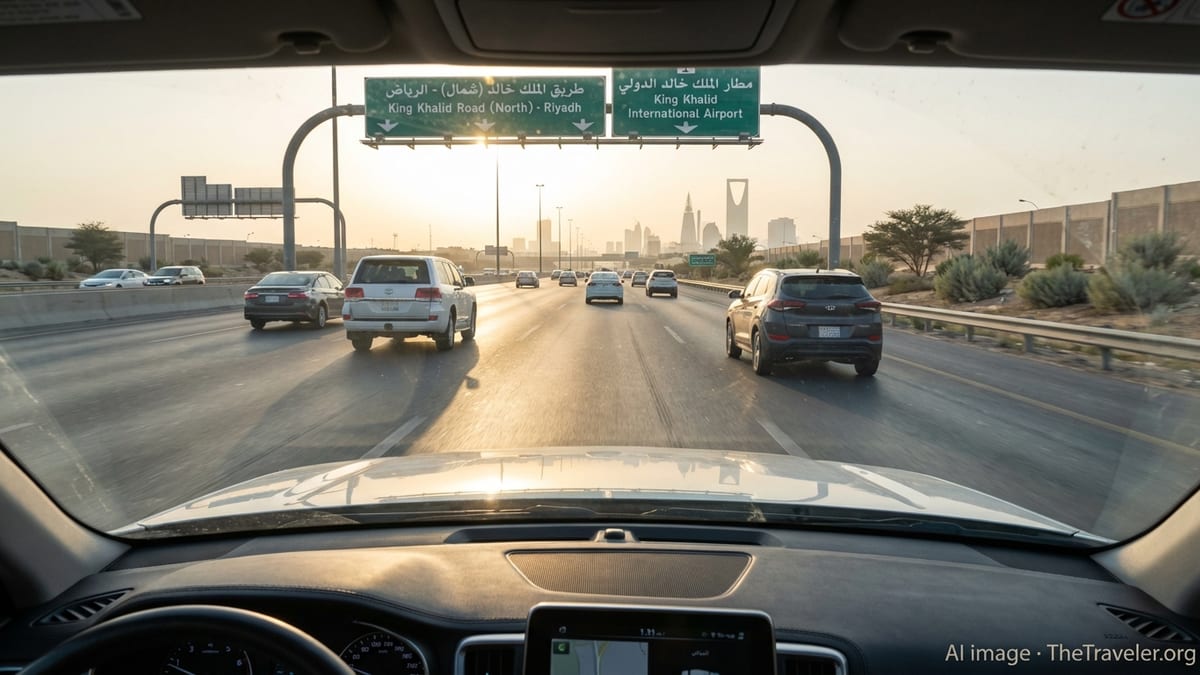
Saudi Arabia’s main cities are linked by modern multilane highways, many of which rank among the best in the region. Surfaces are generally smooth, signage is clear in both Arabic and English, and long-distance routes include frequent fuel stations, mosques, and rest stops. Around large metropolitan areas, you will find ring roads, cloverleaf interchanges, and complex flyovers that resemble those in North America or Western Europe. Night lighting is often good on major arterial roads and within cities.
Outside these networks, conditions can vary. Some secondary roads in rural or mountainous areas may be narrower, with occasional potholes, limited lighting, and fewer guardrails. In desert regions, blown sand can accumulate across the surface and create slippery patches or small dunes that appear suddenly after windy days. Flash floods are another hazard: despite a dry climate overall, when rain does fall, it can be intense and overwhelm drainage systems, leading to quickly rising water in wadis and low-lying underpasses. If you see water flowing across a road, do not attempt to cross unless you are certain it is shallow and safe.
Sandstorms are an important seasonal risk, especially in late spring and summer. When a storm moves in, visibility can drop abruptly from several kilometers to just a few meters, and fine dust can irritate eyes and lungs. The safest option is to avoid driving during strong sandstorms entirely. If you are already on the road when conditions deteriorate, slow down gradually, turn on low-beam headlights and hazard lights, and increase your following distance. If visibility becomes critically low, pull off the road as far as possible, stop, keep hazard lights on, and wait until conditions improve rather than trying to push through blind.
In mountainous areas such as the Asir region near Abha or the winding roads up to Taif, you will encounter steep gradients, sharp curves, and sometimes dense fog, particularly in cooler months and at higher elevations. Use lower gears when descending to avoid overheating your brakes, and remain patient with slower heavy vehicles. Rockfalls and stray animals can also appear on mountain roads, so scanning well ahead and avoiding nighttime travel in unfamiliar highland routes can reduce risk significantly.
Driving Culture, Lane Discipline, and Everyday Etiquette
For many newcomers, the greatest adjustment in Saudi Arabia is not the written rules but the unwritten ones. Driving styles can be assertive, especially in large cities, with frequent lane changes, tailgating, and limited use of turn signals. It is common to see drivers weaving through traffic at higher speeds than visitors might expect. As a defensive driver, your best strategy is to maintain generous following distances, use your mirrors constantly, and anticipate that vehicles may appear suddenly in your blind spots.
Lane discipline can be inconsistent. On multilane highways, you may find slower vehicles lingering in the outer lanes while faster cars overtake on the inside. Heavy trucks sometimes occupy middle or right lanes even when climbing hills slowly. Rather than trying to “correct” other drivers, work with the reality you see: overtake only when you have ample room, always signal clearly, and avoid engaging with aggressive drivers. If another vehicle is following very closely, gradually move to a safer lane when possible and let them pass.
Roundabouts are common both in cities and on secondary roads, and the general rule is that vehicles already inside the roundabout have priority, unless local signs indicate otherwise. Many drivers, however, enter quickly and change lanes within the circle without much warning. Approach roundabouts at moderate speed, check both sides carefully, and never assume another driver will yield just because you have theoretical right of way. At intersections controlled by traffic lights, red-light cameras are widespread, and fines for running a red light are among the highest, so easing through late ambers or early reds is a costly mistake.
Hazard lights are widely used as a communication tool beyond their formal purpose. You will see them during sudden slowdowns on highways, in sandstorms or heavy rain, or when vehicles stop on the shoulder. Some drivers also use a quick tap of the hazard lights as a “thank you” after another motorist lets them merge, although this practice is gradually giving way to more conventional light signals. As a visitor, adopting the safety-related uses of hazard lights in low-visibility or emergency conditions is helpful, but avoid overusing them in ways that might confuse other drivers.
Speed Limits, Enforcement, and Safety Priorities
Saudi authorities treat speeding as one of the primary causes of serious accidents, and enforcement has become visibly stricter. Typical posted limits in built-up areas range from around 50 to 70 kilometers per hour, rising to around 80 to 100 kilometers per hour on main urban arteries and up to about 120 kilometers per hour on national highways. On certain newer expressways designed for higher speeds, limits may be modestly higher, but they are always clearly signposted. Because long desert stretches can feel empty, it is easy to drift above the limit without realizing it, especially in powerful rental SUVs, so regular speed checks on your dashboard are essential.
The Saher camera system, together with other digital monitoring tools, is now present on most major routes and at many intersections. Cameras measure both instant speed and sometimes average speeds between fixed points. Fines are automatically recorded against the vehicle’s registration and can later affect your ability to exit the country if unpaid. Rental companies will typically charge your credit card for any fines incurred during your hire period, sometimes with added administrative fees. For residents, repeated offenses can accumulate demerit points and trigger inquiries or mandatory safety courses.
Saudi Arabia invests heavily in road-safety campaigns that target behaviors such as phone use, failure to wear seat belts, drifting or racing on public roads, and dangerous overtaking. Social media and local news channels regularly highlight enforcement drives, and during holiday periods police presence on major routes is often increased. In practical terms, this means you are more likely than ever to encounter checkpoints, mobile cameras, or unmarked patrol vehicles, particularly as you approach cities, border crossings, and busy interchanges.
For visitors, the safest approach is simple: obey posted limits, leave enough time for your journey so you are not tempted to speed, and avoid joining informal “convoys” of drivers who appear to be traveling well above the limit. When descending long hills, switch to lower gears rather than riding your brakes, which can overheat and lengthen stopping distance. Remember that even if other drivers appear to be ignoring the rules, you will still be held accountable for your own speed and driving conduct.
Renting a Car, Insurance, and Border Considerations
Car rental is straightforward across Saudi Arabia, with international and local companies serving all major airports and most city centers. To rent, you typically need a passport, an accepted driving license or international permit, and a credit card in the driver’s name. Minimum age requirements vary by company but are often around 21, with surcharges for drivers under 25. Many vehicles in the rental fleet are late-model sedans and SUVs with automatic transmission, air conditioning, and modern safety features, which are practical choices given the climate and distances involved.
Insurance arrangements deserve careful attention. Basic third-party coverage is usually included by default but may offer limited protection for damage to your own vehicle or personal liability. Collision damage waivers, theft protection, and extended liability coverage can be added at the rental desk or sometimes reserved in advance through international booking platforms. Because roads can be busy and parking lots crowded, especially in commercial districts, buying higher coverage levels is often prudent. Always inspect the vehicle thoroughly before departure, noting any scratches or dents in the rental form and taking timestamped photos.
For most tourists, driving will remain within Saudi borders, but some residents and Gulf-based travelers consider cross-border trips by car. Regulations for taking a Saudi-registered rental vehicle into neighboring countries are strict and often prohibited by rental contracts without special permissions. Separate rules also govern how long foreign-plated vehicles from other Gulf Cooperation Council states can remain inside Saudi Arabia over a given year. If you plan to approach land borders, ensure your visa, ownership or rental documents, and insurance explicitly allow such travel, and confirm with your rental company in writing rather than assuming it is acceptable.
Parking varies significantly between older neighborhoods and new developments. Many malls and office towers offer structured parking garages, sometimes free and sometimes paid, while traditional markets and residential districts may rely on curbside spaces that fill quickly. Illegally parked vehicles are increasingly subject to fines or towing, particularly if they block entrances, fire lanes, or spaces reserved for people with disabilities. Look for clear signage indicating time limits and restrictions, and when in doubt, choose secure paid parking rather than risking a ticket or conflict.
Health, Safety, and Practical Travel Tips for Drivers
The kingdom’s climate is one of the main challenges for drivers not used to extreme heat. Summer temperatures in much of the country can exceed 45 degrees Celsius during the day, which can quickly turn a minor mechanical issue into a serious problem if you are stranded without shade or water. Before any long drive, check coolant and oil levels if you are using a private vehicle, confirm the air conditioning is functioning properly, and carry ample bottled water for all passengers. It is wise to travel outside the hottest hours where possible, especially with children or elderly passengers.
Dehydration and fatigue are serious safety risks. Long, straight highways and monotone desert views can lull even experienced drivers into drowsiness. Plan regular breaks at service stations, swap drivers if possible, and stop immediately if you feel your concentration slipping. Caffeine alone is not a substitute for rest. At night, visibility decreases and the likelihood of encountering wandering camels, goats, or dogs on open highways increases. Their eyes can be difficult to see in time, and collisions with large animals such as camels can be catastrophic, so moderating your speed and using high beams appropriately on unlit stretches is crucial.
Navigation is generally easy thanks to widespread coverage by major digital map services, and addressing systems in major cities are improving. That said, rapid construction and new road projects can outpace mapping updates. It is helpful to cross-check your route on more than one app or use local advice when driving to newly developed districts or remote attractions. Do not rely entirely on GPS when it suggests unpaved shortcuts through the desert or narrow urban backstreets; stick to main roads unless you are equipped with a suitable vehicle and know what to expect.
In the event of an accident, Saudi law requires drivers to remain at the scene, activate hazard lights, and, when safe, move vehicles out of live traffic lanes. Emergency services can be reached by dialing the national emergency number, and many cities use specialized accident-reporting agencies that will attend the scene, document damage, and help process insurance claims. If you are driving a rental car, contact the rental company as soon as possible and follow their instructions strictly. Avoid arguments at the roadside; remain calm, exchange details, and let the official process determine responsibility.
The Takeaway
Driving in Saudi Arabia can be immensely rewarding, connecting you directly to Red Sea coastlines, rugged mountains, and vast desert interiors that are difficult to reach by public transport. The country’s road network is modern and expanding, and enforcement systems are increasingly sophisticated. At the same time, assertive driving habits, high speeds, and unique environmental hazards demand concentration and respect from anyone behind the wheel.
If you approach driving here with preparation and patience, the learning curve need not be steep. Study local rules before you arrive, choose an appropriate vehicle, keep your documents and insurance in order, and build extra time into journeys so you are not pressured into risky maneuvers. Pay close attention to changing weather, from sandstorms to sudden winter downpours, and do not hesitate to stop if conditions become unsafe. Most importantly, drive defensively, assume the unexpected, and remember that caution is always preferable to convenience on the kingdom’s roads.
As Saudi Arabia continues to open up to tourism and reshape its cities, driving will remain one of the most flexible ways to experience the kingdom on your own schedule. By combining respect for the rules with an understanding of local habits and environmental realities, you can explore with confidence and leave with memories of the landscapes, not the traffic incidents.
FAQ
Q1. Can tourists drive in Saudi Arabia with a foreign license?
Yes, many tourists can drive using a valid foreign license or an international driving permit for short stays, provided their visa status allows it and the rental company accepts their documents.
Q2. Is it safe for women to drive alone in Saudi Arabia?
In major cities it is increasingly common and generally safe for women to drive alone, though it is wise to take normal precautions, plan routes, and avoid isolated stops at night.
Q3. What are the typical speed limits on Saudi roads?
Typical limits are around 50 to 70 km/h in built-up areas, 80 to 100 km/h on main city roads, and about 120 km/h on most national highways, unless signs state otherwise.
Q4. Are there toll roads in Saudi Arabia?
Some newer expressways and major routes operate with toll systems or concession arrangements, and more may appear over time, so check with your rental company and watch for toll plazas and signage.
Q5. What should I do if I am caught in a sandstorm while driving?
If visibility drops, slow down gradually, turn on low-beam headlights and hazard lights, increase following distance, and if conditions become extreme, pull safely off the road and wait it out.
Q6. Is off-road or desert driving recommended for visitors?
Off-road desert driving should only be attempted with a suitable 4x4 vehicle, recovery gear, good local knowledge, and ideally with an experienced guide or convoy; novices should stick to paved roads.
Q7. How strict are penalties for drunk driving in Saudi Arabia?
Penalties are extremely strict, as alcohol for the general public is illegal; driving under the influence can lead to detention, heavy fines, deportation for foreigners, and long-term legal consequences.
Q8. Can I use ride-hailing apps instead of renting a car?
Yes, ride-hailing services operate widely in major Saudi cities and can be a convenient alternative to renting, especially if you are uncomfortable with local driving styles or urban traffic.
Q9. What type of car is best for long-distance driving in Saudi Arabia?
For long trips, a well-maintained sedan or SUV with good air conditioning, modern safety features, and sufficient fuel range is ideal, and a higher-clearance vehicle helps on rougher rural roads.
Q10. How can I pay traffic fines incurred while driving a rental car?
Traffic fines recorded on a rental car are usually passed to the rental company, which pays them and then charges your credit card, often adding an administrative fee, so drive carefully to avoid them.