

More news on this day
Air travel across the Gulf and wider Middle East was thrown into fresh turmoil on March 16 after a reported drone strike and ensuing blaze near Dubai International Airport forced Emirates to cancel dozens of flights and delay many more, rippling disruption through Saudi Arabia, the United Arab Emirates, Jordan and key long-haul routes to Asia, Europe and Africa.
Get the latest news straight to your inbox!
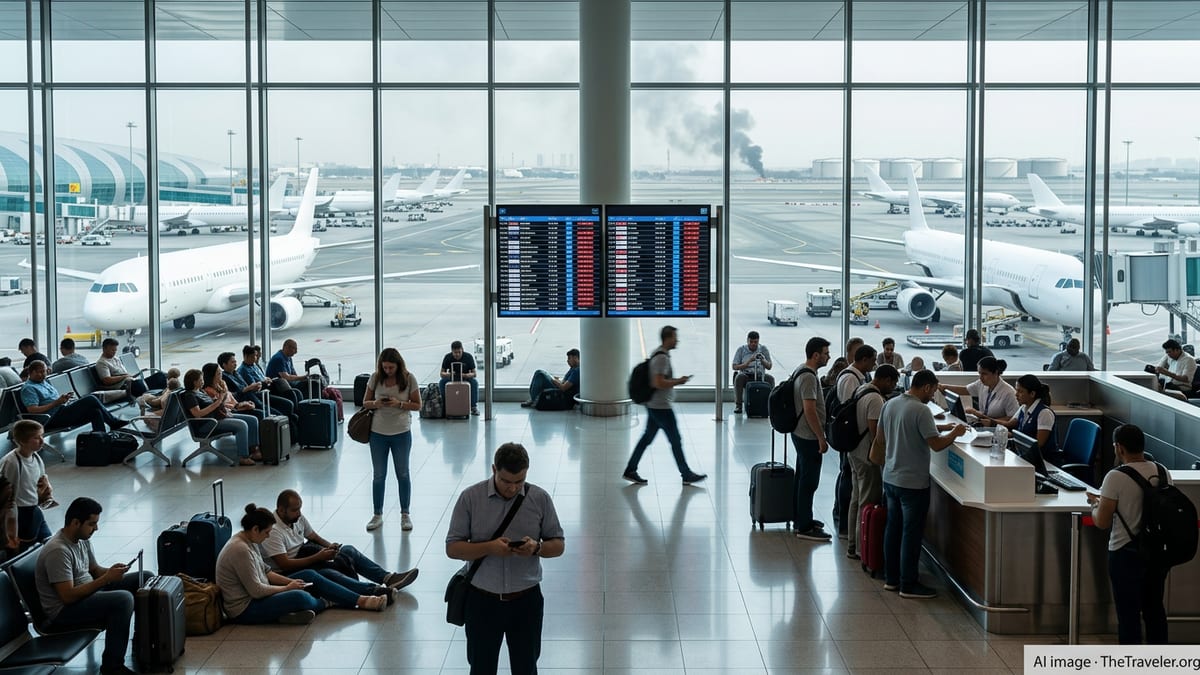
Emirates Cuts Schedule As Dubai Hub Partially Shuts
Publicly available flight-status data and airline advisories on Sunday indicate that Emirates has scrubbed around 50 flights and delayed at least 78 more from its Dubai hub, as crews and air traffic controllers work around a constrained runway and terminal operation. The reductions follow a drone impact on a fuel facility close to Dubai International that sparked a large fire and prompted an immediate suspension of movements at one of the world’s busiest international airports.
The latest disruption comes on top of intermittent suspensions at Dubai International in recent weeks linked to wider Iranian drone and missile strikes targeting infrastructure across the United Arab Emirates. Published coverage describes a pattern of brief but sharp shutdowns, with aircraft diverted to Al Maktoum International Airport and other regional gateways whenever airspace risk is deemed elevated or smoke and debris limit safe operations around the main hub.
Emirates has been operating a reduced schedule since regional tensions escalated in late February, and Sunday’s cancellations extend that strain into another day of rolling changes. The carrier is prioritising passengers already stranded by previous disruptions, with many travelers reporting rebookings, missed connections, and overnight stays as airport hotels and nearby accommodation fill rapidly.
While some services resumed once the fire was brought under control, flight-tracking data shows uneven recovery, with long-haul departures bunched in narrow operational windows and many shorter regional rotations scrubbed entirely to free up aircraft and crew. Travelers connecting through Dubai are being warned to expect last-minute gate changes and extended ground holds, even if their flights remain listed as operating.
Regional Knock-On Effects In Saudi Arabia, UAE And Jordan
The impact of the Dubai incident has quickly radiated across the wider network, affecting major airports in Saudi Arabia, the UAE and Jordan that depend on predictable schedules to and from the Gulf hub. Reports from Dammam and Riyadh note clusters of Emirates cancellations and lengthy delays, as inbound aircraft fail to depart Dubai on time or are rerouted around temporarily restricted airspace.
In the Saudi cities of Dammam and Riyadh, passengers on morning and midday departures to Dubai have described crowded terminals, long queues at airline desks and rolling delay announcements. With Emirates trimming frequencies and aircraft arriving out of rotation, ground teams are juggling rebookings onto later flights or alternative routings through other regional hubs, including Doha and Abu Dhabi, when available seats permit.
In the UAE, secondary airports are also feeling the strain. Abu Dhabi and Sharjah are receiving additional diverted traffic, complicating runway and gate assignments and prompting their own sets of delays. Travelers who started the day on domestic or short regional hops within the Gulf are finding themselves caught in a web of missed onward connections because their Dubai leg has vanished from the timetable.
To the northwest, Jordan’s main gateway in Amman is experiencing similar turbulence, particularly on routes linking Dubai with Europe and the Levant. According to publicly available schedules, several Dubai–Amman rotations have been consolidated or pushed back by multiple hours, leaving passengers facing unscheduled layovers and tight onward connections to European capitals once they finally depart.
Global Routes To Tokyo, Cairo And Beyond Disrupted
The Dubai shutdown is also reverberating far beyond the Middle East, given Emirates’ role as a key connector between Asia, Africa, Europe and the Americas. Long-haul routes to Tokyo, along with heavily traveled services to Cairo and other North African and Asian destinations, feature prominently on the list of delayed and cancelled flights.
Travelers bound for Tokyo from cities across Europe and North America rely on precise connection times in Dubai, and Sunday’s reduced schedule has fractured that choreography. Delayed inbound flights are missing their departure banks to Japan, forcing Emirates to retime or cancel legs altogether. Passengers report being rerouted through alternative Asian hubs or rebooked onto departures leaving a day or more later than planned.
In North Africa, Cairo is among the destinations experiencing notable disruption, with some rotations cancelled and others delayed by several hours as aircraft and crews are reassigned to priority long-haul services. The uneven pattern leaves some flights operating close to schedule while others wait extended periods for clearance slots and available gates in Dubai.
Similar stories are emerging across South and Southeast Asia, where cities such as Delhi, Mumbai, Manila and Bangkok are tied deeply into the Dubai hub structure. Even when flights from these cities depart, they often do so under revised timings that break carefully planned onward connections, compelling airlines and passengers to rebuild itineraries on the fly.
Travelers Face Long Queues, Limited Options And Evolving Advice
For travelers caught mid-journey, the immediate reality is long queues at transfer desks, crowded waiting areas and uncertainty about when they will reach their final destinations. Social media posts and traveler forums show images of congested concourses in Dubai, with many passengers attempting to sleep on floors or in chairs while they wait for new boarding passes and hotel vouchers.
With hundreds of flights affected since the latest drone-related incident, seats on alternative routes are in short supply. Competing carriers are also managing their own risk assessments and operational constraints, meaning that simple rebookings onto other airlines are not always possible. In many cases, travelers are being told to expect extended stopovers or to accept entirely re-routed journeys that add multiple connections and significant extra travel time.
Airlines operating through Dubai are advising passengers, via public statements and online updates, to check the latest status of their flights before heading to the airport and to allow additional time for security and check-in. Travel insurers are beginning to feature in online discussions as passengers review policies to determine coverage for missed connections, hotel stays and newly purchased replacement tickets.
Industry analysts writing in regional and international media note that the cascading effect of each suspension period at Dubai International can take days to unwind. Aircraft and crew are positioned around the globe, and any prolonged disruption in Dubai ripples outward, breaking the delicate timing that enables the hub-and-spoke model to function efficiently.
Ongoing Security Concerns Weigh On Middle East Aviation
The latest drone strike and fire near Dubai International Airport are part of a broader pattern of security incidents affecting aviation across the Gulf in early 2026. Public reports describe Iran-linked missile and drone attacks that have periodically targeted infrastructure in the United Arab Emirates, prompting temporary airspace closures and a series of operational pauses at both Dubai and Abu Dhabi airports.
While air defenses and emergency services have limited the physical damage from many of these incidents, falling debris, smoke and the need to assess runways and fuel systems for safety have repeatedly forced short-notice halts to arrivals and departures. Each pause compels airlines to divert or hold aircraft, quickly saturating nearby airports and leading to a backlog of flights waiting for clearance to enter UAE airspace.
According to open-source conflict monitoring and aviation safety reporting, carriers serving the region have begun to incorporate larger schedule buffers and contingency routings into their planning. However, the combination of dense traffic through Dubai and the unpredictability of further attacks means that even modest interruptions can still generate widespread disruption, particularly during peak travel periods.
Travel industry observers suggest that sustained instability could influence how airlines distribute capacity across the region, potentially shifting some connecting traffic to alternative hubs if security risks or insurance costs rise further. For now, Dubai remains a central node in global aviation, but the latest wave of cancellations and delays underscores how quickly that position can be strained when regional tensions intersect with critical transport infrastructure.