

More news on this day
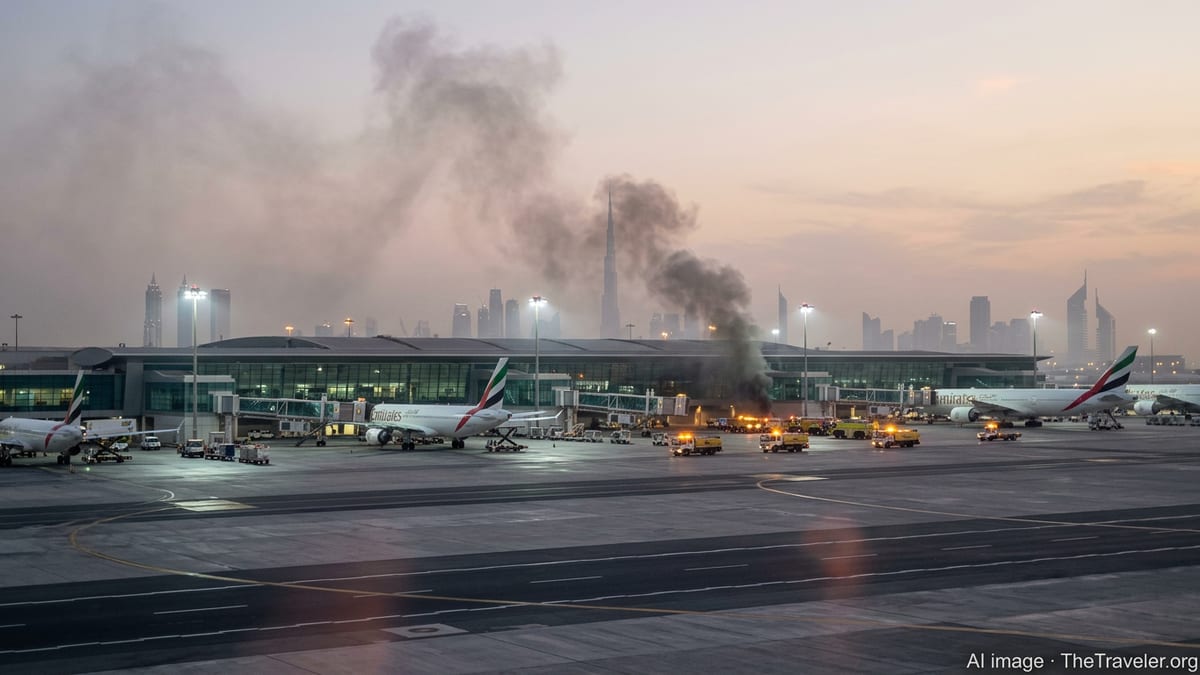
Dubai International Airport, one of the world’s busiest aviation hubs, has been partially disrupted after a drone strike triggered a fire and forced diversions, raising fresh alarm over the safety of air travel through the Gulf as the rapidly escalating Iran war spills into key civilian infrastructure.
Get the latest news straight to your inbox!
Fire, Flight Disruptions and Confusion for Travelers
Initial reports from regional and international outlets indicate that a drone struck an area near runways and support facilities at Dubai International on Monday, igniting a fire that sent thick smoke into the air and prompted an immediate response from emergency teams. Early assessments suggest the incident damaged ground infrastructure rather than passenger terminals, but the full extent of the impact is still emerging as authorities conduct inspections.
Air traffic monitoring data and airline updates show that arrivals into Dubai were briefly halted, with several inbound aircraft ordered into holding patterns over the Gulf and others diverted to airports in Abu Dhabi, Muscat and Doha. Departures were delayed as airport staff temporarily paused boarding and ground movements while fire crews worked to contain the blaze and secure affected areas.
Travelers passing through the airport reported long queues at security and departure gates, with some describing being directed away from windows and into interior corridors while alarms sounded. Publicly available accounts from social media and aviation tracking platforms point to a period of significant disruption lasting several hours before a gradual resumption of limited operations on select runways.
Published coverage also highlights a wave of misleading and fabricated videos purporting to show massive explosions or terminal damage at Dubai International. Local airport and media statements cited in recent fact-checks describe many of these viral clips as digitally altered, contributing to confusion among travelers trying to understand the real situation on the ground.
Dubai Hit as Iran War Reaches Major Civilian Hubs
The strike on Dubai International comes amid a widening conflict that has already seen Iranian missiles and drones launched toward multiple Gulf states following coordinated United States and Israeli attacks on targets inside Iran at the end of February. Recent reporting from international outlets has documented a series of Iranian drone and missile operations against ports, energy facilities and military sites across the United Arab Emirates and neighboring countries.
In recent days, publicly available information shows drones and missile debris striking near the United States consulate in Dubai and hitting oil infrastructure around the Port of Fujairah, sparking fires and briefly interrupting some loading operations. Analysts note that while earlier salvos tended to focus on energy and military-linked facilities, the latest wave increasingly edges closer to dense urban centers and heavily used civilian hubs.
Coverage in regional and European media in early March already described a previous incident in which Dubai’s main airport came under attack, temporarily halting repatriation flights and underscoring the vulnerability of international transit points. The latest drone strike and fire at the airport reinforce concerns that civilian infrastructure, including key aviation gateways, is now firmly within the conflict’s reach.
At the same time, fact-checkers have flagged a parallel surge in false claims about strikes on Gulf airports, including older, unverified assertions of attacks on Dubai that were later dismissed. This mix of confirmed incidents and fabricated content has made it harder for travelers, airlines and tourism businesses to quickly assess risk as the security landscape shifts.
Impact on Airlines, Hub Operations and Global Connections
Dubai International is a cornerstone of global connectivity, linking long-haul routes between Europe, Asia, Africa and Australasia and serving as the primary hub for Emirates and a key base for flydubai. Even short-lived disruptions at the airport can ripple across international networks, stranding transit passengers and complicating schedules for days.
Following earlier strikes linked to the current war, publicly accessible airline statements described temporary suspensions of flights, rerouting of services and the use of backup infrastructure across the UAE. Similar patterns are emerging again, with aviation data showing aircraft repositioned to secondary airports and some carriers extending minimum connection times for itineraries routed through Dubai.
Travel industry observers point out that repeated security scares risk eroding traveler confidence in Gulf hubs that have long marketed themselves as stable and efficient transit points. Insurance and risk consultants are already monitoring whether underwriters will adjust premiums or introduce new conditions for airlines and tour operators serving the region, especially if drone and missile incidents continue in the vicinity of major airports.
Despite these pressures, publicly available information suggests that UAE carriers remain intent on maintaining their role as global connectors. Recent coverage has highlighted commitments by leading airlines to restore schedules as quickly as safety assessments allow, even after previous attacks forced short-term suspensions and use of airport tunnels and shelters for passengers.
Heightened Aviation Security and Evolving Drone Threats
The strike and resulting fire at Dubai International highlight the evolving challenges that drones and precision weapons pose to civil aviation. Security experts interviewed in recent analyses of the Iran war emphasize that large hub airports present an especially attractive target because even limited damage or temporary closures can disrupt tens of thousands of passengers and a complex web of connecting flights.
In the UAE, the regulatory environment for recreational and commercial drones was already tightly controlled before the current conflict, with licensing systems, no-fly zones around airports and periodic confiscations of unauthorized devices. The latest cross-border attack, however, underscores that domestic enforcement alone cannot fully shield airports from state-linked or military-grade drones launched from well beyond national airspace.
Aviation analysts also note that the region’s experience is part of a broader global pattern in which airports, oil facilities and seaports have increasingly found themselves near or on the front lines of conflicts where drones, missiles and cyber tools are widely used. The incident in Dubai is therefore seen as another case study in how quickly a high-tech war can spill into spaces that, until recently, were perceived as largely insulated from direct attack.
In response, airport operators worldwide are reassessing the combination of early warning systems, air defense coordination, hardened infrastructure and contingency planning needed to keep passengers safe and operations resilient. The events in Dubai are likely to fuel further debate over how to protect open, high-traffic spaces like runways and terminal approaches without undermining the efficiency that major hubs depend on.
Traveler Advice Amid Ongoing Volatility
For travelers with upcoming itineraries through Dubai, industry guidance remains focused on close monitoring rather than automatic cancellation. Travel agents and risk specialists commonly recommend checking flight status directly with airlines, registering for carrier alerts, and verifying transit requirements before departure, especially for complex long-haul connections routed through the Gulf.
Given the confusion caused by fabricated videos and exaggerated social media claims following both the latest fire and earlier incidents, passengers are being urged by airport and government advisories to rely on official notices, airline communications and established news organizations rather than unverified clips. Recent fact-checks of viral footage misrepresenting events in Dubai underline how quickly misinformation can spread during high-tension moments.
Travel insurers are also watching developments closely. Policyholders are being encouraged to review coverage terms related to war, terrorism and civil unrest, as many standard policies contain exclusions or specific conditions for conflict-related disruptions. Some specialist products, however, may offer broader protection for trip interruptions or rerouting linked to security incidents at major hubs.
For now, published aviation data suggests that Dubai International continues to operate at reduced but recovering capacity after the drone strike and fire, with airlines adjusting schedules and routes to work around damaged areas. As the wider conflict shows little sign of easing, the airport’s experience is likely to remain a key barometer of how the Iran war is reshaping not only regional security but also the everyday realities of global air travel.