

More news on this day
Travelers in Dubai are facing rapidly changing advice as governments issue “depart now” and “reconsider travel” warnings in response to missile strikes, airspace disruption and wider conflict across the Middle East.
Get the latest news straight to your inbox!
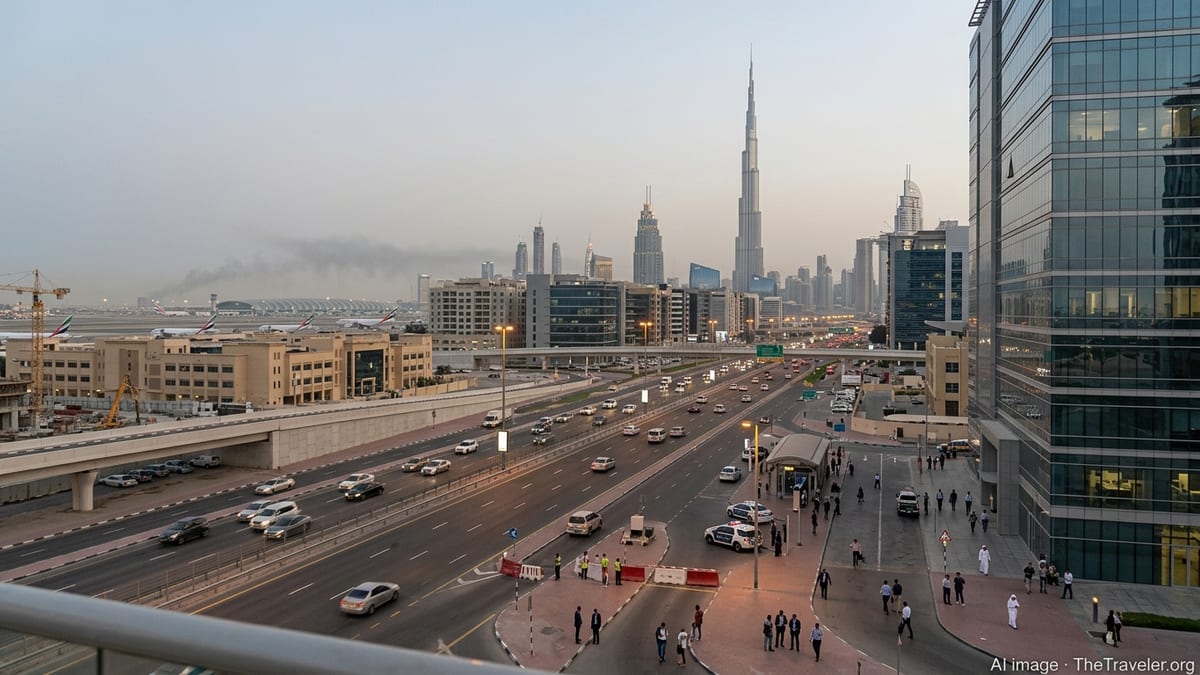
Heightened conflict reshapes risk assessments for Dubai
Dubai, long marketed as a safe and stable gateway between East and West, is now at the center of a rapidly evolving regional security crisis. Recent missile and drone strikes linked to the conflict involving Iran have affected locations in the United Arab Emirates, including areas in and around Dubai, prompting widespread concern among governments and travel providers.
Publicly available reporting on the 2026 Iranian strikes on the UAE describes a series of attacks that have targeted airports, critical infrastructure and high-profile commercial sites. Travel advisories note that debris, fires and temporary closures have been recorded at or near civilian hubs, which typically handle millions of transit passengers every month. While local services continue to function in many districts, the perceived risk to tourists and business travelers has shifted sharply in a matter of weeks.
These developments have triggered a reassessment of Dubai’s short term risk profile. Analysts tracking the situation describe a fluid environment in which the primary concern is the possibility of further missile or drone activity affecting civilian areas or air corridors, even if many daily routines within the city remain outwardly normal.
‘Reconsider travel’ and ‘do not travel’ warnings expand
Several governments have now elevated their advice for travel to the United Arab Emirates, citing the regional conflict and specific incidents affecting Dubai. Coverage in specialist travel and consumer outlets highlights that the United States has moved the UAE to a “Level 3: Reconsider Travel” advisory, reflecting increased security risks and the potential for further attacks or disruptions.
Other nations have taken an even stronger line. Reports summarizing official guidance from Australia state that the country’s Smartraveller service has raised its advice for the UAE to “do not travel,” a level typically reserved for destinations facing armed conflict or a high risk of terrorism and civil unrest. Irish and British media, drawing on guidance from Dublin and London, indicate that both governments now advise against all but essential travel to the UAE and other Gulf states affected by the same crisis.
Travel industry bulletins stress that these ratings have concrete implications beyond headline risk. Many standard travel insurance policies exclude cover if a traveler visits or remains in a destination subject to “do not travel” advisories. As a result, tourists currently in Dubai are being urged by insurers and consumer advocates to check policy wording closely and to document any decisions to stay or leave while advisories remain elevated.
‘Depart now’ messages and pressure on remaining routes
Alongside advisory changes, more urgent messaging has emerged for citizens already in the wider region. Statements reproduced in international media show that the United States has instructed its nationals in several Middle Eastern countries, including the UAE, to leave while commercial options remain available, with especially stark “depart now” language used in relation to Iran. Similar language appears in guidance for Americans in parts of southeast Türkiye, where recent security alerts have emphasized the need to exit affected areas quickly.
Although wording about immediate departure has not been applied as uniformly to Dubai as to some neighboring territories, the reference to the UAE in broader evacuation-style alerts has added to a sense of urgency among foreign visitors. Coverage of airline policies shows major carriers introducing extensive waivers for travel to and from Dubai, allowing passengers to rebook, reroute or cancel trips without standard change penalties over a multiweek window.
Airlines based outside the region have also adjusted their schedules. Reports indicate that Lufthansa has suspended flights to Dubai and Abu Dhabi for defined periods in March, while British Airways has halted its Abu Dhabi services until at least the end of the year due to airspace uncertainty. These moves, combined with intermittent suspensions by regional carriers and the temporary closure of certain air corridors, have reduced capacity at one of the world’s busiest hubs and could complicate efforts for travelers to leave at short notice.
What this means for travelers currently in Dubai
For visitors already in Dubai, the immediate challenge lies in balancing on the ground conditions with the rapidly tightening web of external advisories. Local transport, hotels and attractions in many parts of the city continue to operate, and the UAE’s official tourism information still promotes the country as open for business. At the same time, multiple advisories abroad now caution against nonessential trips, and some explicitly recommend that foreign nationals consider leaving while commercial flights remain available.
Travel risk consultants note that this divergence is not unusual in a fast moving crisis. Destination authorities may emphasize continuity of services, while foreign ministries and consular services in origin countries focus primarily on risk reduction for their own citizens. In Dubai’s case, the main concern is not everyday crime or political unrest, but the possibility that renewed strikes or debris could affect critical transport infrastructure, or that escalating regional tensions could trigger sudden airspace closures.
Travelers who choose to remain in Dubai are being advised, through open source guidance, to maintain flexible plans, stay in close contact with airlines and monitor government advisories from their home country on a daily basis. Those who decide to depart are encouraged to book confirmed flights as early as possible, as evidence from recent days shows that seats on remaining services can sell out quickly once warnings intensify.
Planning future trips as the situation evolves
The new round of warnings has created significant uncertainty for people with upcoming travel to Dubai, particularly those with long planned holidays or business events scheduled in the next few months. Industry coverage suggests that many tour operators and airlines are now offering enhanced flexibility for departures falling within defined waiver periods, including free changes to alternative destinations or credit vouchers for later travel.
Specialist travel media recommend that would be visitors avoid making nonrefundable bookings for Dubai until there is sustained evidence of stabilization both in the airspace and in government advisories. Prospective travelers are also being urged to pay close attention to the fine print of any new insurance policies, looking specifically for clauses related to war, terrorism and government travel bans, as these sections are now central to financial protection for trips touching the Gulf region.
For now, Dubai remains technically open but framed by a growing ring of caution from abroad. With conflict dynamics still unsettled and missile activity not fully ruled out, travel advice is expected to remain volatile. Anyone considering a journey to or through Dubai in the near term is being encouraged by publicly available guidance to take a conservative approach: monitor official updates, prioritize flexible tickets and be prepared to change plans quickly if “depart now” style messaging expands or flight options narrow further.