

More news on this day
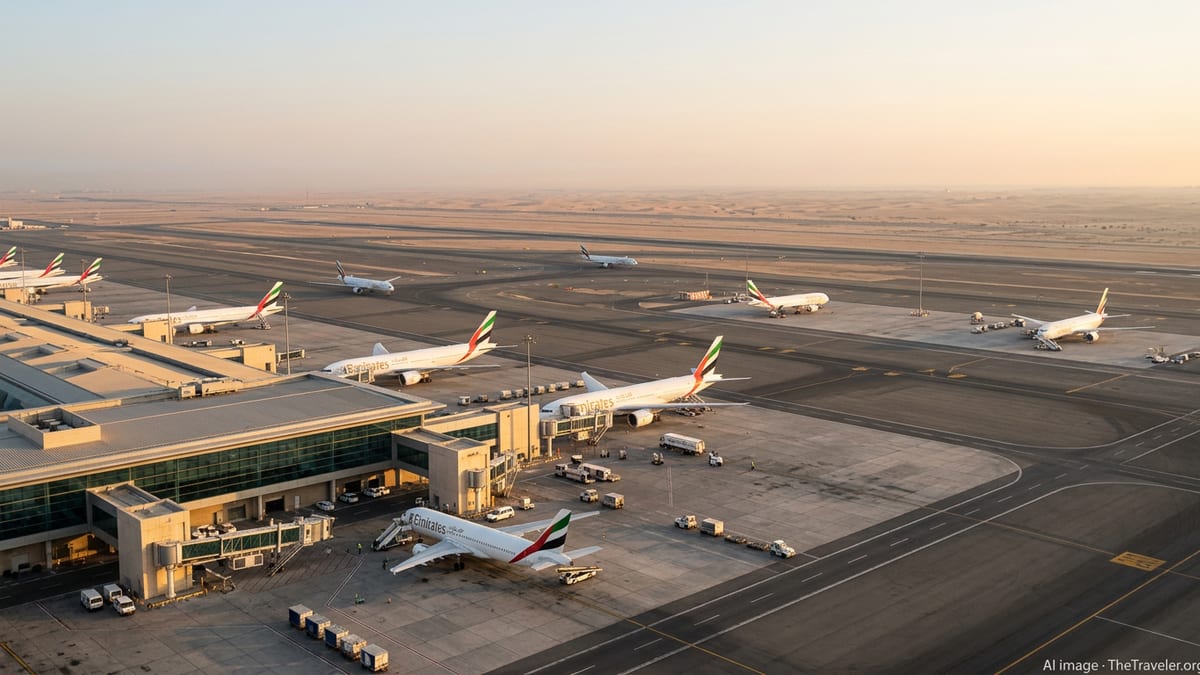
Dubai World Central – Al Maktoum International Airport has resumed partial operations, providing a crucial backup gateway as the United Arab Emirates cautiously reopens its skies following a sweeping regional airspace shutdown linked to the escalating war involving Iran, the United States and Israel.
Careful Restart After Complete Airspace Shutdown
The resumption of limited services at Al Maktoum International (DWC) comes just days after the UAE’s General Civil Aviation Authority ordered a rare, near-total closure of national airspace on February 28 in response to missile and drone attacks and wider military action across the Middle East. That decision forced Dubai’s two main hubs, Dubai International Airport (DXB) and DWC, to suspend commercial flights and diverted or stranded tens of thousands of passengers regionally.
Authorities began easing restrictions on March 2, authorising what they described as “limited” or “exceptional” flight operations from DXB and DWC, focused primarily on repatriation, cargo and high-priority movements. Airport officials and airlines stressed that this initial phase marked the start of a staggered recovery rather than a full reopening, with most scheduled passenger services still grounded or heavily reduced in the days that followed.
On March 7, Dubai Airports confirmed that operations had been partially restored, with a growing number of flights using both DXB and DWC. The move coincides with a broader, though fragile, stabilisation of airspace management in the Gulf as military planners and civil aviation regulators attempt to separate commercial corridors from active conflict zones.
Despite the easing, Dubai officials continue to urge passengers not to travel to either airport unless they have been contacted directly by their airline with a confirmed departure time. Check-in counters are operating on a heavily controlled schedule, and terminal access is being managed to prevent overcrowding as airlines clear backlogs of stranded travellers.
DWC Steps Up as Strategic Relief Hub
The partial reopening highlights DWC’s increasingly strategic role in Dubai’s aviation network. Built in the desert south of the city and envisioned as the emirate’s future primary airport, Al Maktoum International has until now handled a relatively modest mix of cargo, charter and low-cost passenger flights compared with the dense traffic at DXB. In crisis, however, its long runways, vast airfield and ample remote stands give Dubai valuable operational flexibility.
During the shutdown, DWC remained largely quiet as regulators maintained tight restrictions on airspace. With partial operations now permitted, the airport is being used as a relief and diversion hub, taking pressure off DXB’s constrained runway capacity and enabling airlines to stage repatriation and special flights away from the main international terminals.
Industry analysts note that the current disruption is offering an unscripted stress test of Dubai’s long-term plan to shift the bulk of passenger traffic from DXB to an expanded DWC over the next decade. While the present ramp-up is limited and reactive, it is forcing airport operators, airlines and ground-handling companies to accelerate coordination, systems integration and contingency procedures at the newer site.
For now, DWC’s passenger facilities are operating on a lean footprint, with selective opening of check-in halls, immigration counters and retail outlets aligned to the narrow flight schedule. Ground-handling teams are prioritising quick aircraft turnarounds and rapid transfer of evacuees and high-need travellers, rather than replicating the full-service experience typical of Dubai’s main hub.
Passengers Face Ongoing Disruption and Tight Controls
For travellers, the restart at DWC and DXB has not yet translated into a return to normal. Many commercial routes into and out of the UAE remain cancelled or significantly curtailed as airlines rework flight paths to avoid large swathes of restricted airspace that cover parts of Iran, Iraq, Israel and neighbouring states. Even where services are technically possible, carriers are staggering schedules to align with aircraft availability, crew duty limits and evolving security assessments.
Passengers booked on flights to or from Dubai in the coming days are being advised to monitor airline notifications closely and to expect last-minute changes in departure airports, timings and routing. Several long-haul services that would ordinarily operate from DXB are being temporarily shifted to DWC as airlines juggle slot availability and runway capacity between the two hubs.
Inside the terminals, operations look markedly different from a typical high-season day in Dubai. Check-in lines, when they form, are dominated by travellers with rebooked or emergency tickets, including tourists attempting to return home, migrant workers connecting to labour corridors and residents trying to reach family abroad. Airport staff and volunteers are steering passengers to updated flight information and offering basic assistance to those caught unprepared by the rapid escalation of the crisis.
Airport operators and carriers have reiterated that walk-up travel is not advisable during this phase. Passengers arriving at either DXB or DWC without confirmed, airline-verified itineraries risk extended waits outside terminals or being turned away altogether, as authorities seek to keep facilities manageable and minimise security risks inside secure areas.
Regional Conflict Reshapes Gulf Air Corridors
The partial reopening of Al Maktoum International is taking place against the backdrop of a broader aviation crisis triggered by the latest phase of the Iran war, which has seen missile and drone attacks across multiple Middle Eastern countries. In response, several states, including the UAE, temporarily closed or heavily restricted their airspace, causing a sudden halt to thousands of flights and forcing carriers to suspend or reroute services across key intercontinental corridors.
Dubai, which in normal times ranks as the world’s busiest airport for international passengers, was particularly exposed. Much of the city’s economic model is tied to its role as a global transit hub connecting Europe, Asia, Africa and Australasia, primarily through the long-haul networks of Emirates and its regional peers. The current disruption has underscored how quickly geopolitical shocks can ripple through this model, stranding travellers and constraining trade flows.
In recent days, some airlines have begun cautiously restoring operations, with Emirates signalling a gradual return of a limited set of routes and regional carriers coordinating repatriation flights under close supervision from civil aviation authorities. However, many services continue to avoid traditional shortcuts across Iran and surrounding conflict areas, opting instead for longer, fuel-intensive detours that add hours to journey times and increase operating costs.
Aviation security experts say the coming weeks will be critical in determining how durable the current adjustments prove to be. If the conflict remains volatile, routings that were once considered temporary workarounds could harden into new norms, potentially reshaping network planning and restoring the strategic value of secondary hubs like DWC for redundancy and surge capacity.
What the Partial Reopening Means for Future Travel
For travellers with upcoming plans to or through Dubai, the message from airlines and airport authorities is one of cautious patience. The partial reopening of Al Maktoum International and Dubai International provides essential breathing room, but schedules are expected to remain fluid, with priority given to clearing backlogs and supporting government-led evacuation efforts before broader commercial demand is fully accommodated.
Travel advisers recommend that passengers keep bookings flexible, avoid tight connections and maintain close contact with their carriers in the days leading up to departure. Those transiting through the UAE may find their itineraries adjusted to route through alternative hubs or, in some cases, temporarily suspended until airlines have greater clarity on airspace access and security conditions.
In the longer term, industry observers suggest that the crisis could accelerate investment in resilience measures that were already under discussion before the conflict, including faster expansion of DWC, enhanced cross-hub contingency planning and improved communication channels to passengers during fast-moving disruptions. The current episode has highlighted both the vulnerabilities of a hyper-connected aviation hub and the advantages of having a large, scalable second airport capable of absorbing shock.
For Dubai and its flagship airports, the coming period will be a balancing act between restoring the seamless connectivity that underpins the city’s global profile and maintaining the heightened security posture demanded by a conflict that has dramatically reshaped the regional aviation map in a matter of days.