

The Netherlands is often described as laid-back and progressive, yet for visitors the country can feel surprisingly rule-bound and direct. Nowhere is this more visible than on the cycle paths and in everyday social interaction. Understanding how Dutch people navigate traffic, time, personal space, and conversation will make your stay smoother and your encounters with locals more enjoyable. This guide explains the essentials of Dutch etiquette, cycling rules, and social customs so you can blend in with confidence rather than by trial and error.
Understanding Dutch Directness and Everyday Politeness
One of the first things many foreigners notice about Dutch culture is its directness. People in the Netherlands tend to say exactly what they mean and expect others to do the same. Feedback is often given plainly, without elaborate softening phrases. A Dutch colleague might say that an idea "does not work" rather than calling it "interesting" and quietly discarding it. This is usually not intended as rude. The cultural norm values clarity, honesty, and efficiency over maintaining appearances.
At the same time, Dutch society is fundamentally polite, just in a more understated way than in some other countries. You are expected to say hello when you enter a small shop or a waiting room, and say goodbye when you leave. In offices it is normal to greet colleagues individually in the morning if the group is small. Please and thank you are important, though not overused, and people will often acknowledge others with a brief nod or smile rather than extended small talk.
Humor can be dry and sarcastic, and teasing among friends or colleagues is common. If you are unsure whether a remark is offensive or simply very direct, assume the latter and respond calmly. Most Dutch people are open to being told when something feels too blunt for you, and they may adapt once they understand your background. What they usually appreciate in return is that you are clear about your own needs and opinions, rather than hiding them behind politeness formulas.
Apologies follow a similar pattern. Dutch people will say sorry when they truly feel responsible, but you are unlikely to hear long, repeated apologies for minor inconveniences. If someone bumps into you on a busy street, you may get a quick apology and eye contact but not much more. This is not indifference; it is simply a concise approach to courtesy that matches the wider communication style.
Greetings, Personal Space, and Social Boundaries
Basic greetings in the Netherlands are straightforward. Among strangers and in formal settings, a simple "hoi" or "hallo" works almost everywhere, while "goedemorgen," "goedemiddag," and "goedenavond" are polite time-specific options. In professional situations, a brief handshake with eye contact is still common at the start of a relationship or meeting, although people are gradually shaking hands a bit less than they once did. Using first names happens quickly, but a respectful tone and calm body language remain important.
Physical affection is more reserved than in some Southern European cultures. Hugs are generally kept for family members and close friends. The well-known triple cheek kiss exists but is used less often than many visitors expect, and usually only in private circles or on occasions such as birthdays and New Year. In most day-to-day contexts, a verbal greeting or handshake is enough. When in doubt, let your Dutch counterpart lead. If they offer a hand or lean in for a kiss, you can follow; if they keep their distance, mirror that boundary.
Personal space on public transport and in queues is respected. People stand with a comfortable gap between one another and rarely push or crowd forward. Talking loudly on trains and buses, especially in the quiet coach, is frowned upon. It is acceptable to ask someone to lower their voice or move a bag from a seat, but this is usually done calmly and without confrontation. On busy cycle paths and pavements, the same principle applies: walk or ride predictably, keep to one side, and avoid blocking narrow passages.
In social settings, invitations and drop-ins follow fairly structured expectations. Many Dutch people keep detailed personal agendas and appreciate advance planning. Spontaneous visits to someone’s home are less common than in some cultures, unless you have a very close relationship. If you are invited over, it is polite to arrive on time or only a few minutes late. Announcing your arrival with a brief message is often appreciated, especially in urban areas where apartment access can be controlled and secure.
Dining, Coffee Culture, and the Meaning of “Going Dutch”
Eating and drinking together is a central way of connecting in the Netherlands, but the style tends to be informal and unfussy. Breakfast and lunch are often simple, with bread, cheese, and spreads playing a starring role. Hot meals are more typical in the evening, although urban food culture has become more flexible in recent years. When you are invited to dinner at someone’s home, it is polite to bring a small gift such as flowers, chocolates, or a bottle of wine. Large or extravagant gifts can feel excessive.
In restaurants and cafes, the concept of "going Dutch" is very real. Splitting the bill is common among friends, colleagues, and even on some early dates. Sometimes one person pays and others reimburse them later using a digital payment request, but the underlying expectation is that everyone covers their share. If you invite someone and clearly indicate that it is your treat, most Dutch people will accept, yet many will still offer to pay their part out of politeness. It is usually enough to say once, clearly, that you are paying if that is your intention.
Coffee culture is strong, and coffee breaks have a social function that goes beyond the drink itself. Being offered a coffee when you arrive at someone’s home or office is a sign of welcome. It is also considered polite to accept at least one drink if you can, even if you only take a few sips. Snacks are modest, often a single cookie or biscuit per person, and not an endless supply. This habit is sometimes jokingly referred to by foreigners, but it reflects a broader cultural theme of moderation and avoiding waste.
Restaurant etiquette is relaxed but structured. You typically wait to be shown to a table in more formal places, while in casual cafes you can often seat yourself. Tipping is appreciated but not as obligatory as in some countries. Leaving around 5 to 10 percent, or rounding up the bill, is considered generous for good service. Service can feel brisk or hands-off by some standards. Staff will not check on your table constantly, partly because lingering over a meal without pressure to leave is considered normal and hospitable.
Cycling in the Netherlands: Rules, Rights, and Responsibilities
Cycling is more than a mode of transportation in the Netherlands; it is an integral part of everyday life and a key element of national identity. As a visitor, renting a bicycle can be one of the best ways to experience Dutch cities and landscapes. It also places you within a detailed set of traffic rules. Cyclists are full participants in traffic, with legal rights and responsibilities that are actively enforced. Treat cycling like driving a vehicle, not like an informal leisure activity, and you will already be closer to local expectations.
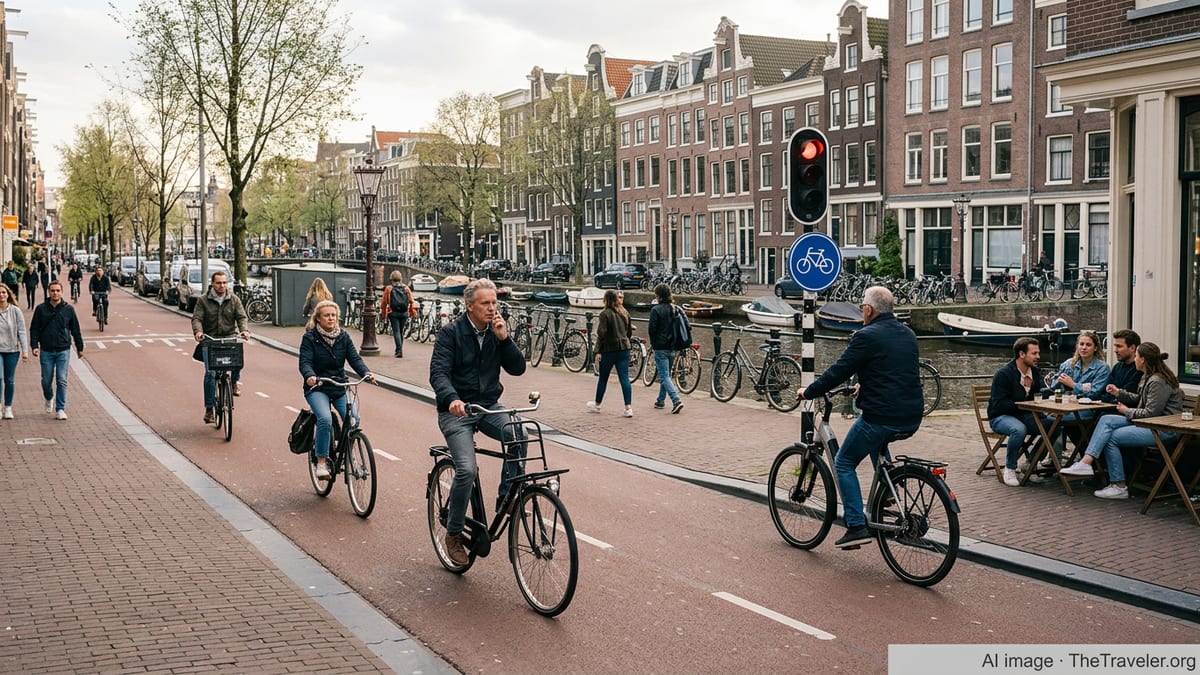
The most important traffic principle is that Dutch bikes usually ride on dedicated cycle paths where they exist. When you see a round blue sign with a white bicycle, that marks a mandatory bike lane, and you are expected to use it instead of the main carriageway. Riding on pavements is generally forbidden for adults, and can result in a fine, regardless of how tempting an empty sidewalk may look. On mixed-use paths that combine pedestrians and cyclists, ride at a moderate speed, signal before overtaking, and slow down when paths are busy or narrow.
Right of way can feel complex at first, but a few basic rules will help. At unmarked intersections in built-up areas, traffic from the right usually has priority, including cyclists. Many junctions, however, are clearly marked with triangles on the road surface or specific signs that indicate who must yield. Trams generally have priority when they appear. At some busy urban intersections you may encounter special phases where all bicycle lights turn green at once and cyclists can cross in every direction. Even then, riders are expected to keep a steady speed, watch for crossing traffic, and avoid cutting sharply in front of others.
Modern Dutch cycling also includes various types of electric bikes and speed pedelecs. Regular e-bikes that assist up to about 25 kilometers per hour can usually use standard cycle paths and do not require helmets for adults, though helmets are strongly recommended and regulations are being tightened for younger riders on faster models. Higher-speed bikes that can reach around 45 kilometers per hour are treated more like mopeds, with separate rules for registration, helmets, and which roads or lanes they may use. If you are renting, ask clearly which category your bike falls into and where it is allowed to ride.
Safety, Fines, and Everyday Cycling Etiquette
For a country that loves cycling, the Netherlands also takes cycling safety seriously. Traffic police do fine cyclists for certain infractions, and visitors are not exempt. Riding through a red light, ignoring a mandatory cycle path, or cycling on the pavement where it is not allowed can lead to penalties. Over the past few years authorities have become particularly strict about phone use while cycling. It is illegal to hold a mobile phone or similar device in your hand while riding. If you need navigation, place your phone in a holder on the handlebars or stop safely to check your route.
Helmet use for adult cyclists on regular bikes remains optional, but the conversation around safety equipment is active, especially as e-bike speeds have increased. You will see more helmets in hilly regions and among commuters on fast e-bikes, as well as on children. Reflectors and lights are a legal requirement. Front and rear lights are mandatory after dark or in poor visibility, and fines for missing or malfunctioning lights are common in winter. If you rent a bike, test the lights before riding away and ask the shop to fix or replace any that do not work.
Beyond the formal rules, there is a strong culture of informal cycling etiquette. Experienced Dutch riders expect everyone to be predictable. Ride in a straight line, avoid sudden stops, and check over your shoulder before changing position. When you need to pass another cyclist, ring your bell once or twice and overtake on the left with a comfortable gap. On busy paths, do not ride more than two abreast, and switch to single file when someone wants to overtake from behind. If you need to send a message or adjust your bag, pull over to the side of the path where you will not block others.
Parking norms surprise many visitors. Leaving a bike loose on a narrow pavement or leaning across a doorway is considered inconsiderate and, in some cities, can lead to removal by municipal services. Use official bike racks where possible, lock your bike securely, and respect signs that prohibit parking in specific spots, such as entrance zones near railway stations. In crowded city centers, bikes parked outside designated areas are sometimes tagged for removal and later taken to storage depots, with retrieval fees charged to the owner.
Work Culture, Timekeeping, and Everyday Organization
Dutch work culture strongly reflects the broader values of directness, equality, and work-life balance. Offices tend to be relatively flat in hierarchy, with managers accessible and decisions often made through consultation. Employees are encouraged to voice their views openly in meetings, including disagreement with superiors, as long as they do so respectfully. This can surprise those from more top-down corporate cultures, but it is central to how Dutch organizations function.
Punctuality is a key aspect of professionalism and social respect. Arriving late to a job interview, doctor’s appointment, or formal meeting is taken seriously unless you have a clear and communicated reason. Even social gatherings are more time-specific than in some cultures. If you are invited at 19:00, it is better to arrive close to that time rather than much earlier or later. When delay is unavoidable, sending a brief message is considered basic courtesy.
Many Dutch people keep detailed calendars, and the habit of "checking the agenda" before making plans is almost a cliché. Rather than suggesting vague ideas about meeting "sometime," locals will often propose precise dates and times, sometimes weeks in advance. This structured approach applies to friendship circles as well. Regular social activities, from sports clubs to book groups, are often scheduled well ahead and taken as seriously as professional commitments.
Work-life balance is protected by norms and by policy. Long workdays and after-hours emails are less idealized than in some countries. Leaving the office at a reasonable hour to spend time with family or engage in hobbies is widely accepted. This attitude extends to holidays. When colleagues are on vacation, they are generally expected to disconnect. It is polite to respect those boundaries and avoid contacting people for non-urgent matters during their time off.
Home Visits, Birthdays, and Family Life
Visiting a Dutch home offers a window into private life that you might not see in public spaces. Houses and apartments are often tidy and carefully maintained, with an emphasis on light, practicality, and understated design. When you enter, it is common to remove your shoes if you see that the host and others have done so, or if you are asked politely. Bringing a modest gift is a sign of appreciation, but avoid anything excessively expensive, which can feel uncomfortable for both sides.
Birthdays occupy a special place in Dutch culture. Family and close friends may gather for coffee, cake, and later drinks or snacks, often arranged in a circle of chairs in the living room. Guests typically congratulate not only the person whose birthday it is, but also their close relatives: parents, partners, and sometimes siblings. This ritual, where you move around the room offering congratulations and a handshake or kiss, can seem formal yet affectionate. If you attend such a gathering, follow the lead of others and join the congratulations, even if you do not know everyone well.
Guests at home gatherings are usually offered one or two drinks at a time, not an endless supply. It is common to be asked what you would like from a short list of options, and for refills to be offered periodically rather than automatically. Snacks may be simple and portioned, such as a plate of cheese cubes with toothpicks or a bowl of crisps shared among the group. The tone is friendly but not lavish, reflecting cultural preferences for moderation and avoiding unnecessary excess.
Children are often given a good deal of independence from a relatively young age, especially around mobility. You may see groups of schoolchildren cycling on their own or with limited adult supervision, reflecting trust in both the traffic system and the children’s training. At the same time, parents expect politeness, honesty, and participation in household tasks. If you interact with Dutch children, treating them with respect and speaking to them directly is appreciated, as is addressing them in simple, clear language if they are still learning English.
Navigating Sensitive Topics and Social Inclusion
The Netherlands is internationally associated with liberal attitudes on topics such as sexuality, drugs, and euthanasia. Public debate in these areas is often frank and pragmatic, but that does not mean every individual is equally comfortable discussing them. When you first meet people, it is usually better to focus on neutral topics such as travel, work, hobbies, or sports. Once you know someone better, you can sense whether more sensitive conversations are welcome.
Religion is a more private matter for many Dutch people than in some societies. Levels of formal religious affiliation have declined over recent decades, and large parts of the population identify as secular. Nevertheless, there are vibrant religious communities, and a range of beliefs coexists. Jokes about religion, or assumptions that others share a specific belief system, can be unwelcome. It is safer to ask open questions and listen rather than making strong statements, especially in mixed groups.
Discrimination is officially rejected and widely criticized in Dutch public discourse, yet experiences are not uniform. People from minority backgrounds may still face prejudice, and debates about racism, migration, and integration are ongoing. As a visitor, it is courteous to avoid stereotyping groups of people and to listen when locals share personal experiences that challenge the image of the Netherlands as entirely tolerant. Many Dutch people value those conversations precisely because they help push society closer to its stated ideals.
Language also plays a role in inclusion. While most Dutch people speak English to a high standard, especially in cities, making a small effort in Dutch can help break the ice. Simple words like "dank je" for thank you or "alsjeblieft" when handing something over are appreciated. If someone switches to English, they are usually trying to make things easier for you, not signaling impatience. A brief acknowledgment that you are still learning goes a long way, and most people will be supportive rather than critical.
The Takeaway
Spending time in the Netherlands can feel remarkably smooth once you understand the cultural logic that connects its bike lanes, coffee tables, offices, and living rooms. Clear communication, mutual responsibility in traffic, punctuality, and a preference for moderation all support a society that values both individual freedom and collective order. For visitors, learning to ride predictably, pay your share, speak plainly, and respect personal boundaries will help you blend in more quickly than mastering any single phrasebook.
Above all, Dutch people tend to appreciate sincerity. You do not need to pretend to know every rule, but you are expected to take those rules seriously once they are explained. Ask when you are unsure, observe how locals behave, and you will find that many apparent strictures are simply ways of sharing limited space fairly. With a bit of preparation and curiosity, the Netherlands offers a rare combination of efficient infrastructure and relaxed everyday life that rewards slow exploration, whether from a saddle or a café chair.
FAQ
Q1. Do I need to wear a helmet when cycling in the Netherlands as a visitor?
For adults on regular bicycles and standard e-bikes, helmets are recommended but not generally required by law. Certain faster bikes categorized more like mopeds do require helmets, so check with your rental shop about the exact type of bike you are using.
Q2. Is it really illegal to use my phone while cycling?
Yes. It is prohibited to hold a mobile phone or similar device in your hand while cycling. You may use your phone for navigation only if it is fixed in a holder on the handlebars, or you stop safely to check it.
Q3. What is the basic right-of-way rule I should remember on Dutch roads?
At many unmarked intersections, traffic coming from the right has priority, and this includes bicycles. However, road markings and signs can overrule this, so always look for yield triangles, priority signs, and traffic lights before assuming you have the right of way.
Q4. Can I ride my bike on the pavement if the road feels unsafe?
In most cases adults are not allowed to cycle on pavements, even if traffic feels busy. You are expected to use the cycle path if one exists, or ride on the road while following general traffic rules. Children sometimes have limited exceptions, but the safest approach as a visitor is to stay off pavements.
Q5. How do Dutch people usually split the bill at restaurants?
It is very common to split the bill so that everyone pays their share, either directly at the table or later via a digital payment request. If you explicitly invite someone as your guest and say you will pay, that is usually accepted, but many people will still offer to contribute.
Q6. Is Dutch directness meant to be rude?
In most cases, no. Direct comments are typically intended as honest and efficient communication, not as personal attacks. If something feels too blunt, you can say so calmly, and many Dutch people will adjust once they understand how their words come across to you.
Q7. How should I greet people I meet for the first time?
In professional and formal situations, a brief handshake with eye contact and a simple greeting is standard. Among younger people and in casual contexts, a verbal greeting without a handshake is increasingly common. Physical affection like hugging is usually reserved for close friends and family.
Q8. Is tipping required in Dutch restaurants and cafes?
Tipping is appreciated but not strictly required. Rounding up the bill or leaving about 5 to 10 percent for good service is considered generous. In very casual places, leaving small change or simply rounding up is often enough.
Q9. How early should I arrive when invited to a Dutch home?
Arriving on time or just a few minutes after the agreed hour is considered polite. Showing up significantly early can put pressure on your hosts, while arriving very late without warning is seen as inconsiderate. If you are delayed, sending a short message is the courteous thing to do.
Q10. Is it okay to start speaking English, or should I try Dutch first?
Most Dutch people speak English well and are comfortable switching quickly, especially in cities. A simple greeting or thank you in Dutch is appreciated, but it is entirely acceptable to continue in English once it becomes clear that it is the most practical option for both sides.