

More news on this day
Spain is bracing for significant Easter travel disruption as ground handling strikes spread to major airports in Madrid, Barcelona and Palma de Mallorca, raising fresh concerns for Europe’s tourism sector already rattled by recent walkouts and weather chaos in Germany, Italy, France and the United Kingdom.
Get the latest news straight to your inbox!
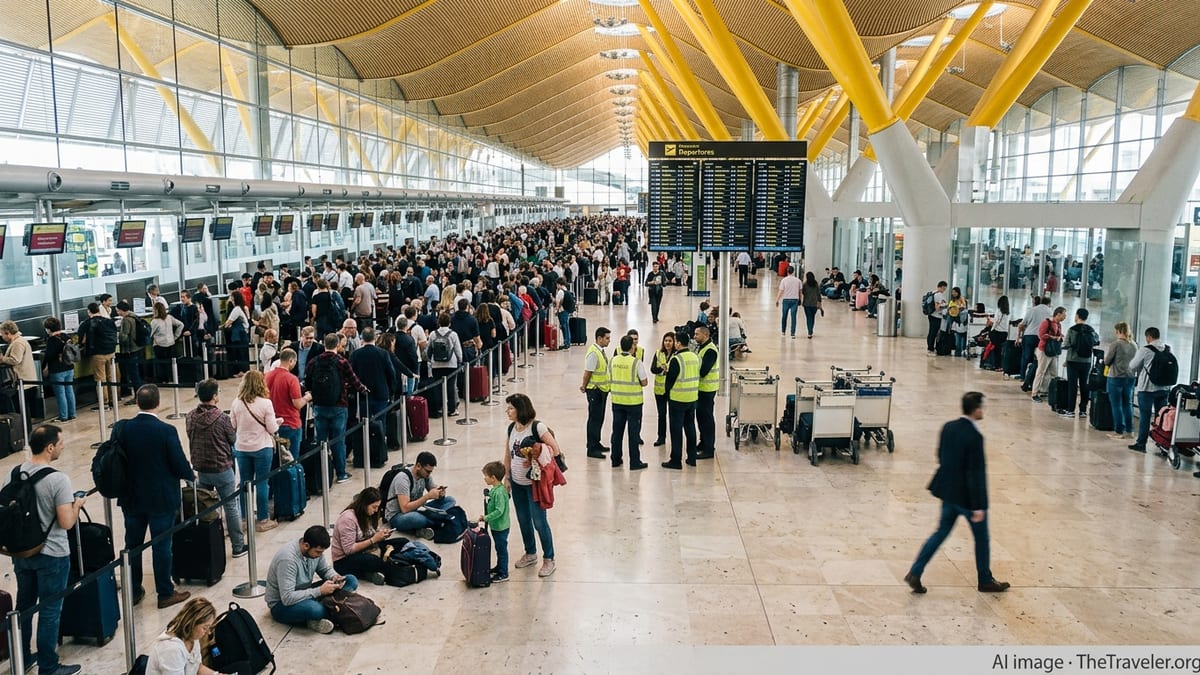
Groundforce Walkout Targets Spain’s Busiest Holiday Gateways
Publicly available information from Spanish media indicates that unions representing Groundforce staff, part of the Globalia group, have called an open-ended strike starting Monday 30 March, coinciding with the peak of Holy Week travel. The action covers around 3,000 ground handling workers across 12 high-traffic airports in the Aena network, including Adolfo Suárez Madrid-Barajas, Josep Tarradellas Barcelona-El Prat and Palma de Mallorca, along with hubs such as Málaga, Alicante, Valencia, Bilbao, Ibiza, Gran Canaria, Tenerife, Lanzarote and Fuerteventura.
The stoppages are described as partial strikes concentrated in three time bands each day: early morning, midday to late afternoon, and late evening. Reports indicate that this pattern is designed to hit the densest departure and arrival waves, when check-in, baggage loading and aircraft turnaround activity are most intense. Even if flights remain scheduled, any slowdown in ramp, baggage and passenger services can quickly cascade into delays and missed connections.
Union statements cited in Spanish coverage point to a breakdown over the interpretation of Groundforce’s collective agreement. Worker representatives argue that management has not applied pay updates in line with inflation since 2022 and accuse the company of using a restrictive reading of wage clauses that has eroded purchasing power. For passengers, these contractual disputes translate into practical questions about whether bags will travel on time and whether aircraft can depart within their assigned slots.
At Palma de Mallorca, where Groundforce is a key provider of ramp and passenger services, previous demonstrations have highlighted what staff described as unsustainable conditions and low pay. With Holy Week marking the symbolic start of the island’s summer season, any prolonged disruption in handling could unsettle airlines and hotel operators that rely on smooth weekend changeovers for package tourism.
Holy Week Timing Raises Stakes for Spain’s Tourism Economy
The strikes hit at a critical juncture for Spain’s travel industry. Aena traffic data for the 2025–2026 winter season show that Madrid, Barcelona and Palma de Mallorca rank among the country’s busiest airports by passenger volume, with Palma alone handling several million travelers over the winter schedule. Holy Week traditionally serves as the bridge between the winter timetable ending on 28 March and the ramp-up of spring and summer leisure traffic.
Tourism bodies consistently identify Semana Santa as one of Spain’s key domestic and international travel periods, with city-break visitors heading to Madrid and Barcelona while beach-bound holidaymakers target the Balearic and Canary islands. Any operational disruption at the main gateway airports can therefore have a multiplier effect, rippling out to regional airports, ferry links and accommodation providers that depend on back-to-back arrivals.
Industry analysts note that Spain enters this period with strong structural reliance on aviation. Aena’s extensive network connects mainland hubs with archipelagos such as the Balearics and Canaries, where air links are essential not only for tourism but also for resident mobility. Ground handling companies like Groundforce act as the connective tissue in this system, coordinating services for both full-service and low-cost carriers.
As airlines and airports prepare contingency plans, travel intermediaries are advising passengers to arrive early at airports, travel with carry-on luggage where possible and stay alert to schedule changes. Even if minimum service levels are imposed to protect essential operations, experience from previous industrial disputes in Spain suggests that lengthy queues, baggage delays and last-minute gate changes remain a real risk when staffing levels are disrupted.
Labor Disputes Put Handling Providers Under the Spotlight
The Groundforce conflict shines a light on the often overlooked handling sector that keeps Europe’s airports running. Public records describe Groundforce as a leading ground services provider in Spain, with a substantial footprint across the Aena network and previous government-backed investment in electrifying its equipment fleet. This scale means that any disruption to its operations can have a disproportionate impact on airlines and passengers.
The dispute over wage updates and the interpretation of collective agreement clauses reflects wider tensions across the European aviation workforce as inflation and cost-of-living pressures bite. Earlier actions involving handling and support staff in Spain, some of which drew limited participation according to airline disclosures, illustrate how fragmented union representation and varying company structures can produce uneven impacts across different airports and carriers.
Observers note that ground handling is a cost-sensitive, highly competitive segment where margins are thin and contracts are often awarded through tenders. When salary expectations rise faster than the fees that airlines are willing to pay, friction between management and staff tends to increase. In this context, the Easter strike at Groundforce is seen as part of a broader reset in labor relations across the sector.
For travelers, however, the underlying contractual details matter less than the practical outcome. The visibility of handlers loading baggage, guiding aircraft and operating jet bridges makes any slowdown immediately tangible in the form of delayed departures and congested gate areas. As airlines assess whether to reassign handling contracts or adjust schedules, short-term uncertainty is likely to dominate the Easter period.
Europe-Wide Disruptions Add to Easter Travel Headaches
Spain’s looming airport disruption arrives on top of a wider wave of travel problems across Europe in early 2026. In Germany, a recent 48-hour pilot strike at Lufthansa in mid-March triggered large-scale schedule reductions, with the carrier publicly outlining plans to operate only a portion of its flights during the industrial action. In parallel, Germany’s rail network has also faced severe winter weather and operational stoppages, compounding difficulties for travelers trying to reach or leave major hubs.
Across the United Kingdom and France, the 2025–2026 winter has been marked by powerful windstorms that have intermittently suspended rail and air services, according to national meteorological and transport reports. These weather systems have brought a mix of high winds, heavy snow and freezing rain, prompting train operators to cancel long-distance services and some airports to restrict operations for safety reasons.
Italy has confronted its own infrastructure vulnerabilities, with recent episodes of rail disruption and localized aviation impacts at airports such as Milan and Florence. Each individual event may be short-lived, but together they point to a travel landscape in which passengers face a growing list of potential obstacles, from labor disputes and capacity constraints to extreme weather and geopolitical tensions.
For Easter 2026, Spain’s ground handling strikes risk knitting these disparate pressures together. Travelers connecting through Madrid or Barcelona from northern Europe, or flying from the UK and Germany to Palma de Mallorca and the Canaries, now face a layered risk profile in which disruption at origin, en route and destination is possible.
What Easter Travelers Should Expect in the Coming Days
With the Groundforce strike scheduled to begin on Monday 30 March and no agreement yet reported, airlines operating in and out of Spain are expected to refine contingency plans in the final days before Easter weekend. Published information from previous disputes suggests that carriers with their own in-house ground staff may be less exposed than those relying heavily on third-party handlers, but knock-on effects are still possible as shared infrastructure becomes congested.
Airport operators typically work with handling firms and unions to define minimum service levels intended to preserve essential connectivity. Even so, travelers during past Spanish holiday strikes have encountered long lines at check-in and security, late baggage delivery and occasional cancellations when turnaround times became unmanageable. Similar patterns could re-emerge at Madrid, Barcelona and Palma de Mallorca if staffing levels fall sharply during the designated strike windows.
Travel advisors recommend that passengers monitor airline apps closely, verify flight status before leaving for the airport and allow additional time at departure terminals. Those with tight connections, especially on separate tickets, may want to consider rebooking to longer layovers or more direct routings where options exist. Flexible ticket policies and travel waivers, if announced, could provide additional room for maneuver.
More broadly, the situation in Spain underlines how Europe’s travel recovery is increasingly intertwined with labor relations and climate volatility. As tourism flows rebound and capacity remains constrained at many airlines and airports, even localized industrial action can tip systems into disruption. Easter 2026 is shaping up as a key test of how resilient Europe’s aviation network has become and how much unpredictability travelers are prepared to accept when planning their holidays.