

More news on this day
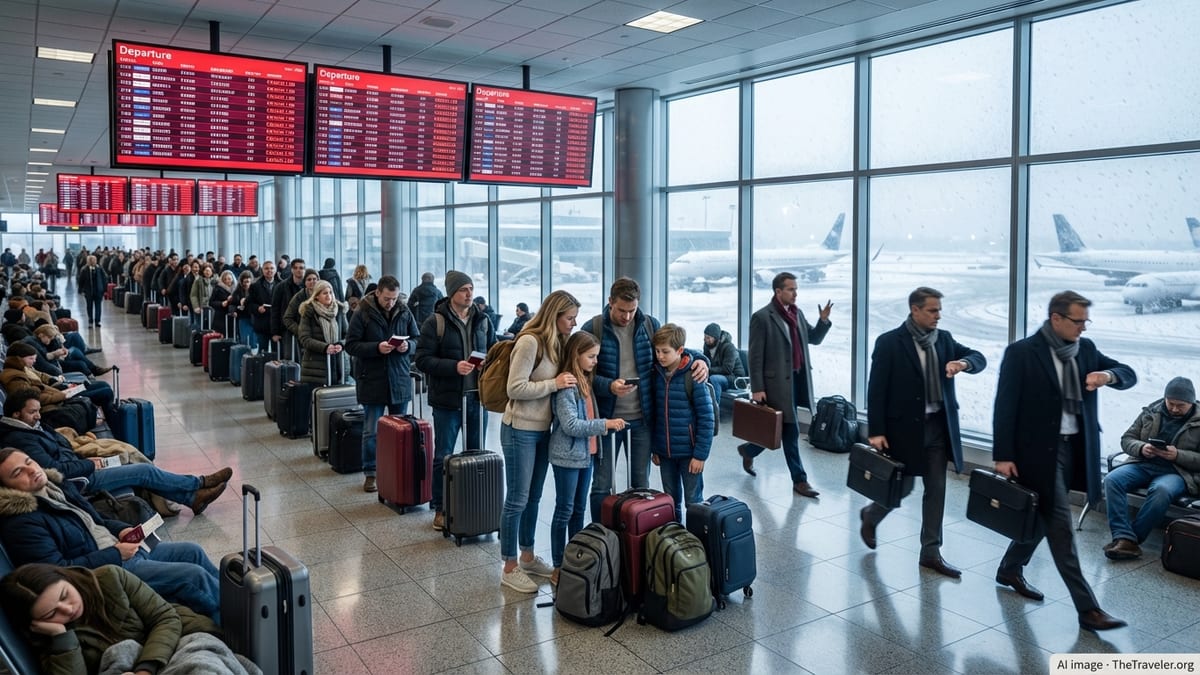
Spring break and Easter holiday travelers passing through Chicago O’Hare International Airport in late March and early April 2026 encountered some of the worst air travel disruption in the United States, as waves of severe weather and tightly packed schedules pushed the major hub to the top of national delay and cancellation rankings.
Get the latest news straight to your inbox!
Storms Collide With Peak Holiday Demand
The run up to Easter Sunday on April 5 coincided with an unsettled weather pattern across the Midwest, with multiple rounds of heavy rain, thunderstorms and low clouds repeatedly targeting northern Illinois. Publicly available aviation disruption trackers show that these storms did not just snarl local commutes; they helped turn Chicago O’Hare into one of the country’s main chokepoints for air travel.
On March 26, aviation compensation and assistance sites documented more than 240 delays and over 20 cancellations tied to an FAA ground delay program at O’Hare, after severe thunderstorms swept over the airfield and slowed the rate at which aircraft could safely land and depart. That early episode previewed what was to come as the broader Easter travel period approached.
By March 31, travel-industry summaries pointed to more than three thousand flight delays and over one hundred cancellations across the United States, with Chicago listed among the hardest hit cities. Coverage of that day’s operations highlighted O’Hare’s role as a disruption multiplier, with the hub experiencing hundreds of rolling delays that rippled outward to secondary airports as aircraft and crews missed their scheduled turns.
The pattern intensified as April began. Weather outlets tracked another strong storm system that crossed the Chicago area in the first days of the month, bringing fresh rounds of lightning, downpours and gusty winds just as Easter travelers were moving through the network. Those conditions repeatedly triggered traffic management programs at O’Hare at the very moment demand was peaking.
Ground Stops and Lengthy Delays at a Critical Hub
Over the course of this unsettled stretch, the most disruptive tool in the air traffic management playbook made several appearances at O’Hare: the ground stop. According to publicly accessible Federal Aviation Administration status boards and local broadcast coverage, at least two significant ground stops were issued for flights heading to or from O’Hare between March 31 and April 2 as storms moved across the region.
Local news reports describe a March 31 ground stop that halted inbound traffic while thunderstorms passed over the airport, followed by a separate event on April 2 that temporarily froze many departures and arrivals during the morning and again in the evening. At one point on April 2, regional media outlets citing FAA data reported that departures to O’Hare were facing average delays of more than three hours due to the weather.
Data aggregated by aviation-focused legal and travel platforms for March 31 show how quickly these measures can cascade. One analysis using FlightAware statistics reported more than 3,100 delays and 117 cancellations nationwide that day, with Chicago O’Hare alone accounting for nearly one third of all U.S. delays and dozens of cancellations. In practical terms, that meant that a single airport was responsible for a disproportionate share of the country’s disrupted flights.
Because O’Hare functions as a primary hub for multiple major carriers, every ground stop has outsized effects. Aircraft arriving late into Chicago can miss their next scheduled departures, crews may time out of legal duty limits, and tightly banked connection schedules can unravel. The result is that even passengers whose itineraries do not begin or end in Chicago often feel the consequences of problems that start there.
Why O’Hare’s Disruptions Spread Nationwide
Analysts who follow airline operations note that O’Hare’s status as an ultra-busy connecting hub leaves little room for error. Spring holiday periods already bring heavier passenger volumes, fuller flights and aircraft operating closer to their maximum daily utilization. When severe weather interrupts that system, the knock-on effects can be more dramatic than at smaller airports.
Publicly available traffic and performance summaries for March 31 illustrate how the network reacts under stress. With O’Hare absorbing hundreds of delays, downline airports began seeing late arrivals, compressed connection windows and last-minute gate changes. Regional jets feeding into Chicago from the Upper Midwest and Great Plains arrived off-schedule, complicating the timing of onward flights to the East and West Coasts.
This dynamic helps explain why Chicago’s troubles showed up so prominently in national statistics for delays and cancellations during the Easter travel period. Even when other airports, such as New York’s LaGuardia, recorded higher raw cancellation counts on certain days, analysts observed that the concentration of delays at O’Hare played a central role in slowing the wider U.S. aviation grid.
Travel industry commentary also points to structural factors at O’Hare, including ongoing construction, complex runway configurations and heavy reliance on tightly timed arrival and departure “banks” during peak periods. When thunderstorms or low ceilings force air traffic controllers to reduce arrival rates, the banked system can quickly fall out of sync, intensifying congestion on ramps and taxiways.
Passenger Experience: Missed Connections and Crowded Terminals
For travelers, the technical details translated into missed holidays, overnight stays and hours spent in crowded terminals. Social media posts and traveler forums in late March and early April were filled with accounts of passengers missing Easter family gatherings, arriving at destinations well after midnight, or waiting on tarmacs and at gates while storms stalled operations in Chicago.
Some passengers described landing early at O’Hare only to sit on the tarmac for extended periods while they waited for an open gate, a symptom of gate and ramp congestion when arrival banks bunch up after a weather delay. Others reported sprinting through terminals in an effort to make rebooked connections, only to find that additional rolling delays had shifted departure times again.
Consumer advocacy and passenger rights organizations used the disruption to remind travelers of their options. Guidance shared through public-facing advisories emphasized checking airline apps frequently, signing up for text alerts, and knowing the difference between weather-related disruptions and carrier-controlled problems, which can determine eligibility for hotel vouchers or rebooking on competing airlines.
At the same time, large numbers of travelers simply had to endure the situation. With flights running close to fully booked across many Easter routes, rebooking options were limited, particularly for families or groups hoping to stay together on a single itinerary. Observers noted that some travelers chose to abandon complex connections through Chicago in favor of overnight trains, rental cars or later departures once conditions improved.
What the Easter Disruptions Signal for Summer 2026
The convergence of volatile spring weather, tight airline schedules and heavy holiday demand at Chicago O’Hare offers an early stress test for the U.S. aviation system heading into the busy summer season. Industry commentators point out that many of the underlying pressures visible during the Easter period, including high load factors, constrained staffing and ongoing infrastructure projects, will remain in place through June, July and August.
Analysts observing March and early April performance suggest that large hubs such as O’Hare, Dallas Fort Worth and Atlanta may again emerge as focal points for nationwide disruption when major storm systems coincide with peak departure days. The Easter travel crisis in Chicago is being cited as a reminder that even brief ground stops or throughput reductions at a single hub can produce knock-on effects that last for days.
For travelers planning to connect through O’Hare later in 2026, widely shared advice includes scheduling longer layovers, favoring early-day departures when possible, and considering backup plans such as alternate routings or nearby airports. While no itinerary can fully eliminate the risk of weather delays at a major Midwestern hub, building in extra margin can reduce the chances that a short thunderstorm window will derail an entire trip.
More broadly, the concentration of delays and cancellations at O’Hare during the Easter period has renewed discussion among aviation observers about long-term resilience. As airlines seek efficiency through high aircraft utilization and tightly banked schedules, and as climate variability brings more frequent episodes of intense storms, large hubs may face increasing pressure to balance throughput with buffer. Early April’s travel chaos in Chicago suggests that this balance remains a work in progress.