

More news on this day
Emirates is reshaping its global schedule across more than 100 destinations, as the Dubai carrier balances a rapid ramp-up in services with ongoing airspace restrictions and shifting demand following weeks of regional disruption.
Get the latest news straight to your inbox!
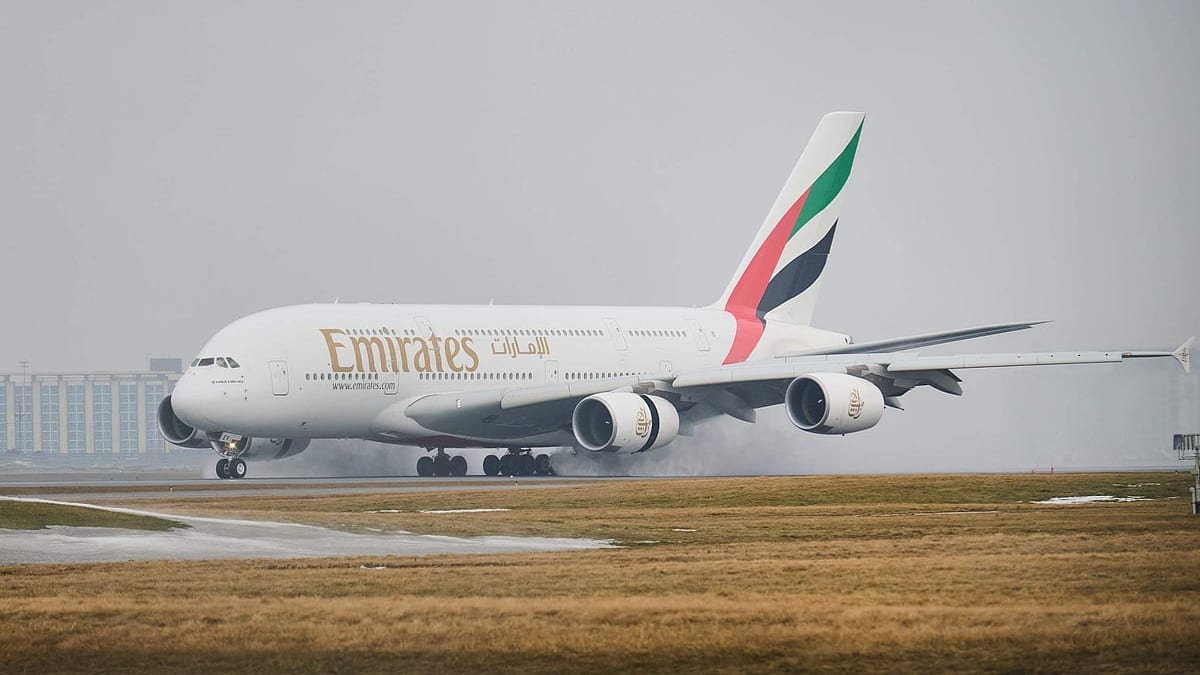
Reduced network still spans over 100 destinations
Publicly available data and recent aviation coverage show that Emirates is currently operating a reduced but still extensive network from Dubai, with flights touching at least 110 to 125 destinations on most days. That figure represents a step down from the airline’s typical schedule to more than 140 cities worldwide, but it marks a sharp recovery from early March, when airspace closures briefly cut the operation back to a few dozen routes.
Reports indicate that Emirates initially consolidated services into a core set of trunk routes, prioritising major European, Asian, Australasian and North American gateways along with key regional cities. Over subsequent weeks, frequencies were cautiously restored and additional points were reintroduced as airspace corridors reopened and regulators adjusted guidance. Analysts note that the pattern is highly dynamic, with some destinations seeing short-notice adjustments as conditions evolve.
Industry trackers suggest the airline is now operating between 150 and 160 daily departures, a significant increase compared with the lowest point of the crisis but still below normal levels. Within that figure, certain long haul routes have returned to near-regular schedules, while others are running at reduced weekly frequencies or remain temporarily suspended.
Emirates’ own public advisories emphasise that the schedule published for April should be viewed as a flexible framework rather than a fixed timetable, reflecting continued caution over regional security and operational resilience.
Key regions see frequency cuts, retimings and suspensions
The most visible impact of the current adjustment has been in markets that hinge on overflying sensitive airspace. Long haul services between Dubai and parts of Europe, East Asia and Oceania have faced a mix of retimings, extended routings and selected cancellations as the airline works around restricted corridors.
In Europe, travel reports describe a patchwork of outcomes: major hubs such as London, Paris and Frankfurt continue to receive multiple daily services, while secondary cities have seen frequencies trimmed or temporarily suspended. Some departures are operating at non-standard times, reflecting longer routings that add 25 to 50 minutes of flying time on certain east–west sectors.
Across Asia and the Pacific, Emirates has sustained connectivity to major gateways including Singapore, Sydney and key Indian cities, but with noticeable schedule revisions. Travellers on routes to Japan, parts of Southeast Asia and select Australian destinations have reported last minute changes, and in a few cases outright cancellations, as aircraft and crews are redeployed to higher priority sectors.
In Africa and the Middle East, coverage from regional outlets highlights a similar mix of cuts and consolidations. Primary commercial centres remain on the map, often with reduced weekly frequencies, while some thinner routes are paused. Aviation analysts describe the approach as a network “thinning” rather than a wholesale pullback, designed to preserve global reach while concentrating capacity where demand and operational certainty are strongest.
Flexible waivers and rebooking options for affected passengers
Alongside the flight adjustments, Emirates has extended a series of customer waivers designed to give travellers more flexibility. Public guidance from the airline and travel-industry advisories state that passengers booked to travel between late February and the end of April can typically rebook their journey, reroute within the same region, or request a refund if their flight is cancelled.
Several advisories indicate that one complimentary date change is being offered on eligible tickets, with rebooked travel generally allowed until mid June, subject to seat availability. Travel agents note that rules can vary slightly depending on the original ticket conditions and point of sale, and encourage customers to review the latest fare notes or contact their booking channel.
Consumer-rights information circulating in European markets also reminds passengers that standard compensation and refund protections remain in place where local regulations apply, even when disruptions are tied to broader geopolitical events. In practice, this often translates into a clear right to a cash refund when a flight is cancelled, but not necessarily to extra cash compensation for delays linked to airspace closures or security directives.
Travel publications stress that, while Emirates has been proactive in updating many itineraries automatically, some bookings are falling through the cracks. Passengers whose flights touch Dubai in the coming weeks are being advised to monitor their reservation closely, verify contact details, and actively seek alternatives if their original routing no not appear in current schedules.
Operational recovery at Dubai hub remains uneven
Dubai International Airport, Emirates’ primary hub, is emerging from one of the most challenging operational periods in its recent history after airspace closures that began on 28 February. Traffic levels have rebounded, and reports suggest that Emirates and its sister carrier flydubai are now operating more than 220 passenger flights per day, but capacity is still below pre-crisis norms and the recovery remains uneven.
Flight-tracking snapshots show that Emirates’ operation dropped from more than 500 daily flights to just a few dozen at the height of the disruption. Since then, the carrier has progressively rebuilt its schedule, carefully sequencing aircraft and crew positioning to avoid cascading delays. Industry observers point to the airline’s extensive widebody fleet as both an advantage in terms of range flexibility and a constraint when airspace closures force long detours.
Some aspects of the hub’s operation, such as the deployment of Airbus A380s on flagship routes, are being restored more slowly. Specialist aviation outlets indicate that the airline is targeting a gradual return of its full A380 programme in the coming months, contingent on security developments and aircraft availability after heavy utilisation during the disruption.
Airport-focused coverage also notes that ground operations in Dubai remain under pressure at peak times, particularly around banked connection waves. Travellers are being encouraged to allow extra time for transfers, monitor gate changes and expect occasional busing or remote stands as the hub juggles irregular aircraft patterns.
What travelers should expect in the weeks ahead
For passengers, the headline takeaway from the Emirates travel update is that the airline’s network is largely back, but not yet back to normal. Flights are operating across more than 100 destinations, yet schedules are more fluid than usual, and last minute adjustments are still a realistic possibility on select routes.
Travel experts recommend checking flight status repeatedly in the 48 hours before departure, including after completing online check in, as some retimings and equipment changes are being pushed close to departure time. Customers with tight self-connecting itineraries or separate tickets are being urged to build in generous buffers, especially when connecting through Dubai between long haul sectors.
Advisories aimed at corporate travel managers suggest prioritising routes that have seen stable operations over recent days, such as primary European and North American gateways, when planning essential trips in April. Where leisure travel is more flexible, postponing or rerouting journeys that rely on thinner Emirates services may reduce the risk of disruption.
With regional airspace gradually reopening and the carrier publicly targeting a return to its full network, analysts expect the scope of Emirates’ schedule adjustments to narrow as spring progresses. Until that happens, passengers flying with the Dubai-based airline are likely to see a network that is broad in geographic reach but still fine tuned on a day to day basis in response to evolving conditions.