

More news on this day
Emirates is preparing to bid farewell to its Airbus A380 in Copenhagen, but the end of Denmark’s only regular superjumbo service will coincide with a sizable capacity boost and a shift toward more frequent, flexible links to Dubai.
Get the latest news straight to your inbox!
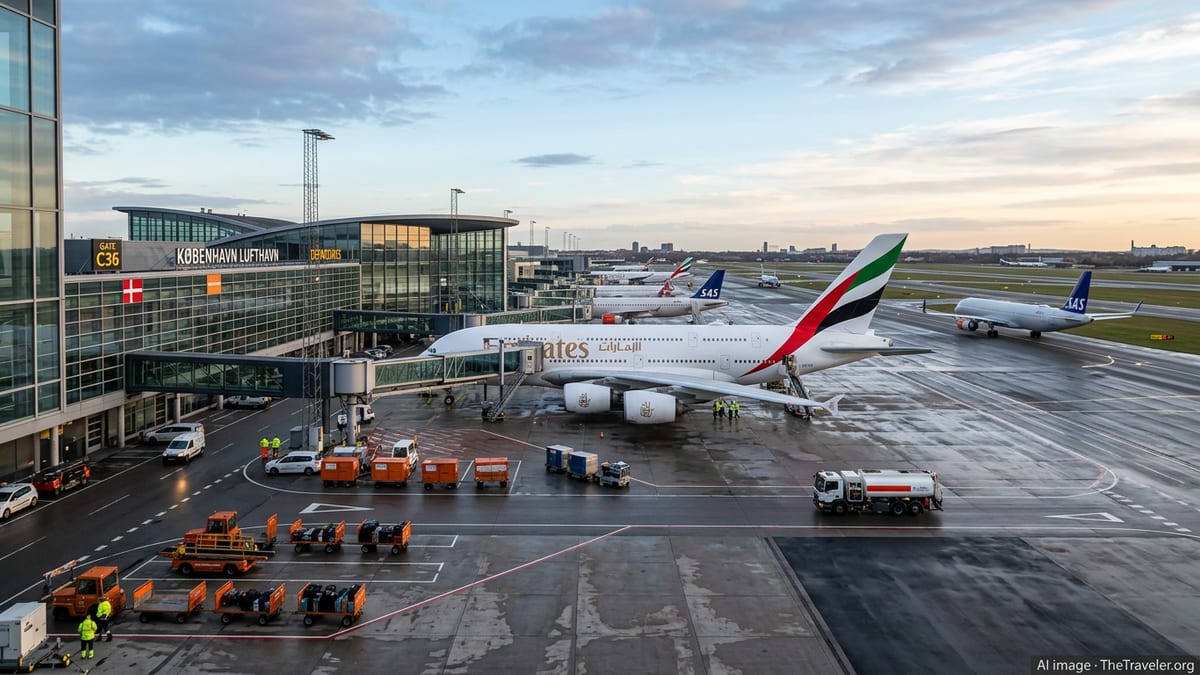
Final Superjumbo Touchdown Set for May 2026
Publicly available schedule data and specialist aviation coverage indicate that Emirates plans to operate its final Airbus A380 rotation between Dubai and Copenhagen on 31 May 2026. The decision will close a distinctive chapter for Copenhagen Airport, which invested in infrastructure to welcome the double decker in 2015 and has since marketed the aircraft as a symbol of its long haul ambitions.
The A380’s presence in Denmark has not been continuous. The superjumbo was withdrawn when the pandemic disrupted long haul travel and then reinstated in early 2025 in a high-density two class layout with 615 seats, one of the largest passenger configurations in commercial service. That move temporarily gave Denmark its highest capacity scheduled passenger aircraft and underlined the strength of leisure and visiting friends and relatives demand via Dubai.
Reports suggest the timing of the final flight reflects Emirates’ broader A380 lifecycle strategy. The carrier remains the world’s largest A380 operator, but is gradually rebalancing its network around a mix of refurbished superjumbos and new generation twins such as the Airbus A350 and Boeing 777 variants, particularly on routes where schedule flexibility and product variety are valued more than a single very large departure.
Two Daily Widebodies Replace One Superjumbo
From 1 June 2026, the A380 will be replaced on the Dubai–Copenhagen route by a pair of smaller widebody jets, according to route planning analyses. One rotation is expected to be operated by a Boeing 777-300ER, while a second daily departure will be flown by the Airbus A350-900, a type that is gradually being introduced across Emirates’ European network.
This represents a strategic pivot from one high-capacity flight to two daily services. Industry data indicate that total daily seats between Dubai and the Danish capital will actually rise by around 17 percent once both flights are operating, to roughly 1,400 seats per day. For passengers, the shift is likely to mean more choice of departure times and improved onward connections through Emirates’ Dubai hub, especially for Scandinavian travelers heading to Asia, Australia and the Indian Ocean.
For Copenhagen Airport and Denmark’s tourism sector, the move signals that Emirates is committed to the market even without the visual spectacle of the A380. Two daily widebodies typically provide better connectivity for business travelers and short trips, as well as smoothing demand peaks and spreading inbound visitor arrivals more evenly across the day.
Premium Economy and Product Upgrade for Denmark
One of the most notable changes tied to the new schedule is the planned introduction of Emirates’ premium economy cabin on the Copenhagen route for the first time. According to airline fleet information and recent network announcements, the A350-900 and refurbished Boeing 777 aircraft are being used to roll out this cabin across selected European gateways, reflecting strong demand for a product positioned between traditional economy and business class.
For Danish travelers, premium economy brings wider seats, increased legroom and upgraded dining compared with standard economy, at a price point lower than business class. The addition is expected to appeal to leisure passengers on long itineraries to destinations such as Bangkok, Sydney or Cape Town, as well as to small and medium-sized enterprises that seek comfort upgrades without paying full corporate business fares.
The change also fits into Emirates’ broader cabin refresh program, which is progressively refitting dozens of A380s and Boeing 777s with updated interiors. Although Copenhagen is losing the on-board bar and expansive upper deck associated with the A380, it is gaining a more modern and diversified product mix aligned with the airline’s latest brand positioning.
What the Shift Means for Copenhagen Airport
Copenhagen Airport has long highlighted its role as a hub for northern Europe, serving not only Denmark but also southern Sweden and parts of Norway. Long haul links to Dubai, operated by Emirates since 2011, are a key component of that strategy, providing one-stop access to markets that are otherwise too thin for direct nonstop service from Scandinavia.
The A380 era helped raise the profile of the route, particularly among aviation enthusiasts and premium travelers drawn to the aircraft’s scale and amenities. However, airport planning documents and annual reports already signal a focus on frequency and connectivity rather than aircraft size alone. The shift to two daily flights may fit that narrative more closely, boosting transfer options for passengers arriving on regional flights from across the Nordics.
In operational terms, replacing a single superjumbo with two smaller widebodies can ease pressure on individual gate areas, security peaks and baggage systems, even if overall daily throughput rises. For airport retailers, more evenly distributed long haul departures can also translate into steadier footfall in duty free and food and beverage outlets throughout the day.
Denmark’s Long Haul Outlook After the A380
The retirement of the A380 from Copenhagen will close a visually striking chapter at Kastrup, but the underlying story is one of growth rather than retreat. Emirates’ decision to double daily services suggests confidence in Denmark and the wider Øresund region as an origin and destination market, with continued opportunities in both inbound tourism and export-oriented business travel.
The move also reflects broader industry trends. Across Europe, airlines are increasingly favoring flexible, fuel-efficient twinjets over very large aircraft, while still using select hubs to showcase flagship types. In that context, Copenhagen’s shift from hosting one of the world’s highest-capacity A380s to fielding two modern widebodies with premium economy aligns the airport with the next phase of long haul network development.
For travelers, the superjumbo’s farewell may be tinged with nostalgia, but the practical outcome is more choice, more cabin options and tighter connections via Dubai. As Emirates retools its fleet and network for the 2030s, Copenhagen’s place on the map appears more embedded than ever, even without the giant silhouette of the A380 on the horizon.