

More news on this day
Dubai-based Emirates is operating a sharply reduced flight schedule across its global network as regional conflict and airspace closures disrupt key corridors through the Gulf, stranding passengers and forcing the airline to prioritise limited capacity on routes to Europe, Asia and Australia.
Get the latest news straight to your inbox!
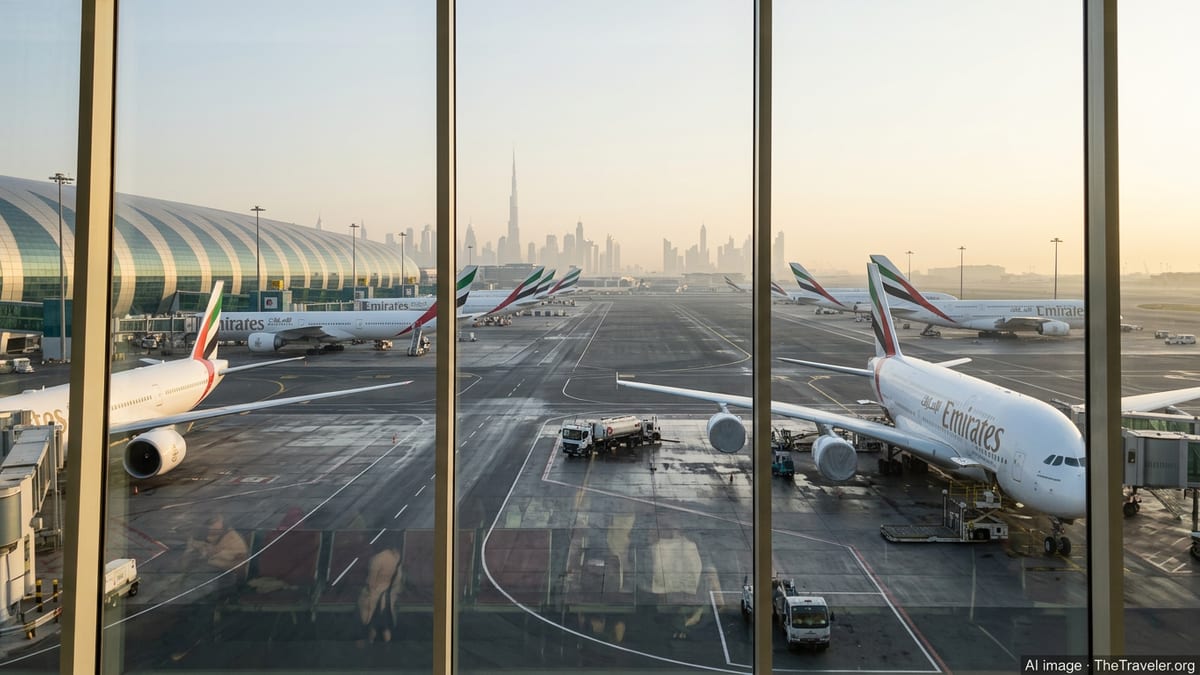
Airspace Closures Force Swift Cuts to Operations
Emirates’ cutbacks follow sudden airspace closures across the Gulf in late February, when escalating hostilities involving Iran prompted the United Arab Emirates and several neighbouring states to shut large portions of their skies to civilian traffic. Dubai International Airport, one of the world’s busiest hubs for international travel, saw regular commercial flights suspended for days as authorities conducted security and safety assessments.
While a partial reopening of regional airspace has allowed the carrier to resume flying, Emirates confirms that it is running a reduced schedule and will do so until conditions stabilise further. The airline has restored only part of its vast global network, with aircraft and crews redeployed to what it describes as “key destinations” to move stranded travellers and maintain essential long-haul links.
Industry trackers report that thousands of flights to and from major Gulf hubs were cancelled in the first week of March, with Emirates among the most heavily affected. Even as operations resume, routes are being reconfigured to avoid conflict zones, adding flying time and complicating crew scheduling, fuel planning and airport slot management.
Impact on Key Long-Haul Markets
The disruption is being felt most acutely on long-haul services that rely on Dubai as a central transfer point between Europe, Asia, Africa and Oceania. Emirates has reinstated a limited number of flights to major Australian gateways including Sydney, Melbourne and Perth, often pairing them with onward legs to cities such as Auckland and Christchurch to maximise scarce widebody capacity.
Services to Europe and North America, traditionally among the airline’s busiest and most lucrative routes, are also operating at reduced frequencies. Some cities are receiving fewer daily flights than usual, while others remain temporarily suspended or are being served with smaller aircraft, leading to tight seat availability in both premium and economy cabins.
Regional links into parts of the Middle East and South Asia are under particular pressure, with continuing airspace restrictions and operational risks constraining what the airline can offer. Flights to selected destinations, including Moscow and Peshawar, have been suspended or curtailed for longer than the rest of the network, reflecting a cautious approach to safety and overflight permissions.
The cuts are rippling through global travel patterns. With fewer Emirates services available, passengers are being rebooked via alternative hubs in Europe, Asia and Turkey, often adding several hours to total journey times and increasing costs for airlines as they absorb hotel stays, meals and irregular operations expenses.
Stranded Passengers, Rebooking Challenges and Travel Advice
For travellers, the sudden shift from a near-full Emirates schedule to a pared-back operation has meant cancelled itineraries, extended layovers and uncertainty over when they can reach their destinations. The airline has been operating special repatriation and recovery flights, prioritising customers whose original travel dates have already passed, and asking passengers not to come to the airport without a confirmed, operating booking.
Emirates and other UAE carriers are offering flexible rebooking and, in many cases, refunds or travel vouchers for disrupted trips. However, limited seat availability on the flights that are running means some passengers are being re-accommodated days later than planned. Call centres and digital channels have experienced heavy demand as customers seek clarity on new departure times and routing options.
Local authorities and airport operators in the UAE are echoing airline guidance by urging travellers to check their flight status repeatedly in the hours before departure and to avoid unnecessary trips to the terminals. Entry to some airport buildings is being restricted to ticketed passengers with same-day, confirmed departures, a measure designed to prevent overcrowding while capacity remains constrained.
Travel experts advise that passengers transiting through Dubai in the coming days build in additional buffer time, remain flexible about routing and cabin class, and monitor airline advisories closely, as schedules are still subject to rapid change in response to security assessments and regulatory decisions.
Operational Recovery Underway but Uncertainty Remains
Despite the scale of the disruption, Emirates insists that recovery is underway. The airline has progressively ramped up its network from a complete halt in scheduled departures at the height of the crisis to a restricted but growing list of destinations. By early March, industry sources indicated that the carrier was operating to dozens of cities, representing a significant portion of its usual schedule, with management publicly expressing confidence that full operations could be restored once regional airspace stabilises.
Dubai’s airports have also moved from total shutdown to what officials describe as “limited operations,” with more departure and arrival banks added each day. Aircraft are being carefully sequenced to make use of available corridors and optimise turnaround times, while cargo and repatriation flights continue to play a prominent role alongside regular commercial services.
Nevertheless, the outlook remains clouded by geopolitical risk. Further missile or drone activity, additional airspace restrictions or damage to aviation infrastructure elsewhere in the region could force renewed cuts in service or fresh suspensions on short notice. Airlines including Emirates are keeping contingency plans in place, with extra crew on standby and flexible fleet assignments that allow them to scale operations up or down quickly.
Aviation analysts note that the current episode highlights both the vulnerability and the resilience of hub-and-spoke carriers in the Gulf. Their central geographic position makes them highly exposed to regional instability, but their large, interchangeable fleets and deep operational experience with disruption management also give them tools to recover more rapidly than smaller competitors.
Broader Effects on Gulf Tourism and Global Connectivity
The reduced Emirates schedule is being closely watched by tourism boards, hotel chains and tour operators in the UAE and beyond. Dubai, which relies heavily on transfer traffic and stopover stays, is likely to see a short-term dip in visitor numbers as long as flight options remain limited and travellers weigh perceived security concerns.
Travel advisers say that while demand for leisure trips to the Gulf has softened, there remains steady interest from business travellers and visiting friends and relatives, particularly once airlines begin to signal a clearer timeline for a full return to normal operations. Many expect pent-up demand to materialise quickly once flight frequencies are restored and travel advisories begin to ease.
Globally, the disruption underscores how central Emirates and other Gulf carriers have become to long-haul connectivity. Reduced operations in Dubai have knock-on effects in markets as far apart as Australasia, Europe, Africa and North America, where travellers often rely on a one-stop journey through the Gulf rather than flying nonstop or changing planes in traditional European hubs.
For now, the message from Emirates is one of cautious progress. Flights are back in the air, but on a tighter, carefully managed network that reflects both operational realities and an overriding priority on safety amid continuing regional tensions.