

More news on this day
Emirates is accelerating its push to make global air travel more accessible for neurodivergent passengers, expanding autism-friendly “travel rehearsal” programs across its network and cementing its position as the world’s first Autism Certified Airline.
From Certification to Global Leadership in Autism Support
Emirates’ emergence as a leader in inclusive aviation is rooted in a multi-year strategy that prioritizes travelers with hidden disabilities, particularly autistic passengers and other neurodivergent individuals. In early 2024, the Dubai-based carrier became the first airline to be formally recognised as an Autism Certified Airline under standards developed by the International Board of Credentialing and Continuing Education Standards. That designation has now been reinforced with an expanded portfolio of services, partnerships and staff training designed to address sensory sensitivities and reduce anxiety throughout the journey.
More than 30,000 Emirates cabin crew and ground staff globally have completed dedicated training modules on autism and hidden disabilities. The program covers practical support techniques, communication styles, de-escalation strategies and guidance on how to respond with empathy in high-stress environments such as security checkpoints and boarding gates. The airline frames this as an operational priority rather than a niche service, integrating accessibility into frontline procedures, digital touchpoints and customer service standards.
These initiatives reflect a broader shift across the aviation industry, but Emirates has moved quickly to formalize its approach and pursue independent accreditation. In coordination with authorities and airport partners in Dubai, the carrier has leveraged the emirate’s existing commitment to “People of Determination” to build an end-to-end model that begins well before a passenger reaches the terminal, and now stretches into rehearsal programs in cities worldwide.
Travel Rehearsals: Practicing the Journey Before the Real Flight
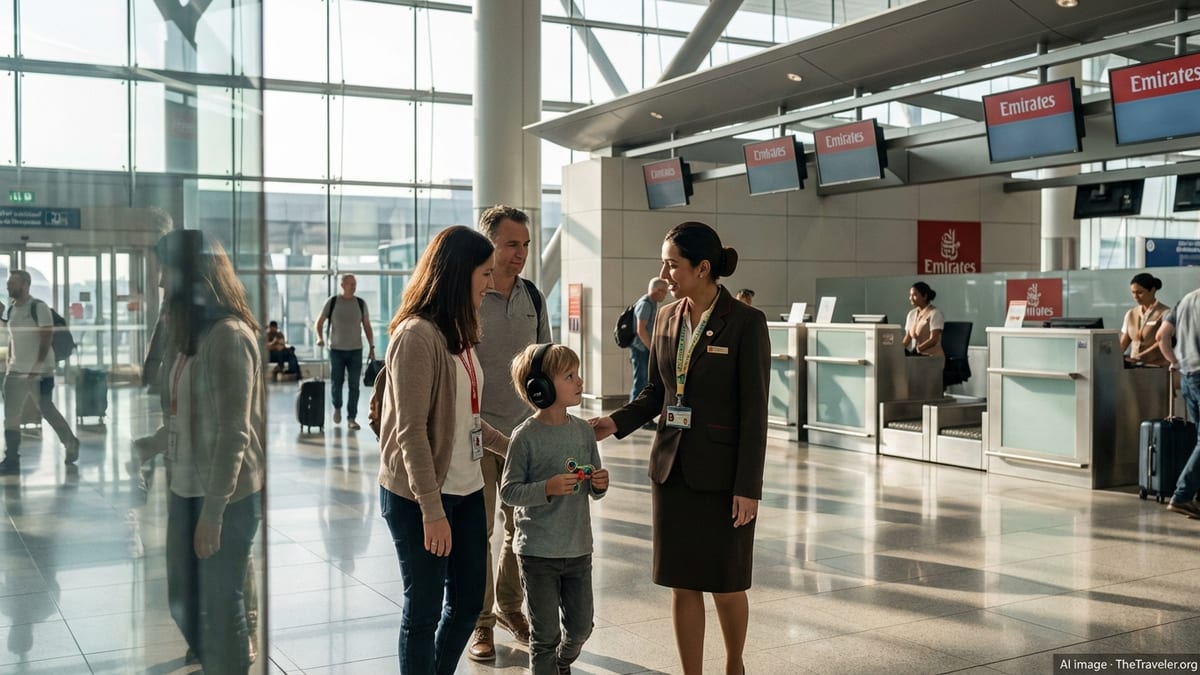
At the core of Emirates’ autism-friendly strategy is its “Travel Rehearsal” concept, a structured simulation that allows neurodivergent passengers and their families to practice the full airport and flight experience in a controlled, low-pressure environment. First piloted in Dubai in 2023 and highlighted publicly in 2024, these rehearsals walk participants through check-in, baggage drop, security screening, immigration, boarding and time onboard, including safety announcements and engine noise.
The rehearsals are designed around feedback from local autism centers, special-education schools and parents’ groups. Children and adults follow the exact sequence they would encounter on an actual travel day, but with additional time, clear explanations and trained staff on hand to pause or repeat steps. Many families report that simply knowing what comes next, and being able to experience the sensory environment in advance, can significantly reduce the risk of distress or meltdowns when the day of travel arrives.
These experiences are not just for passengers. They also serve as live training scenarios for airport and airline staff, who receive direct feedback from neurodivergent travelers and caregivers. Emirates and its partners use insights from each rehearsal to adjust signage, refine communication, and identify bottlenecks or unexpected triggers, such as sudden loud alarms or bright, flashing screens at certain points of the journey.
Expanding Across Continents: Rehearsals Go Global
What began as a Dubai-focused experiment has now become a global program. Emirates is rolling out travel rehearsals in at least 17 cities across its network, including Barcelona, Brisbane, Budapest, Cebu, Christchurch, Durban, Luanda, Madrid, Manila, Mauritius, Manchester, Montreal, Nice, Oslo, Paris and Toronto. Dubai and other UAE locations remain central hubs, but the airline is increasingly embedding rehearsals into local airports where its flights operate.
The expansion continued this week with a new rehearsal at Denpasar’s Ngurah Rai International Airport in Bali. On February 18, 17 participants, including eight children with autism and their guardians, took part in a guided simulation that mirrored the full travel sequence, from arrival at the airport’s international drop-off area to baggage collection and customs after “landing.” Emirates representatives in Indonesia described the event as part of a long-term commitment to bring accessible travel options to key leisure and family destinations on its network.
By exporting the rehearsal model beyond Dubai, Emirates is effectively creating a template for airports and regulators in different regions. Local teams must adapt to national security rules and infrastructure layouts, but the underlying aim remains the same: reduce unpredictability, provide clear visual and verbal cues, and create pathways that neurodivergent travelers can recognize and trust. The airline says more international airports are preparing to host similar events in the coming months.
Dubai’s Autism-Friendly Ecosystem and the Airport Experience
Emirates’ initiatives sit within a wider effort by Dubai to brand itself as an autism-friendly destination. Dubai International Airport has been recognised as a Certified Autism Center, meaning its facilities and services meet established criteria for supporting neurodivergent travelers. One visible element is the use of the Hidden Disabilities Sunflower symbol, which appears on lanyards, staff pins and signage to discreetly signal that a passenger may need extra time, clearer communication or a quieter route through the terminal.
Families can request an “Autism Friendly Route” at Dubai International, giving access to priority lanes at check-in, immigration, security and boarding. This is intended to minimize queuing time, which often combines noise, crowds and sensory overload. Airport staff trained in working with hidden disabilities are stationed along this route and are briefed to adapt their approach, such as allowing a child to board first to settle into the seat, or last if waiting in the gate area is more comfortable.
Dubai authorities, together with the airline and tourism bodies, have also developed visual guides that map each stage of the airport journey, using photos and step-by-step explanations. These materials let families build visual schedules at home, preparing children for what they will see, hear and be asked to do. Officials describe the city’s autism-friendly strategy as part of a broader social agenda aimed at supporting families and enhancing the experience of “People of Determination,” a local term for people with disabilities.
Onboard Support: Training, Seating and Sensory Tools
Once onboard, Emirates has been working to align the cabin experience with the needs of neurodivergent travelers. Passengers who self-identify as having a hidden disability can request that the “DPNA” service code be added to their booking, signaling a developmental or intellectual disability to staff throughout the journey. This allows crew to anticipate potential needs, allocate extra time for boarding or safety briefings, and seat families together in areas that may feel calmer, such as bulkhead rows with more space.
The airline encourages families to pre-select meals and in-flight entertainment using its app, so that favorite foods and familiar shows are ready on departure. This kind of predictability can be particularly beneficial for autistic children who rely on routine and known stimuli. Emirates is also introducing a range of tactile fidget toys and sensory tools across all cabin classes, to be offered to neurodivergent passengers and any traveler experiencing heightened anxiety. Items such as soft aircraft-shaped stress relievers and small fidget cubes are intended to provide controlled sensory input and a calming focus during take-off, landing or turbulence.
Cabin crew training emphasizes non-judgmental responses to behaviors that might once have been misunderstood, such as stimming, rocking or covering ears during loud announcements. Staff are instructed to check in with caregivers, offer practical solutions like moving seats if feasible, and adjust their communication style, including using simple, concrete language instead of idiomatic phrases that may be confusing for some autistic passengers.
Pre-Travel Planning and Digital Accessibility
Recognizing that stress often begins long before travelers reach the airport, Emirates has built an online Accessible and Inclusive Travel Hub that centralizes information for passengers with additional needs. The platform covers subjects such as hidden disabilities, mobility assistance, medical travel and family travel, with sections tailored to those flying with autistic children or adults. The airline says it used inclusive research methods while designing the hub, involving users with different disabilities to test navigation, clarity and content structure.
For neurodivergent travelers, the hub and related resources provide practical tools to script the journey in advance. Families can learn how to request the DPNA code, what documentation may or may not be required, what to expect from priority routes in Dubai, and how to access visual guides for airport procedures. They can also find information on special meal options and guidance on packing comfort items such as noise-cancelling headphones or weighted lap pads.
Emirates encourages early communication about accessibility needs, urging passengers to contact local offices ahead of travel dates. The airline presents this not as an application for “special treatment” but as a collaborative planning process that helps staff understand triggers, preferred communication methods and any equipment or assistance required. This proactive stance aligns with insights from autism advocacy groups, which emphasize that predictability, clear expectations and flexible responses can be as important as physical infrastructure.
Industry Momentum and the Wider Shift Toward Neurodiversity
Emirates’ initiatives come amid growing industry awareness of the barriers neurodivergent travelers face at airports and onboard aircraft. Airlines in North America, Europe and the Asia Pacific region have adopted programs such as sensory rooms, quiet spaces and practice boarding days under banners like “Wings for Autism” or airport-specific rehearsal schemes. These events similarly allow children and adults on the autism spectrum to experience check-in, security and boarding without the added pressure of a scheduled departure.
What differentiates Emirates, analysts say, is the scale and formalization of its approach, combined with its early move to obtain dedicated autism certification. By extending rehearsals to multiple continents and embedding autism awareness throughout its training and digital infrastructure, the carrier is positioning itself as a reference point for global best practice. The model is being closely watched by other full-service airlines and hub airports seeking to improve their own accessibility credentials.
Advocacy organizations argue that accessible travel is not only a social responsibility but also a significant market opportunity. Studies cited by Emirates and its partners suggest that many families with neurodivergent children avoid flying entirely because of the stress and unpredictability involved. When airports and airlines introduce autism-friendly measures, those same families report being more willing to book trips, potentially unlocking a substantial wave of pent-up demand for both leisure and visiting-friends-and-relatives travel.
Looking Ahead: Normalising Autism-Friendly Travel Worldwide
As Emirates deepens its autism-friendly initiatives, the airline’s leadership has framed accessible travel as a long-term transformation rather than a limited campaign around awareness days. The continued rollout of travel rehearsals, the evolution of sensory tools onboard and the integration of accessibility content into digital channels are all positioned as foundations for wider systemic change.
Industry observers expect that as more airports in the Emirates network host rehearsal events, the practical knowledge gained will influence terminal design, signage strategies and staff deployment beyond the specific needs of autistic travelers. Features such as clearer visual communication, reduced queuing times for those who need it and calmer wayfinding environments are likely to benefit a broad spectrum of passengers, including elderly travelers, families with young children and those with anxiety disorders.
For now, Emirates’ combination of global reach, formal certification and hands-on rehearsal programs has placed it at the forefront of autism-friendly air travel. As other carriers and aviation authorities take note, the practices being refined in Dubai, Denpasar and a growing list of international cities may help shift expectations of what inclusive air travel looks like, and who it is designed to serve.