

More news on this day
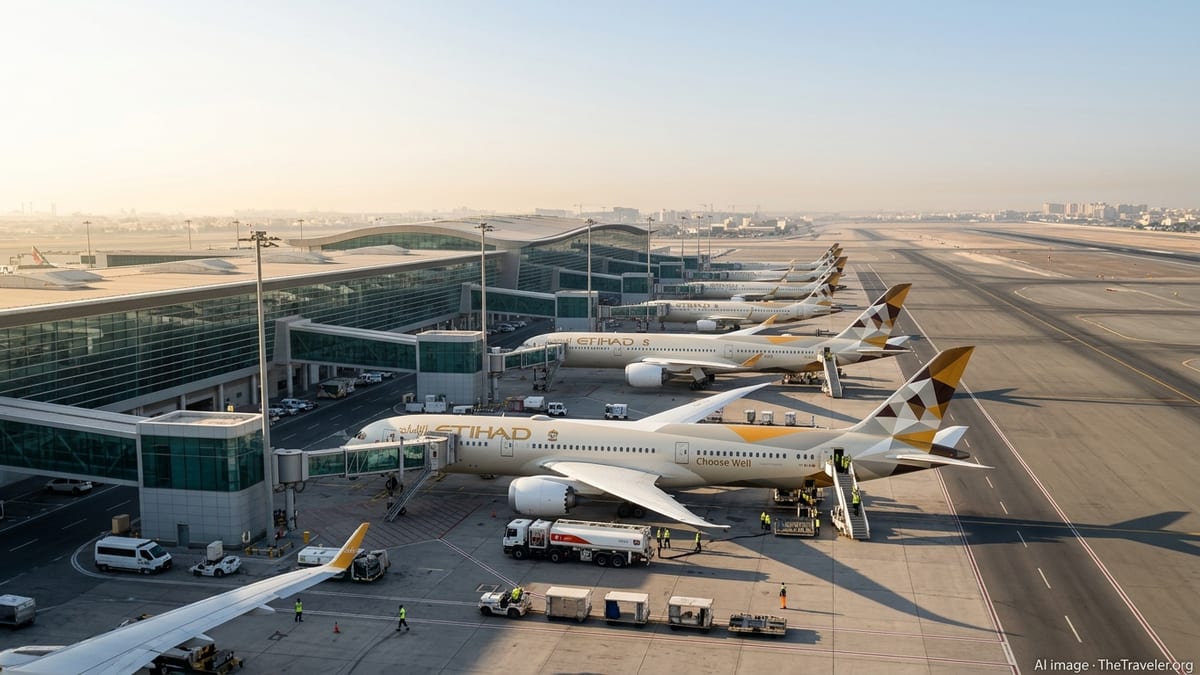
Etihad Airways is expected to operate 62 passenger departures from Abu Dhabi on Friday, March 27, 2026, marking a significant step in the carrier’s gradual restoration of scheduled services following weeks of disruption to air travel across the United Arab Emirates.
Get the latest news straight to your inbox!
Measured Ramp-Up After Earlier Flight Suspensions
Publicly available travel advisories and airport updates indicate that Etihad’s network has been rebuilding in phases after a period in early March when most commercial flights to and from Abu Dhabi were suspended and later restarted with a reduced schedule. In that initial restart phase, the airline focused on a limited list of core destinations and a smaller number of frequencies while operational conditions were reassessed and airspace capacity was gradually restored.
Since the first wave of resumptions in early March, timetable filings and booking data show a steady increase in daily departures out of Abu Dhabi, with additional cities and higher weekly frequencies being reintroduced as conditions allowed. Industry coverage has highlighted how airlines at Zayed International Airport have been spacing flights more conservatively and coordinating closely on departure and arrival slots, a pattern that aligns with Etihad’s decision to scale up cautiously rather than return immediately to pre-disruption volumes.
Within that context, scheduling 62 outbound Etihad flights for Friday, March 27, 2026, represents a notable step up from the earliest restart days, when only a fraction of the network was operating. While still below the peak levels implied by the airline’s record traffic and fleet growth in 2025, the figure signals that Abu Dhabi’s home carrier is working toward restoring a more recognizable hub structure by late March.
Key Long-Haul Markets Anchor the 62-Flight Roster
The planned 62 departures are expected to be anchored by Etihad’s long-haul services linking Abu Dhabi to Europe, North America, and major cities across Asia-Pacific. Recent network updates for the 2026 northern summer season point to robust schedules on core routes such as London, Paris, and key Southeast Asian destinations, supported by widebody aircraft including Boeing 787s and Airbus A350s. These high-demand corridors form the backbone of the hub’s intercontinental connectivity and are among the first to see capacity restored when conditions stabilize.
North American routes, which have featured prominently in Etihad’s recent growth announcements, are also expected to contribute to the 62-flight tally. New services planned for 2026, alongside established operations to gateways such as New York, factor into Abu Dhabi’s strategy of drawing long-haul transfer traffic while also serving point-to-point demand to the UAE capital. Schedules for late March suggest that at least some of these services are operating on or close to their intended frequencies, even as select flights remain subject to last-minute adjustments.
In Asia, Etihad’s expansion over the past two years, including increased frequencies to markets in India and Southeast Asia, has reinforced Abu Dhabi’s position as a connecting hub between Europe and the broader Asia-Pacific region. A portion of the 62 ex-Abu Dhabi flights on March 27 is expected to serve these high-traffic regional and medium-haul city pairs, which generate both origin-and-destination demand and a large share of connecting itineraries that flow through the UAE.
Short- and Medium-Haul Connectivity Across the Middle East and Africa
Beyond its intercontinental network, Etihad’s schedule for Friday, March 27, 2026, is set to feature a dense layer of short- and medium-haul departures across the Gulf, wider Middle East, and parts of Africa. Recent statistics from Abu Dhabi’s aviation authorities show that regional connectivity has been a central factor in the emirate’s record passenger volumes, with carriers including Etihad adding routes and frequencies to nearby capitals and major commercial centers.
In the Middle East, Etihad’s services to Gulf Cooperation Council states and to Levant markets support both business and leisure flows, as well as same-day connections to longer-haul flights. On a day with 62 outbound departures, multiple banks of flights within the region help sustain Abu Dhabi’s role as a transfer point, offering early-morning, mid-day, and late-night options that align with arrivals from Europe, Asia, and North America.
African routes, where Etihad has been gradually increasing its presence, are also expected to figure into the March 27 schedule. Over the last two years, the airline has signaled a stronger focus on African connectivity, including more frequent services to selected gateways. These operations expand Abu Dhabi’s reach into emerging markets and contribute to the mix of destinations represented in a 62-flight departure day.
Hub Operations at Zayed International Airport
Zayed International Airport, Etihad’s home base, ended 2025 with record passenger traffic, supported in part by the carrier’s accelerated network and fleet growth. Airport operator data describe the facility as one of the fastest-growing large hubs in its region, with an expanding portfolio of airlines and destinations and new infrastructure designed to handle higher volumes and more complex transfer flows.
For a hub airline such as Etihad, a 62-departure day is significant not only in absolute terms but also in how those flights are structured across the day. Schedule patterns indicate that departures are clustered into connection-friendly waves that match arrival banks from long-haul markets, allowing passengers to transfer between continents with relatively short layovers. This banked structure, even when operated at lower-than-peak volumes, preserves the connectivity benefits that Abu Dhabi has been cultivating.
The airport’s recent performance figures, combined with Etihad’s own traffic milestones and fleet expansion, suggest that operations on March 27 are part of a broader trajectory toward higher daily movements. With more aircraft available and new routes due to begin in the coming months, Zayed International is positioned to support further increases in both departure counts and overall passenger throughput as conditions allow.
What 62 Daily Departures Signal About Etihad’s Recovery
Etihad’s decision to schedule 62 outbound flights from Abu Dhabi on Friday, March 27, 2026, offers a snapshot of an airline that is still managing the operational aftereffects of recent regional events while keeping its longer-term growth strategy in view. Public financial and traffic results for 2025 showed record passenger numbers and profits, driven by expanded capacity and a larger, more efficient fleet, and those fundamentals remain the backdrop to the current rebuilding of day-to-day operations.
Travel industry observers note that Etihad has been pursuing a strategy of disciplined growth, adding destinations and aircraft while maintaining high load factors. In that context, a measured ramp-up to 62 departures on a single day reflects a preference for restoring reliable, consistently filled flights rather than chasing headline-grabbing volume. It also underscores the importance of aligning schedules with available airspace capacity and the evolving operational environment across the Gulf region.
For passengers, the March 27 schedule points to a broader and more familiar array of travel options out of Abu Dhabi compared with the heavily curtailed operations seen earlier in the month. With additional routes due to start later in 2026 and further network adjustments expected as conditions evolve, the 62 ex-Abu Dhabi flights planned for this Friday suggest that Etihad is moving steadily back toward the scale of operations that underpinned its recent record year.