


More news on this day
The European Union is pressing ahead with its new biometric Entry/Exit System at external borders, declining to suspend the scheme for the summer peak even as officials acknowledge around 20 particularly problematic crossing points where queues and technical problems have already strained travellers and border staff.
Get the latest news straight to your inbox!
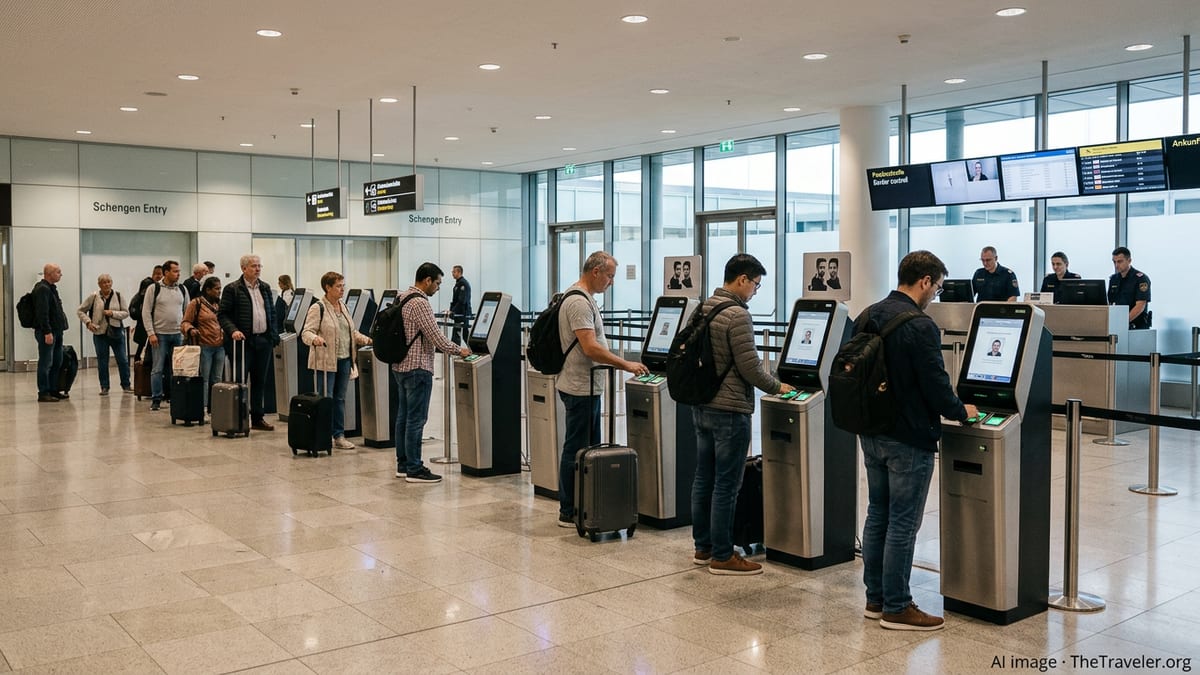
Pressure grows over queues at key Schengen gateways
Reports from European and specialist travel media indicate that the rollout of the Entry/Exit System has created long waits at several of the continent’s busiest air and land borders. Airport groups and airline associations have warned since the pilot phase that biometric registration can increase processing times by more than half during peak hours, with some hubs previously experiencing waits of several hours during stress tests.
According to recent coverage, national authorities have mapped about 20 “difficult spots” where passenger volumes, infrastructure limits or technical instability make bottlenecks more likely. These include several major Schengen airports handling large numbers of long haul arrivals, as well as high traffic road crossings used by coach operators and cross border commuters.
Travel industry bodies argue that these pressure points risk cascading disruption across the network as the main summer season begins, with missed connections, delayed departures and mounting staffing costs at border control. Consumer organisations have meanwhile warned that the impact will be felt most sharply by non European visitors and dual nationals who must now undergo biometric checks on every entry and exit.
Commission rules out general suspension, offers targeted relief
Publicly available information from Brussels shows that the European Commission has rejected calls from airlines and some member states for a blanket suspension of biometric checks during the peak holiday months. Officials maintain that the system delivers significant security benefits by replacing passport stamps with a centralised record of crossings, refusals of entry and verified biometric templates.
Instead of a full pause, the Commission has endorsed a more limited form of flexibility. In line with earlier legal provisions, national authorities may temporarily suspend the capture of fingerprints and facial images at individual border posts when waiting times exceed agreed thresholds. Under this approach, standard passport checks remain mandatory, but the additional biometric step can be postponed at specific locations and times.
Recent guidance stresses that such derogations should be exceptional, time limited and tied to clear indicators such as queue length and processing capacity. The Commission has also highlighted statistics showing that the Entry/Exit System has already detected tens of thousands of overstays and refusals of entry since initial deployment, arguing that this demonstrates why the core architecture should stay in place.
Frontex support and technical fixes aim to stabilise rollout
In response to mounting operational complaints, the European Union is preparing additional support measures to help member states cope with the new workload. Reporting from Brussels based outlets notes that Frontex, the bloc’s border agency, is being positioned to send temporary reinforcements to the most congested airports and land crossings where national staffing is under strain.
Extra resources are also being channelled into technical assistance, with teams tasked with resolving software glitches, fine tuning biometric capture devices and improving the integration of national border systems with the central database. Industry feedback suggests that inconsistent hardware performance and training gaps have been major contributors to early delays, particularly where first time users struggle with fingerprint or facial scans.
EU institutions are encouraging wider use of pre enrolment tools and self service kiosks for repeat travellers, which could help shorten manual checks once passengers are familiar with the process. However, rollout of these solutions remains uneven across the Schengen area, and several airports that rely heavily on physical booths are expected to remain under pressure throughout July and August.
Travellers face patchwork of experiences across Schengen
For travellers, the decision not to suspend biometric checks means that border experiences are likely to vary sharply depending on the point of entry. According to travel advisories summarising recent developments, some airports report only modest increases in processing times, while others warn of possible queues stretching well beyond one hour at peak arrival banks.
Road crossings and ferry ports have recorded mixed results. On some routes, particularly those with lower volumes or recent infrastructure upgrades, the Entry/Exit System has been integrated with little visible disruption. Elsewhere, coach operators and tour companies have flagged concerns about roadside delays as entire vehicles must disembark so that first time visitors can complete registration at limited numbers of booths.
With no Europe wide suspension in place, responsibility for contingency planning largely rests with individual states and operators. Many airlines now advise passengers heading into the Schengen zone to allow significantly more time for border control and to avoid tight connections on itineraries that involve an initial arrival from outside the area followed by a separate onward ticket.
Security objectives weighed against tourism and mobility
The Commission and several member governments continue to frame the Entry/Exit System as a long term investment in secure and efficient borders. By centralising data and using biometrics, the system is designed to make it harder for travellers to overstay or use multiple identities, while also giving border guards faster access to travel histories.
Critics in the transport and tourism sectors do not contest the security aims but argue that implementation has been rushed compared with the pace of infrastructure upgrades and staff recruitment on the ground. They also worry that a perception of chaotic queues at certain European gateways could deter visitors or push long haul travellers to reroute via non Schengen hubs.
As summer begins in earnest, the standoff over suspension has turned into a test of whether targeted derogations, extra personnel and technical fixes can stabilise border flows without diluting the biometric regime. For now, publicly available information indicates that the European Union prefers to preserve its new digital border architecture and manage the 20 identified trouble spots within that framework, rather than pausing the system across the board.