

More news on this day
Air travel across Europe faced another day of heavy disruption as 231 flights were reportedly cancelled and around 1,449 delayed across key hubs in Germany, England, the Netherlands, Portugal and Denmark, affecting operations at Frankfurt, London, Amsterdam, Madeira and Copenhagen and impacting major airlines including Lufthansa, easyJet, SAS, KLM and Iberia.
Get the latest news straight to your inbox!
Wave of Disruptions Across Major European Hubs
Publicly available tracking data and industry reports indicate that congestion has intensified across Europe’s busiest corridors, with cancellations and delays clustering around Frankfurt, London, Amsterdam, Madeira and Copenhagen. These airports serve as essential hubs and leisure gateways, so even a single day of significant schedule disruption can strand thousands of travelers and ripple into wider networks.
The reported figure of 231 cancellations and 1,449 delays reflects a pattern seen repeatedly in early April, when several European airports have already struggled with a combination of unsettled spring weather, airspace constraints and operational bottlenecks. Recent coverage has highlighted days when more than 1,600 European flights were delayed and dozens cancelled, underscoring how quickly routine pressure on runways and airspace can turn into broad travel headaches.
While some airports have seen higher absolute numbers on specific days, the latest disruption stands out for its broad geographic spread. Germany, England, the Netherlands, Portugal and Denmark all feature prominently, a mix of core business hubs and popular tourism gateways at the start of the busy spring travel period.
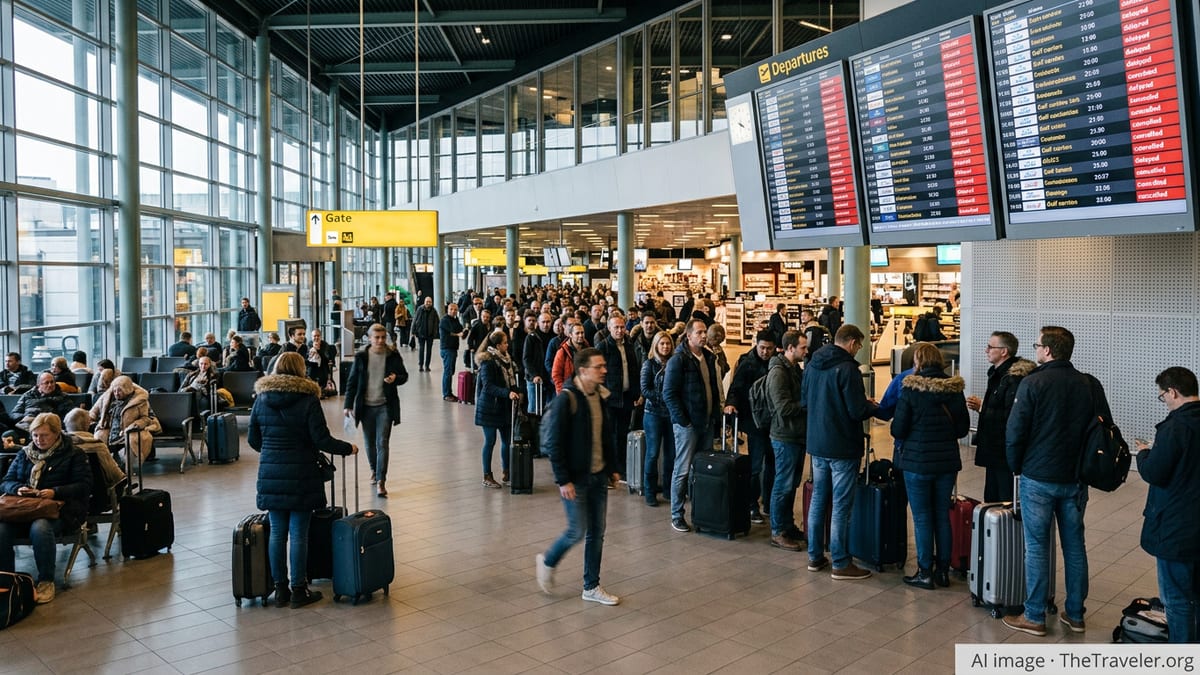
For passengers, the impact has been felt in growing queues at security and check in, crowded gate areas and long waits for aircraft arriving late from other parts of the network. With aircraft and crew operating on tight rotations, a delay early in the day in Frankfurt or London can quickly cascade into late departures and missed connections as far away as Madeira.
Frankfurt, London, Amsterdam, Madeira and Copenhagen Under Strain
Frankfurt, one of Europe’s primary intercontinental gateways, has been a focal point of disruption. Previous punctuality analyses for the region show that Frankfurt is particularly vulnerable to a combination of low visibility, congestion and staffing challenges, which can rapidly translate into rolling delays as aircraft and crews miss their scheduled slots. Those same structural pressures appear to be amplifying the latest wave of schedule issues.
In the United Kingdom, London’s crowded airport system has also come under renewed pressure. Recent travel reports describe days when London hubs have seen well over 200 delayed departures in a single day, with early morning cancellations at key bases compounding later queues. With London serving as both an origin and a connection point for much of northern and western Europe, even modest disruption there can propagate along routes into Scandinavia, Iberia and central Europe.
Amsterdam Schiphol, one of the continent’s busiest transfer hubs, has been grappling with its own operational constraints in recent months. Earlier in April, coverage highlighted nearly 2,000 late flights in a single day linked to Air France and KLM network pressures centred on Paris and Amsterdam, demonstrating how hub congestion can spread beyond any one carrier. The latest figures again place Amsterdam among the hardest-hit airports for delays, forcing many passengers into missed connections or overnight rebookings.
Further south, Madeira’s role as a key leisure destination for northern European travellers makes it particularly sensitive to disturbances higher up the network. Delays at London, Frankfurt or Amsterdam can quickly translate into late arrivals or cancelled rotations on island routes, leaving holidaymakers waiting in terminals or facing last minute changes to their plans. Copenhagen, serving both as a Scandinavian hub and a link to broader European traffic flows, has also reported growing knock-on effects as delayed flights arrive late from central and western Europe.
Major Airlines See Schedules Upended
The latest disruption has affected a broad mix of full service and low cost airlines. Network carriers such as Lufthansa, KLM, SAS and Iberia, along with large low cost players including easyJet, have all seen a share of cancellations and substantial delays, according to tracking services and aviation news outlets. Because these airlines rely heavily on tight hub-and-spoke connections at airports like Frankfurt, Amsterdam and Copenhagen, disruption in any part of the system can quickly spread.
Recently published data on earlier April travel days in Europe shows that Lufthansa, British Airways, KLM, Ryanair, Vueling and others have all experienced spikes in late or cancelled flights as weather systems, air traffic control restrictions and airport congestion combined. The latest round of disruption appears to fit that broader pattern, with airlines juggling crew rosters, aircraft positioning and limited spare capacity to keep as many services operating as possible.
For passengers booked on multi-leg itineraries, the challenges are especially acute. A single delay on a feeder flight into Frankfurt or London can cause missed intercontinental connections and force complex rebookings, sometimes across different alliances or partner airlines. Given the reported scale of delays and cancellations, many travellers are likely to face rerouting via alternative hubs or overnight stays while airlines work through backlogs.
Low cost carriers are not immune. Reports point to days when airlines such as easyJet have faced clusters of late departures from bases in the UK and continental Europe, driven by a mix of weather and airport-related issues. Unlike some full service carriers, which may have more options for re-accommodating passengers onto later long haul services, point to point operators often have less flexibility when entire rotations are thrown off schedule.
Weather, Airspace and Operational Pressures Combine
The causes of the latest wave of cancellations and delays appear to be layered rather than singular. Aviation and travel analysis published in recent days points first to unsettled spring weather, with strong winds and low cloud over parts of western and northern Europe slowing departures and arrivals. Such conditions can reduce runway capacity, force aircraft to hold or divert, and require greater spacing between flights.
At the same time, ongoing airspace constraints continue to affect European operations. Parts of the continent remain subject to route restrictions linked to geopolitical tensions and long standing military or air traffic management limitations. These factors shorten the number of available routings and can push more flights into already busy corridors, heightening the risk of delays when traffic peaks.
Operational issues at specific airports also play a role. Recent punctuality reports for Europe have underlined how staffing shortages in ground handling, security screening or air traffic control can magnify the impact of even minor weather events. When key hubs like Frankfurt, Amsterdam or London operate close to capacity during peak hours, relatively small disturbances can quickly escalate into substantial backlogs of delayed departures and arrivals.
Industry observers also note the continued tightness of airline and airport resources. Many carriers and ground service providers are still rebuilding capacity after the pandemic era, and spare aircraft and crews to recover from disruptions remain limited. As a result, a single cancelled rotation in the morning can remove the buffer needed to absorb later schedule shocks, leading to more cancellations and rolling delays throughout the day.
What Passengers Can Expect in the Coming Days
With disruption levels elevated in several European hubs in early April, travellers are likely to see lingering knock on effects, particularly on short and medium haul routes that rely on tight aircraft rotations. Once aircraft and crews are out of position, it can take days of relatively smooth operations to restore normal patterns across a large network.
Consumer advocacy organisations and travel rights specialists advise that passengers keep a close watch on flight status via airline apps and airport information boards, especially for connections through Frankfurt, London, Amsterdam, Madeira and Copenhagen. Experience from recent days suggests that same day changes remain possible as airlines juggle resources, and that early morning services may be particularly vulnerable when aircraft arrive late from overnight operations.
Under European and UK passenger rights rules, travellers whose flights are cancelled are generally entitled to a choice between a refund and rerouting, as well as care and assistance such as meals and accommodation where required. Compensation may depend on the underlying cause of the disruption and whether it is considered outside the airline’s control, such as severe weather or airspace closures.
As airlines across Germany, England, the Netherlands, Portugal and Denmark work through the current backlog, passengers planning trips in the coming days may benefit from allowing additional time for connections, considering earlier departures where possible and preparing for the possibility of last minute gate changes or rebookings. With the spring travel season still ramping up, how smoothly carriers and airports handle this latest episode may provide an early indicator of resilience ahead of the peak summer rush.