

More news on this day
Thousands of air passengers across Europe faced severe disruption today as a wave of flight cancellations and delays hit major hubs in Switzerland, the United Kingdom, France and Germany, with data indicating at least 51 cancellations and more than 750 delays affecting operations at airports including Zurich, London, Paris and Frankfurt.
Get the latest news straight to your inbox!
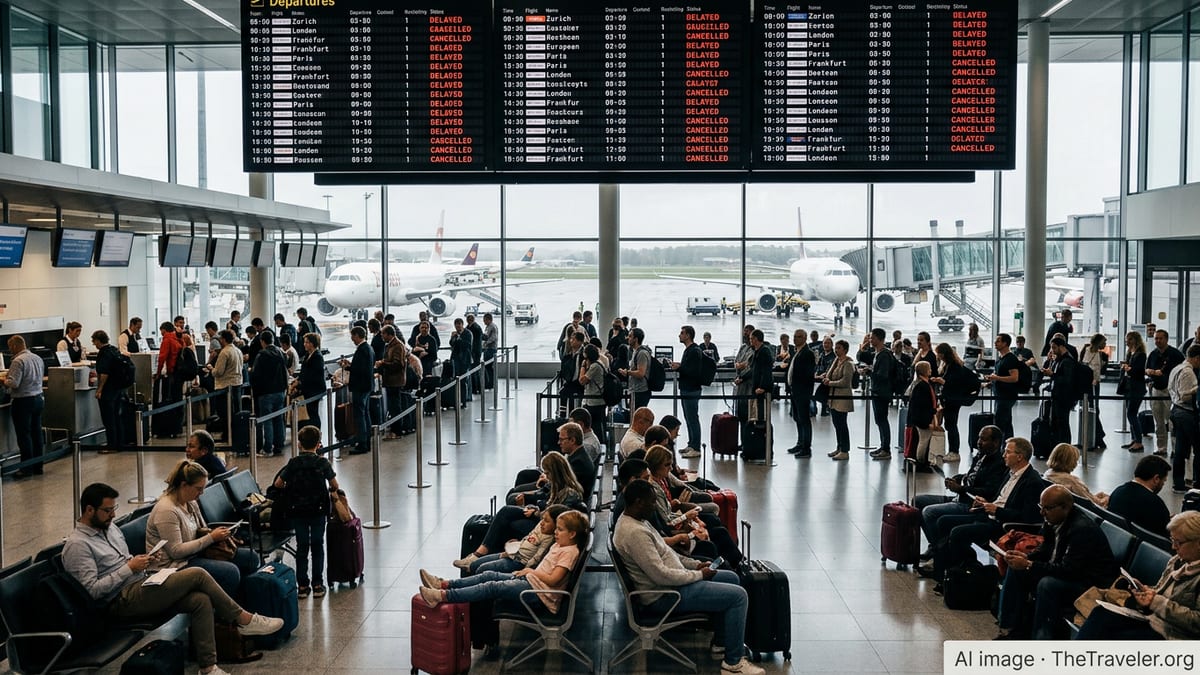
Major Hubs Across Europe Struggle With Disruptions
According to live airport boards and flight-tracking data, the disruption is spread across several of Europe’s busiest hubs, including Zurich Airport in Switzerland, multiple London airports in the United Kingdom, the Paris airport system in France and Frankfurt in Germany. The cumulative impact of 51 cancellations and 758 delays has pushed terminal operations close to capacity in peak periods, with knock-on effects across regional and long haul networks.
Publicly available information shows that delays are affecting departures and arrivals throughout the day rather than being concentrated in a single morning or evening peak. This pattern indicates a broader operational strain, where early schedule issues cascade into subsequent rotations, tightening turnaround times and limiting recovery options for airlines.
Operational dashboards suggest that some secondary airports in the region, including key bases used by low cost carriers, are also reporting elevated delay levels. While the absolute number of cancellations remains modest compared with major weather or strike events, the widespread nature of the disruption across four countries is creating an uneven and unpredictable travel experience for passengers.
Travel analytics for the current week already showed pressure on Europe’s aviation system due to seasonal demand and ongoing staffing constraints. Today’s figures add another layer of complexity, with airlines forced to adjust rotations, reroute aircraft and reposition crews while attempting to preserve core routes and peak leisure flows.
Ryanair, easyJet, Air France, KLM, SAS and Others Hit
The disruption is affecting a mix of low cost and network airlines. Schedules from Ryanair and easyJet, two of Europe’s largest budget carriers, show multiple delayed services across intra European routes, particularly those linking secondary UK and German airports with hubs in Switzerland and France. These delays often compound as aircraft operate multiple short sectors in a single day.
Legacy carriers are also dealing with significant knock on effects. Air France and KLM, which operate extensive connecting networks through Paris and Amsterdam, are seeing longer ground times and altered departure slots that reverberate through their European feeder services. Scandinavian airline SAS is similarly exposed on routes into German and Swiss hubs, where any local congestion immediately impacts onward connections to the Nordic region.
Publicly available performance statistics from recent months have already highlighted how tightly scheduled many European operators are, leaving limited buffer to absorb irregular operations. When several major hubs experience delays simultaneously, airlines have fewer spare aircraft and crews available to stabilise their programmes, leading to selective cancellations on lower demand or more easily rebooked services.
Industry observers note that such multi carrier, multi country disruptions underscore the interconnected nature of European air travel. A delay on a short sector from London to Zurich can ripple through to affect long haul passengers heading onward to Asia or North America, while cancellations on regional routes in Germany can break carefully timed connections for travellers returning to smaller cities in Scandinavia or southern Europe.
Passengers Face Long Queues and Tight Connections
For travellers on the ground, today’s figures translate into long queues at check in, security and rebooking desks across affected airports. Social media posts and traveller forums describe congested departure halls in Zurich, London and Paris, with passengers seeking updated information on revised departure times and alternative routing options.
At transfer focused hubs such as Frankfurt and Paris, missed connections have become a significant concern. Even relatively short delays on feeder flights can push travellers beyond their minimum connection times, forcing airlines to rebook passengers on later services and, in some cases, to provide overnight accommodation when onward flights are not available until the following day.
Families and leisure travellers appear particularly affected, as many are travelling on point to point tickets with limited flexibility built into their itineraries. Business travellers with tight schedules are also reporting disruptions to meetings and events when morning departures slip by an hour or more. In some terminals, airport teams have been redirecting passengers to self service kiosks and mobile applications in an effort to ease pressure on physical service desks.
With disruptions dispersed across several countries, alternative options such as rail or coach travel are proving viable on some short haul sectors, especially between major cities like Paris, Brussels, Frankfurt and Zurich. However, capacity on high speed trains is finite, and same day seats can be difficult to secure during peak travel periods, leaving many passengers reliant on air travel despite the delays.
Weather, Capacity and Air Traffic Constraints Combine
Operational updates from airports and aviation agencies indicate that today’s problems do not stem from a single dramatic incident, but rather from a confluence of factors. Seasonal weather patterns, including low cloud, strong winds and patchy rainfall in parts of Western and Central Europe, have required greater spacing between aircraft, reducing runway throughput at times.
Air traffic flow management measures in crowded European airspace have also played a role, with capacity restrictions reported over parts of France and Germany. When traffic levels approach sector limits, regulators impose arrival and departure slot controls that may force aircraft to hold on the ground before departure, building delays that are difficult to recover later in the day.
Several major airlines and airports in the region have acknowledged in recent months that staffing remains a challenge in key operational roles, from ground handling and security to air traffic control. Even modest fluctuations in demand or minor technical issues can have outsized consequences when systems are already operating close to their limits, increasing the likelihood that isolated delays escalate into a broader wave of disruption.
Analysts point out that while today’s totals of 51 cancellations and 758 delays are far below the levels recorded during major storm events or strike actions in previous seasons, they nonetheless highlight the fragility of Europe’s aviation network during busy travel periods. With passenger volumes continuing to trend upward, pressure is mounting on airlines and airports to build greater resilience into schedules and infrastructure.
What Travellers Can Do During the Ongoing Disruption
Travel advice from consumer organisations and aviation watchdogs stresses that passengers affected by today’s disruptions should first confirm the status of their flight through airline apps or official airport information channels before heading to the airport. Same day schedule changes, including aircraft swaps and gate moves, remain common while operations are under strain.
For those already at the airport, experts recommend monitoring departure boards closely and staying within easy reach of the assigned gate, as revised boarding calls can come with limited notice once an aircraft and crew become available. Where possible, travellers are encouraged to use digital rebooking tools or chat functions to adjust itineraries, which can often be faster than joining long queues at service counters.
In Europe, passenger protections under frameworks such as EU261 and related national regulations may provide compensation or assistance in cases of significant delay or cancellation, depending on the cause and length of disruption as well as the route and operating carrier. Travellers are advised to retain boarding passes, booking confirmations and receipts for any meals or accommodation arranged during extended waits.
With further delays still possible as aircraft and crews gradually return to planned rotations, passengers traveling through Zurich, London, Paris, Frankfurt and other busy European hubs over the next 24 hours are being urged by travel experts to allow extra time, prepare for schedule changes and build flexibility into onward connections where feasible.