

More news on this day
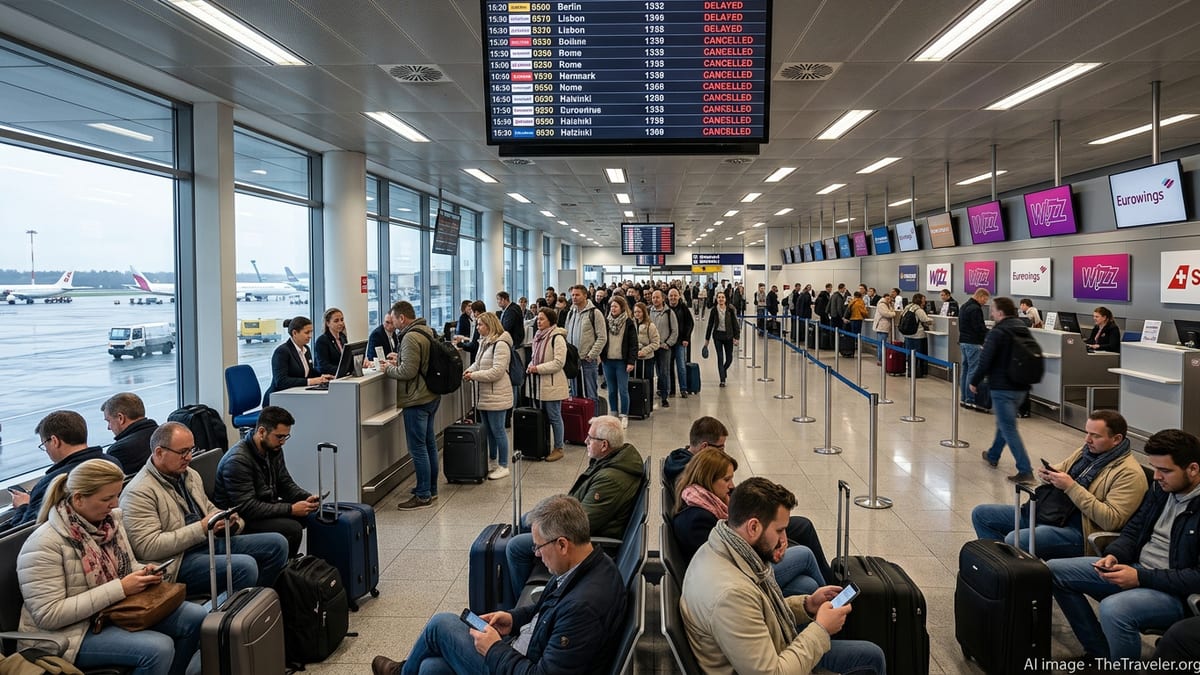
Thousands of passengers across Europe faced hours-long queues, missed connections and last-minute rebookings on Friday as a fresh wave of disruption hit the continent’s skies, with 1,204 flights delayed and 234 cancelled, heavily impacting routes in and out of Portugal, Finland, Italy and major hubs including Berlin and Lisbon.
Get the latest news straight to your inbox!
Widespread Disruption Across Europe’s Key Hubs
The latest figures from real-time disruption trackers show that more than 1,400 flights were affected within a single operational day, underscoring how fragile Europe’s air network remains in early 2026. Airlines including Wizz Air, Eurowings and Swiss were among the carriers reporting significant knock-on delays, particularly on intra-European routes linking Germany, Portugal, Italy and the Nordic region.
Berlin Brandenburg and Lisbon Humberto Delgado were among the hardest hit airports, with departure boards filled with late-running services and a growing list of cancellations. Italian and Finnish gateways also reported mounting delays as aircraft and crews were held up at congested hubs elsewhere in the network, disrupting carefully timed rotations.
Air traffic analysts say the current wave of disruption is being fuelled by a combination of unstable spring weather systems over southern and western Europe, ongoing reroutings linked to airspace constraints, and lingering crewing and fleet imbalances from earlier in the week. The result is a tightly wound network in which problems at a handful of major airports quickly cascade across the continent.
For passengers, the statistics translate into missed holidays, broken business itineraries and long lines at customer-service counters. Many travellers arriving into Berlin, Lisbon, Rome and Helsinki have reported waiting several hours for rebooking, with some being placed on next-day departures as airlines struggle to find spare seats.
Portugal, Italy and Finland Bear the Brunt
Portugal’s aviation network has been under sustained pressure in recent days, and the latest disruption has again focused attention on Lisbon’s overstretched main airport. Heavy showers and strong winds sweeping in from the Atlantic have forced temporary runway flow restrictions, slowing departures and arrivals and contributing to the spike in delays and cancellations affecting services to and from cities such as Porto, Faro and European capitals further north.
In Italy, delays have been particularly visible at Rome Fiumicino and Milan’s main airports, where tight turnarounds for short-haul flights have been undermined by late inbound aircraft. Travellers headed for leisure hotspots and business centres alike have faced rolling departure-time revisions, with some flights first delayed, then ultimately cancelled as operating windows closed.
Finland, though handling a smaller share of Europe’s daily traffic, has not escaped the turbulence. Helsinki’s role as a northern connection point for both Nordic and central European routes means that disruptions further south have rippled into its schedule. Late-evening departures to Germany, Switzerland and Italy have been especially vulnerable where aircraft were inbound from already delayed flights.
Tourism officials in Portugal and Italy warned that the timing of the chaos, ahead of the busy spring and Easter travel period, risks denting traveller confidence. Hoteliers in Lisbon, Rome and coastal resort regions reported a rise in last-minute check-ins from stranded passengers, with some properties near major airports nearing full occupancy as airlines scrambled to secure accommodation.
Airlines Struggle With Knock-On Effects
Low-cost carrier Wizz Air has seen a series of disruptions build across its dense point-to-point network, with delays on core routes feeding into cancellations later in the day when crews and aircraft reached their maximum legal operating limits. Passengers on routes linking central Europe with Italy and Portugal reported being offered rerouting a day or more later, reflecting limited spare capacity in high-demand markets.
Eurowings, which has been expanding at Berlin Brandenburg and increasing links to southern Europe, also faced a challenging operational day. Services connecting Berlin with Lisbon, Italian gateways and Nordic cities experienced rolling delays as aircraft arriving late from earlier flights pushed back subsequent departures, particularly on afternoon and evening rotations.
Swiss, operating out of its Zurich hub, saw its punctuality dented by upstream congestion on shared European air corridors. While the carrier maintained a relatively low cancellation rate compared with some rivals, extended holding patterns and slot restrictions translated into late arrivals at destinations in Germany, Italy and the Iberian Peninsula, complicating tight connection windows for onward passengers.
Aviation experts note that when multiple carriers encounter difficulties on the same day, the usual safety valves in the system, such as spare aircraft or seats on alternative airlines, quickly disappear. That makes it far harder for Wizz Air, Eurowings, Swiss and others to absorb irregular operations, turning what might have been localized issues into an episode of continent-wide disruption.
Berlin and Lisbon Emerge as Bottlenecks
Berlin Brandenburg has once again emerged as a key pressure point in Germany’s aviation network. With a large share of point-to-point European traffic and growing low-cost carrier presence, the airport is particularly exposed when neighbouring hubs experience difficulties. As delayed flights from elsewhere arrive late into Berlin, aircraft and crew rotations are thrown off balance, forcing ground handlers and schedulers into constant adjustment.
On Friday, long queues formed at check-in and security in Berlin as passengers attempted to navigate rapidly changing departure times. Travellers reported gate changes posted at short notice and boarding starting only to be paused while updated slot times were coordinated with air traffic control, further adding to the sense of uncertainty.
Lisbon, already known for its congestion and limited runway capacity at peak times, also functioned as a major bottleneck in the current episode. Tight spacing between departures means that even short weather or flow-control interruptions can echo through the schedule for hours. Airlines serving Lisbon, from low-cost operators to full-service carriers, were forced to retime or cancel selected flights to re-stabilise their operations.
In both cities, passengers with onward connections were particularly hard hit. Missed links to secondary Portuguese, Italian and Nordic destinations were common, compelling travellers to accept alternative routings via other European hubs or to overnight before rejoining the network the following day.
What Stranded Travellers Can Do Now
With the number of delayed and cancelled flights running well into four figures, consumer-rights groups have urged passengers to familiarise themselves with European air passenger protections. Within the European Union, significant delays, last-minute cancellations and denied boarding on covered flights can trigger entitlements to care, rerouting and, in many cases, financial compensation, depending on the cause of the disruption and the length of the delay.
Passengers are being advised to keep all documentation related to their disrupted journeys, including boarding passes, booking confirmations, meal and hotel receipts, and written communications from airlines. These can be crucial when filing claims or disputes in the days after travel, especially where schedules changed multiple times.
For those yet to travel, airlines and travel advisers recommend building additional buffer time into itineraries, particularly for journeys requiring connections in Berlin, Lisbon, Rome or other major hubs that have recently seen elevated disruption levels. Booking earlier flights in the day, when schedules tend to be more resilient, can also reduce the risk of knock-on delays.
While aviation authorities and airlines insist that they are working to restore schedules and limit further cancellations, the scale of the latest episode serves as a reminder that Europe’s air network remains vulnerable. Travellers planning trips in the coming days are being urged to monitor flight status closely, stay flexible where possible and be prepared for further last-minute changes as operations gradually stabilise.