

More news on this day
Major European and US carriers including Austrian Airlines, KLM, Delta Air Lines and Air France have suspended services to Dubai, Tel Aviv and Beirut amid the latest escalation in Middle East tensions, triggering a fresh wave of cancellations, last-minute rerouting and empty hotel rooms across the United Arab Emirates, Israel and Lebanon.
Get the latest news straight to your inbox!
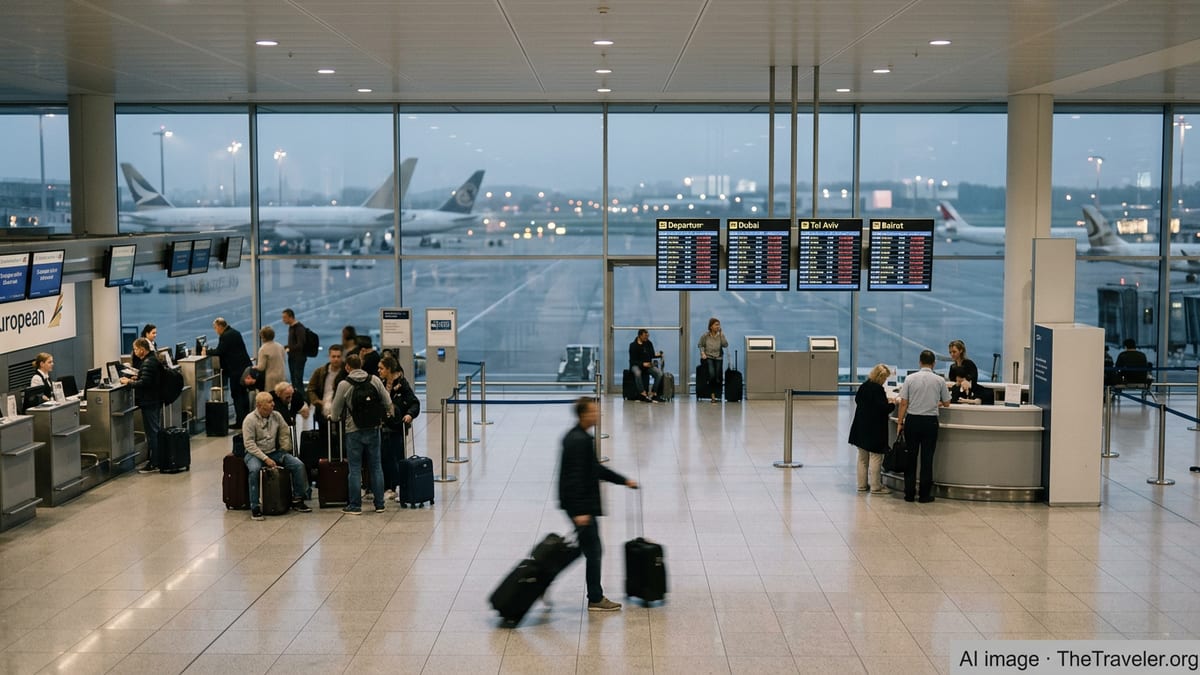
Wide-Ranging Flight Suspensions Hit Key Gateways
The latest round of flight suspensions follows a series of airspace restrictions and security alerts linked to the ongoing Iran war and related regional tensions, which have repeatedly disrupted air corridors over the Gulf and Levant. Over recent days, airline schedule updates and passenger advisories have translated into full pauses or sharply reduced operations on routes to Dubai, Tel Aviv and Beirut, three cities that normally function as critical hubs for both business and leisure travel.
Austrian Airlines, part of the Lufthansa Group, has halted services on its Vienna–Dubai, Vienna–Tel Aviv and Vienna–Beirut routes, joining sister carriers that have already pulled back from the region. KLM has cancelled flights to Tel Aviv for the winter 2025–26 season and recently extended a suspension of its Dubai operations, advising passengers that flights to, from and via the emirate remain off the schedule while safety assessments continue.
Air France, meanwhile, has paused flights to both Tel Aviv and Beirut and announced a temporary suspension of its Dubai service as security conditions in the wider Middle East remain volatile. Delta Air Lines, which had already been cautious on its Tel Aviv operations, has now effectively frozen passenger options into Israel by halting bookings and cancelling planned services, cutting a major transatlantic link between North America and the region.
Although some regional carriers continue to operate limited services under revised routings, aviation analysts note that the withdrawal of large European network airlines and a major US carrier simultaneously amplifies the shock. Passengers relying on one-stop connections from North America and Europe to the Gulf and Levant are facing longer journeys, higher fares on remaining routes and, in many cases, outright cancellations.
Tourism Hubs Face Sharp Drop in Arrivals
The sudden loss of capacity is being felt most acutely in tourism-dependent cities. Dubai, which had positioned itself as a resilient global gateway able to weather earlier rounds of geopolitical tension, is now experiencing a rare contraction in international arrivals as flights from major European partners are cut back or diverted. Travel agents report a spike in refund requests and trip postponements, particularly from risk-averse leisure travellers and corporate clients with large group bookings.
In Israel, Tel Aviv’s Ben Gurion Airport has become a barometer of the crisis. Successive rounds of security incidents have led foreign carriers to scale down or suspend operations, undercutting what had been a strong rebound in inbound tourism. Hotels along Tel Aviv’s beachfront and in nearby Jerusalem are seeing international reservations evaporate, with many properties shifting focus to domestic guests and short-notice stays from aid agencies, NGOs and media organizations.
Lebanon, where tourism had been one of the few bright spots in an otherwise fragile economy, is also reeling. With European airlines cancelling flights into Beirut and several Gulf carriers trimming schedules, the country’s summer season prospects have darkened. Tour operators in Europe and the Gulf report that packaged holidays to Lebanon are being withdrawn from sale or rebranded with flexible dates as uncertainty over air links persists.
Industry observers warn that even a short-lived wave of suspensions can leave a longer shadow over demand. Travellers who have been stranded or forced into complex rebookings often opt to avoid the region for a year or more, redirecting their spending to Mediterranean destinations, Southeast Asia or the Caribbean.
Hotels and Hospitality Struggle With Volatile Demand
Across the UAE, Israel and Lebanon, hotels that only months ago were targeting record occupancies are contending with abrupt shifts from full to half-empty inventories. In Dubai, large beachfront resorts and downtown business hotels report waves of cancellations tied directly to KLM and Air France suspending flights, with corporate groups particularly sensitive to any suggestion of airspace risk. Revenue managers are responding by cutting rates, loosening minimum-stay rules and pushing last-minute promotions through regional online travel agencies.
Tel Aviv’s hospitality sector, which had relied on a mix of tech-industry visitors, city-break tourists and pilgrimage traffic, is now adjusting staffing levels and deferring planned renovations. Smaller boutique hotels and guesthouses face a tougher outlook, as many lack the cash flow buffers of global chains. Some properties are pivoting to extended-stay offers for relocated families, journalists and diplomatic staff, attempting to stabilize income while traditional tourism remains depressed.
In Beirut, the impact is magnified by Lebanon’s broader economic challenges. Hotel owners describe a “stop-start” pattern of demand where a single weekend of relative calm prompts a flurry of bookings, only for another headline about suspended flights or cross-border shelling to trigger a wave of cancellations. Industry associations are calling for targeted tax relief and government-backed marketing campaigns once air links are restored to help rebuild confidence in the destination.
Meeting and conference planners across the three markets are also scrambling. Large-scale events scheduled for the first half of 2026 are being postponed, moved online or relocated to alternative hubs such as Istanbul, Athens or Cyprus, compounding revenue losses for convention centers, caterers and local transport providers.
Travellers Face Disruption as Airlines Offer Waivers
For individual travellers, the immediate effect is uncertainty and extra expense. Airline waiver policies have expanded and evolved as the crisis has deepened, with carriers offering fee-free changes, refunds or rerouting via alternative hubs. However, limited seat availability on remaining services, particularly via Gulf and European partners, has left many passengers stranded or facing lengthy detours through secondary airports.
Travel advisors recommend that passengers with upcoming itineraries touching Dubai, Tel Aviv or Beirut monitor airline notifications closely and avoid starting journeys without confirmed onward connections. In some cases, airlines are proactively rebooking customers on alliance partners or regional carriers still operating into the affected cities, but schedules can change with little warning as security assessments are updated.
Insurers are also under pressure, as travellers attempt to claim for trips disrupted by airspace closures and government travel advisories. Policy wording on war, terrorism and civil unrest varies widely, leaving some customers fully covered while others discover that standard policies exclude exactly this kind of disruption. Industry groups expect a wave of complaints and potential regulatory scrutiny once the immediate crisis abates.
Despite the turmoil, aviation experts stress that safety considerations remain paramount for airlines and regulators. Decisions to suspend or reroute flights, while painful for travellers and tourism-dependent economies, are framed as necessary precautions in a region where the security landscape can shift dramatically in a matter of hours.
Uncertain Timeline for Recovery
How long the latest suspensions will last is unclear. Some airlines have attached provisional restart dates to Dubai services and tentative timelines for reviewing flights into Tel Aviv and Beirut, but executives consistently emphasize that any resumption will depend on security assessments by national authorities and real-time intelligence about regional airspace risks.
Tourism boards in the UAE, Israel and Lebanon are already drawing up contingency plans, from intensified promotion of domestic and regional travel to virtual trade fairs aimed at keeping their destinations front of mind for international partners. However, with flight schedules changing week to week, marketing campaigns remain largely symbolic until reliable air links are restored.
Past crises in the Middle East have shown that demand can rebound rapidly once airlines return and headlines stabilize, particularly for established hubs such as Dubai. Yet the cumulative effect of repeated disruptions, combined with broader geopolitical uncertainty, may test that resilience. For now, empty airport gates and half-filled hotels stand as visible reminders of how quickly the region’s interconnected travel ecosystem can be thrown into turmoil.