

More news on this day
EVA Air is elevating its West Coast offering this spring, introducing a Boeing 787-9 Dreamliner with the carrier’s latest fourth-generation Premium Economy cabin on its busy San Francisco–Taipei route, a move aimed at business and leisure travelers seeking extra comfort without the full business-class fare.
Get the latest news straight to your inbox!
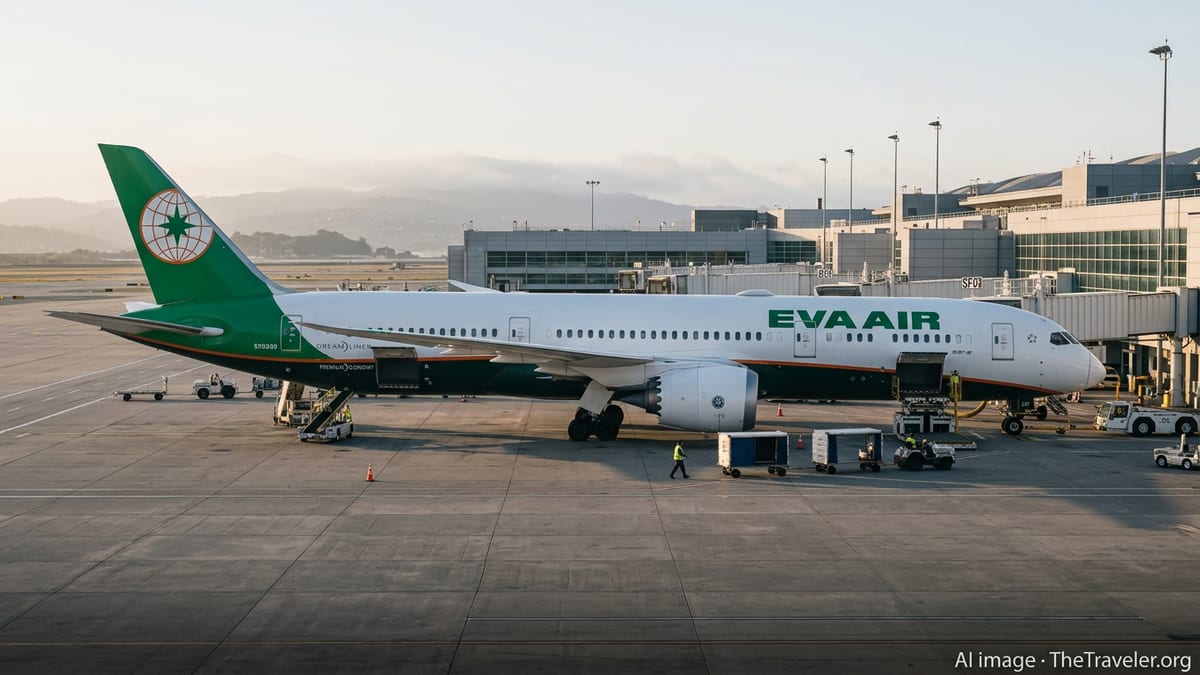
Fourth-Generation Premium Economy Makes U.S. West Coast Debut
The rollout of EVA Air’s upgraded Premium Economy product on the San Francisco–Taipei service is part of a broader strategy to strengthen its mid-cabin offering across North America. The airline has been gradually introducing the new cabin on long-haul Boeing 787-9 aircraft, and San Francisco is among the first U.S. gateways to see the refreshed configuration on a flagship transpacific route.
According to recent industry and airline announcements, the enhanced Premium Economy cabin is tied specifically to the 787-9 fleet, which EVA Air has been expanding through new orders and retrofits. The configuration is designed to bridge the gap between standard economy and the airline’s Royal Laurel business class, targeting travelers who want more space and amenities but remain cost-conscious.
The timing also reflects growing premium demand on the San Francisco–Taipei corridor, which serves a mix of technology, finance, and visiting-friends-and-relatives traffic. With competition intensifying on transpacific services, the upgraded 787-9 is expected to help EVA Air defend its market share while reinforcing its image as a five-star carrier focused on cabin comfort.
San Francisco joins a small but growing group of North American routes slated to feature the updated 787-9 Premium Economy cabin, following initial deployments on select services from Taipei to Asia and Europe. For regular SFO passengers, that means a noticeable hardware step-up compared with older widebodies that have traditionally flown the route.
What Passengers Can Expect Onboard the 787-9
EVA Air’s fourth-generation Premium Economy is pitched by the airline as a business-class-like experience in terms of personal space and overall environment. On the 787-9, seats are wider than in standard economy and offer a significantly greater recline, with a leg rest and footrest combination intended to make overnight flights more comfortable for sleeping.
The cabin also introduces updated seat shell styling, larger personal in-flight entertainment screens, and enhanced storage areas for small devices and personal items. Power outlets and USB ports are available at every seat, allowing passengers to work or stream throughout the roughly 13-hour journey between San Francisco and Taipei.
Soft-product upgrades are designed to differentiate the cabin further. On long-haul U.S. services, Premium Economy passengers receive upgraded bedding, including a larger pillow and thicker blanket, as well as amenity kits produced in partnership with lifestyle and outdoor brands. Meal service features plated hot entrees with metal cutlery, along with an expanded selection of beverages compared with the main cabin.
Onboard connectivity is another key benefit. EVA Air has been rolling out free inflight Wi-Fi access for eligible passengers across its Wi-Fi-equipped fleet, including the Boeing 787 family. Premium Economy travelers who are members of the carrier’s Infinity MileageLands program can take advantage of complimentary browsing allowances, an appealing perk for business travelers seeking to stay online across the Pacific.
Schedule, Fleet Strategy and Market Positioning
The 787-9 deployment on the San Francisco–Taipei route is aligned with EVA Air’s long-term fleet renewal plans. The airline has steadily grown its Dreamliner portfolio and has approved additional 787-9 orders, underscoring its plan to lean more heavily on fuel-efficient, mid-size widebodies for key long-haul markets over the next decade.
Industry documents and corporate filings indicate that EVA Air is preparing to use the 787-9 not only to open new destinations but also to upgauge or modernize service on existing trunk routes where demand for a differentiated mid-cabin product is strong. San Francisco, a mature and high-yield market with deep Taiwan and broader Asia connections, fits squarely within that strategy.
The introduction of the upgraded Premium Economy cabin on this route also plays into EVA Air’s competitive positioning in the transpacific corridor. The airline has consistently ranked among the world’s top carriers in independent surveys, particularly for cabin cleanliness and economy-class catering. Enhancing Premium Economy on a flagship U.S. route reinforces its reputation for offering strong value in the middle of the cabin hierarchy.
From an operational perspective, shifting more capacity to the 787-9 also supports EVA Air’s sustainability goals. The type typically burns less fuel per seat than older-generation widebodies, helping the airline reduce emissions while keeping operating costs in check. That in turn can support more stable pricing and product investment even in a volatile fuel market.
Connecting the Bay Area to a Growing Taipei Hub
San Francisco is a critical spoke in EVA Air’s expanding North American network, which now spans multiple gateways across the United States and Canada. The San Francisco–Taipei route serves as a primary bridge between the Bay Area’s technology and business communities and a fast-growing hub at Taiwan Taoyuan International Airport.
By upgrading the aircraft and cabin on this route, EVA Air is reinforcing Taipei’s role as a convenient one-stop connection point to destinations across Asia. Passengers arriving from San Francisco can connect onward to major cities in Northeast and Southeast Asia on coordinated schedules, often without changing terminals or clearing security again.
The carrier’s focus on transit friendliness at Taipei complements the onboard improvements of the 787-9. For Premium Economy passengers in particular, the combination of a higher-comfort long-haul sector and relatively seamless onward connections can be a compelling alternative to routings via other hubs on the U.S. West Coast or in Northeast Asia.
The move also reflects the broader rise of premium leisure and small-business travel between the Bay Area and Asia. As remote work and flexible schedules make longer international trips more feasible, airlines like EVA Air are looking to entice travelers with a mid-cabin product that blends practicality, comfort, and price.
Booking Considerations for San Francisco Travelers
For passengers flying between San Francisco and Taipei, the arrival of the 787-9 with the new Premium Economy cabin introduces additional factors to consider when choosing flights. Travelers will want to pay close attention to aircraft type and cabin layout at the time of booking, particularly if they are aiming for the updated seats on specific departure dates.
Because EVA Air continues to operate a mix of aircraft types across its long-haul network, seat maps and cabin configurations may vary. On services scheduled with the 787-9, Premium Economy is typically laid out in a dedicated small cabin between business and economy, which can offer a quieter atmosphere and faster service compared with the larger main cabin at the rear.
Frequent flyers and corporate travelers may also weigh the value of Premium Economy against the airline’s business and standard economy offerings. For many, the incremental cost of Premium Economy over regular economy can be justified by the additional legroom, improved recline, enhanced meals, and amenity kits, especially on overnight flights where rest is a priority.
As EVA Air continues rolling out its fourth-generation Premium Economy on more routes, San Francisco-based passengers are likely to see a growing number of options featuring the refreshed cabin. The 787-9 introduction on the SFO–TPE route marks a notable step in that evolution, signaling that the Bay Area remains central to the airline’s transpacific ambitions.