

More news on this day
Malaysia is drawing fresh attention to its rural heartlands, spotlighting kampung homestays that invite travelers to live with local families, join village rituals and celebrate major festivals far from the country’s busy urban centers.
Get the latest news straight to your inbox!
Homestays Anchor Malaysia’s Rural Tourism Push
Malaysia’s national tourism strategy is placing renewed emphasis on village-based homestays as a way for visitors to experience traditional kampung life while channeling tourism income directly into rural communities. Publicly available information from Tourism Malaysia describes the official homestay programme as a certified network of villages where guests stay with host families, sharing daily routines rather than occupying standalone holiday rentals.
Government data reported in local media indicates that hundreds of thousands of visitors are already choosing these experiences each year, generating tens of millions of ringgit in revenue for rural households. For 2026, policymakers have outlined ambitions for the homestay sector to contribute substantially more as part of the wider Visit Malaysia Year campaign, positioning kampung stays as a core experiential product instead of a niche add-on for backpackers.
Recent coverage highlights that the push includes both long-established homestay clusters and new community-based tourism projects, from Peninsular Malaysia to Sabah and Sarawak. Participation in the programme is framed as a way for villages to diversify livelihoods beyond agriculture while preserving heritage, crafts and performing arts that might otherwise struggle to survive.
Industry analyses also suggest that Malaysia’s model is broadly aligned with a global shift toward slower, more meaningful travel. International travelers increasingly seek encounters with local communities and everyday culture, and kampung homestays are being promoted as a way to meet that demand in a structured, regulated setting.
Inside Kampung Life: From Morning Markets to Riverbanks
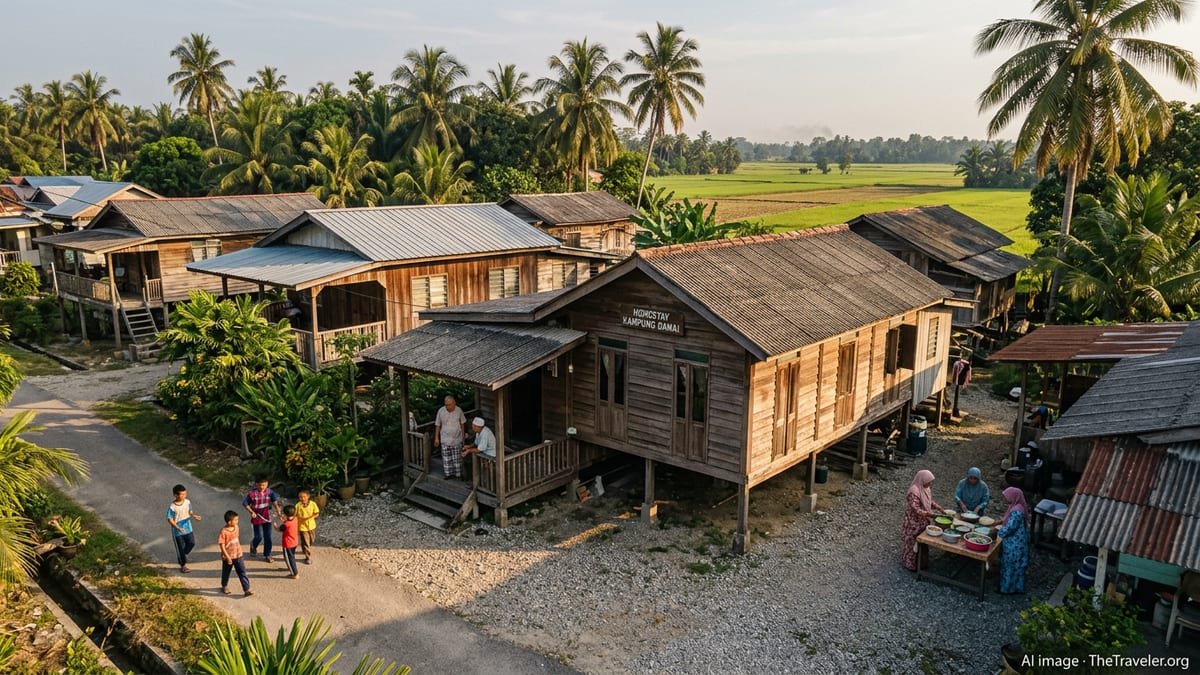
For many visitors, the appeal of a kampung homestay lies in the rhythm of daily life that unfolds far from high-rise skylines. Typical programmes outlined by Tourism Malaysia and regional tourism boards feature early-morning visits to local markets, communal breakfasts of traditional dishes and guided walks past wooden houses on stilts, coconut groves and paddy fields.
Some village clusters incorporate nature-based activities alongside cultural immersion. In parts of Pahang, Terengganu and Sabah, visitors can join river cruises, jungle treks or agro-tourism visits to smallhold farms and orchards, before returning to share evening meals with host families. Reports on community-based tourism in Kampung Batu Puteh and other riverine settlements describe how such activities are structured to highlight both biodiversity and local stewardship of the environment.
Hands-on experiences often sit at the center of curated homestay itineraries. Participating kampung communities are known to offer batik or weaving workshops, cooking lessons using heirloom recipes, demonstrations of traditional games, and introductions to instruments and dances that may only appear at weddings or harvest events. The intention, according to programme descriptions, is not only to entertain guests but also to keep these skills alive among younger villagers.
At the same time, official guidelines underline that homestays are meant to remain rooted in authentic domestic spaces, rather than turning into resort-style complexes. Hosts open rooms within existing village houses, and shared spaces such as verandas, courtyards and suraus remain focal points of social interaction between residents and visitors.
Festivals Bring Kampung Celebrations to the Fore
Kampung homestays are also being promoted as a gateway to Malaysia’s packed calendar of religious and cultural festivals, giving travelers a front-row seat to celebrations that feel very different from city-center parades or shopping mall events. During Hari Raya Aidilfitri, many Malay-majority villages hold open houses, communal feasts and visits between neighbors, with homestay guests often invited to join the flow of greetings and home-cooked dishes.
In Chinese, Indian and multiethnic settlements, homestay programmes have highlighted Lunar New Year, Deepavali and harvest-related festivities as major draws. Media features on village tourism in Selangor and Johor, for example, describe traditional wooden homes decorated with lanterns or kolam designs, lion dance troupes weaving through narrow village lanes and evening gatherings where multiple generations share meals outdoors.
Beyond national holidays, specific rural festivals are gaining prominence in tourism promotion. Events such as the Kenyir Geopark Festival in Terengganu, which packages village lifestyle, local gastronomy and cultural performances around a lake setting, are cited as models for linking seasonal celebrations with extended homestay stays. Similar initiatives in Sabah and Sarawak pair homestays with cultural showcases that spotlight indigenous traditions and music.
Travel advisories and destination guides increasingly encourage visitors to time their trips around these festive periods, while noting that advanced planning is essential due to limited village capacity. Organizers also stress the importance of cultural etiquette, asking guests to respect dress codes, religious practices and household routines when participating in celebrations.
Desa Kirana and New Community-Based Tourism Models
Several recent initiatives show how Malaysia is expanding and refining the homestay concept. One example attracting attention is the Desa Kirana framework, which aims to integrate homestays, small-scale attractions and local product development into cohesive rural tourism destinations. Public reports on the programme suggest targets for drawing tens of thousands of additional visitors to selected villages over the coming years.
In Sabah, community-based tourism schemes linked to the Malaysia Homestay Experience Programme are being rolled out in kampung such as Bambangan, identified in news coverage as a pioneer site for Sandakan. These projects typically combine overnight stays with guided tours of nearby forests, rivers or coastal ecosystems, often led by residents who have received training as nature or culture interpreters.
Sarawak, meanwhile, has registered dozens of homestay clusters across its diverse rural districts, with state-level briefings describing the sector as a key channel for bringing tourism income to longhouse communities and small towns. Stakeholders present these efforts as part of a broader rural revitalization agenda that includes infrastructure upgrades and marketing support tailored to community-run tourism.
Observers note that these models attempt to balance commercial ambitions with safeguards for cultural integrity and environmental management. Official registration, periodic inspections and collaboration with village committees are used to differentiate recognized homestays from informal guesthouses, giving travelers clearer expectations about the standards and experiences on offer.
What Travelers Should Know Before Booking a Kampung Stay
As kampung homestays gain visibility on booking platforms and in international media, travel planners are being encouraged to understand what distinguishes Malaysia’s certified model from generic holiday rentals. Programme descriptions emphasize that genuine homestays involve living with host families in their own homes, sharing meals and participating in community life, whereas many urban apartments marketed as homestays operate more like standard short-term rentals.
Tourism Malaysia advises that registered villages and operators adhere to specific criteria related to safety, cleanliness and cultural programming. Travelers seeking an immersive experience are often directed to check that their chosen stay forms part of an approved homestay cluster, particularly if they want to join organized activities such as craft workshops or village tours.
Comfort levels in kampung homestays can differ significantly from city hotels, and travel features urge visitors to come prepared for simpler amenities, tropical weather and early-morning sounds from roosters or nearby mosques. In exchange, guests typically gain closer access to home-cooked cuisine, personal introductions to local customs and the chance to see how rural communities are navigating economic and environmental change.
Rural tourism advocates also highlight the importance of responsible behavior. That includes dressing modestly in conservative areas, asking before taking photographs of people, minimizing plastic waste and spending on local services such as village eateries and craft stalls. Approached with sensitivity, Malaysia’s kampung homestays are presented as a way for travelers to broaden their understanding of the country beyond familiar city skylines, while supporting communities that are reshaping tourism on their own terms.