

More news on this day
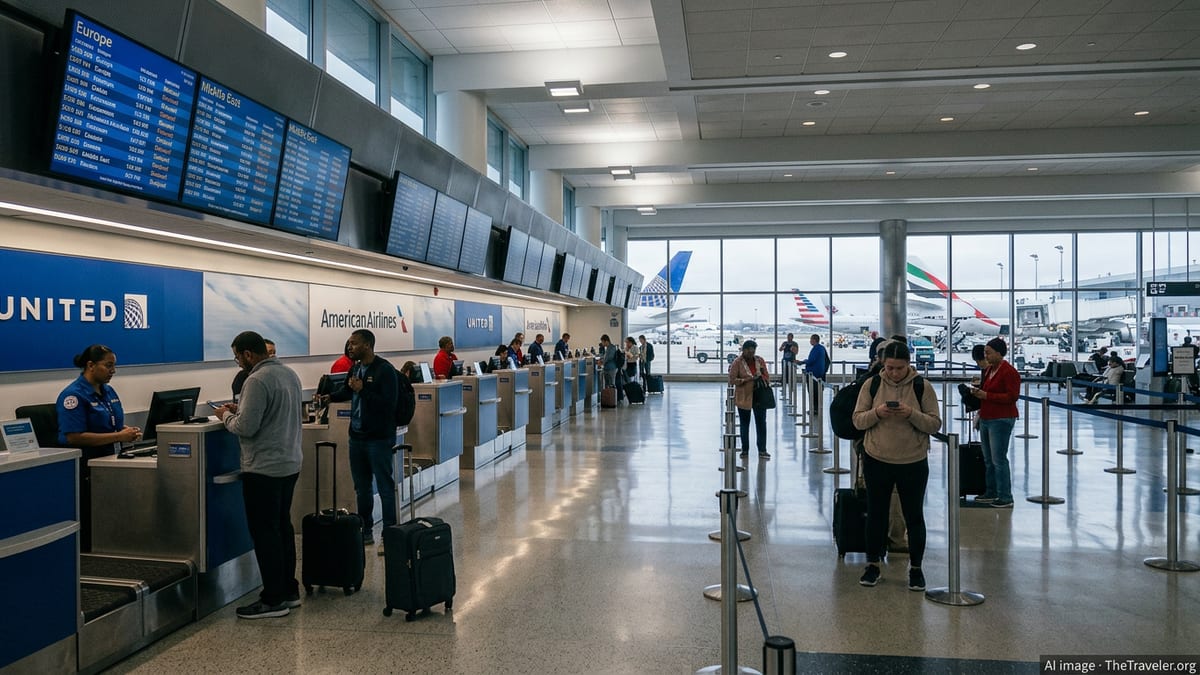
Chicago O’Hare International Airport is bracing for a turbulent summer after the Federal Aviation Administration moved to sharply cap daily flights, forcing United Airlines, American Airlines, Qatar Airways and Emirates to contemplate historic schedule cuts that are already rippling through global tourism and hospitality markets.
FAA Imposes Sweeping Limits at a Critical Global Hub
The FAA has told airlines it intends to limit daily takeoffs and landings at Chicago O’Hare to as low as about 2,500 operations during the March 29 to October 25 summer season, down from schedules that had been built around more than 3,000 daily movements on peak days. Carriers were previously warned of a 2,800-flight ceiling, but recent briefings indicate regulators want deeper cuts to relieve chronic congestion and reduce the risk of cascading delays during the busy travel months.
United and American, O’Hare’s dominant hub carriers, aggressively expanded their summer 2026 schedules, with United planning roughly 750 daily departures and American more than 500. That growth, layered on top of other domestic and international operators using O’Hare as a gateway between North America, Europe, the Middle East and Asia, left the airport on track for its busiest summer on record and triggered FAA concern that the system could buckle under strain.
Officials point to mounting weather disruptions, air traffic controller staffing challenges and a string of gridlocked days at key hubs as justification for preemptive capacity reductions. Industry sources say the agency has made clear in closed-door meetings that schedule cuts are not optional and that airlines which fail to comply could face enforcement action or lose preferred operating windows.
The caps come as O’Hare is in the midst of a long-term expansion and modernization program, underscoring the tension between airport growth ambitions and the practical limits of the national airspace system. For travelers, that disconnect is likely to manifest as thinner schedules, fewer nonstop options and higher fares through one of the world’s most important connecting hubs.
United and American Confront Forced Pullbacks
For United Airlines and American Airlines, which depend on O’Hare as a linchpin of their domestic and international networks, the FAA’s move amounts to an unwelcome about-face after months of planning for record capacity. Both carriers have been adding routes and frequencies out of Chicago, banking on pent-up travel demand, strong corporate bookings and growing international traffic.
United executives have publicly acknowledged that a cap as low as 2,500 daily movements would require “a few hundred” flights to be removed from peak schedules. Network planners now face the delicate task of deciding which routes and time bands to trim while protecting high-yield long haul services and key business markets. Shorter regional flights to nearby Midwestern cities are expected to be particularly vulnerable as the airline prioritizes widebody and transcontinental operations.
American, which has been rebuilding its Chicago presence after ceding ground to United in recent years, also stands to lose hard-won gains. The carrier has been reintroducing international services and layering additional domestic frequencies to feed them. Any forced reductions risk diluting connecting flows and could push American to divert some planned growth to other hubs where regulatory constraints are less acute.
Both airlines are quietly lobbying for a fair allocation formula that reflects their scale at O’Hare while limiting damage to their competitiveness. At the same time, they are preparing for a fresh wave of customer service challenges as summer travelers are rebooked, itineraries are re-timed and once-secure connections are thrown into doubt.
Long Haul Carriers Face a Squeeze on Premium Routes
While the flight caps are primarily aimed at managing overall volumes, international carriers such as Qatar Airways and Emirates are also being swept up in the turbulence. O’Hare has emerged in recent years as a strategic gateway for global airlines tapping into Chicago’s corporate base and its role as a major origin-and-destination market for transatlantic and Middle East traffic.
Slot and schedule negotiations are now under way as airlines vie to preserve their most lucrative departure and arrival times. For long haul operators with one or two daily rotations, a single unfavorable change can undermine carefully constructed banks of onward connections in Doha or Dubai, eroding the value proposition for premium and transit passengers.
Qatar Airways and Emirates are already contending with wider Middle East airspace disruptions that have forced diversions, cancellations and reduced schedules across the region. The prospect of further restrictions at a key U.S. gateway like O’Hare compounds those pressures, narrowing options for rerouting and reducing the flexibility to add capacity where demand remains robust.
Travel agents report that some high-end customers booking complex itineraries between secondary U.S. cities and destinations in Africa, South Asia and the Indian Ocean are facing longer layovers, additional stops or higher fares as inventory tightens. With capacity capped at both ends of the journey, airlines have less room to absorb surges in demand or to offer creative rebooking solutions when things go wrong.
Tourism and Hospitality Brace for a Summer Capacity Shock
The cutbacks at O’Hare come at a sensitive moment for Chicago’s visitor economy and for international tourism more broadly. After several seasons of steady recovery from the pandemic, hotels, convention organizers and cultural institutions had been counting on 2026 to consolidate gains, supported by strong transatlantic and long haul travel.
City tourism officials say they are closely monitoring how many international seats will actually disappear once airlines finalize their revised schedules. Even modest reductions in widebody capacity can translate into thousands fewer high-spending visitors over the course of a summer, particularly from markets such as the Gulf, India and Southeast Asia that rely on one-stop connectivity through hubs like Doha and Dubai.
Downtown hotels, which have already been contending with shifting business travel patterns and a more cautious corporate events market, fear that meeting planners could be deterred by reduced flight options and concerns about reliability. Large conventions often select host cities years in advance based on air access; a season marked by aggressive capacity caps and recurring disruptions could weigh on Chicago’s competitive standing for future bids.
Restaurants, attractions and retail operators that benefit from international tourism are also exposed. While domestic leisure demand has been resilient, overseas visitors tend to stay longer and spend more per trip, making them a disproportionately important segment for the city’s hospitality sector. Any sustained squeeze on long haul capacity through O’Hare risks leaving that recovery incomplete.
Travelers Face Fewer Choices and Rising Prices
For passengers, the most immediate impact of the FAA’s decision will be felt in the form of schedule changes, thinner flight options and mounting fare pressure on key routes. Analysts expect airlines to preserve as much high-yield capacity as possible, which typically means defending peak business departures and long haul services while trimming off-peak frequencies and marginal point-to-point routes.
Leisure travelers connecting through O’Hare to Europe, the Middle East and beyond may find that itineraries that once offered multiple daily options on United, American, Qatar Airways and Emirates now provide fewer choices and tighter booking windows. Those who delay purchasing tickets could encounter steeper prices as reduced capacity pushes load factors higher.
Consumer advocates are urging travelers with summer plans involving Chicago to monitor their bookings closely, sign up for airline alerts and avoid nonrefundable add-ons, such as independent hotel reservations, until their flights are reconfirmed under the new schedules. They also recommend building in longer connection times, especially on itineraries that mix domestic and international segments across different carriers.
With airlines still negotiating the final shape of their O’Hare operations and the FAA yet to publish its definitive operating limits, uncertainty remains high. What is clear is that one of the world’s busiest hubs is entering the peak 2026 travel season under unprecedented regulatory constraints, with consequences that will be felt from Chicago’s hotel corridors to resort lobbies half a world away.