


When your flight is delayed or canceled, the first instinct is to grab your phone and Google the airline’s customer service number. Increasingly, that split-second decision is exactly what scammers are counting on. A new wave of schemes is abusing compromised websites, online ads, and even Google’s AI Overview feature to put fraudulent “support” numbers in front of stressed travelers looking for help fast.
Get the latest updates straight to your inbox!
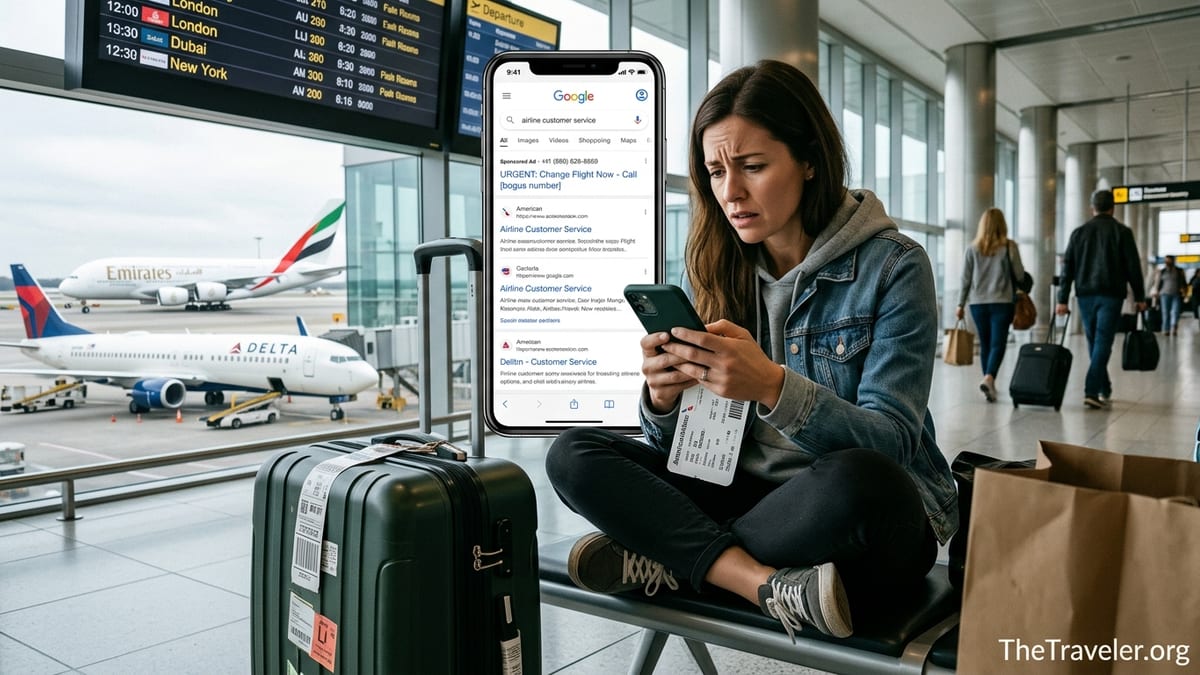
A New Kind of Airline Customer Service Scam
Investigators and security researchers are warning that fake airline customer service numbers are no longer buried on shady websites. Today they can appear at the very top of search results, in sponsored ads, on seemingly legitimate blogs, and within AI-generated summaries. In late October, researchers at security firm Aurascape documented a coordinated campaign where scammers seeded bogus support numbers for major brands across hacked sites and user-generated content. When people searched Google or used AI-powered search assistants for “Emirates customer service phone” or similar queries, the AI tools sometimes surfaced the planted numbers as if they were official.
The U.S. Federal Trade Commission has been warning for several years that scammers pay for search ads or manipulate search results so their impostor customer service lines appear before the real ones. In travel, that can mean a traveler Googling “Delta change flight,” tapping the first “Delta customer service” result and landing in a call center that has no connection to Delta at all. The page may display airline logos and familiar wording, but every detail is designed only to get the caller on the phone and paying fees that never reach the airline.
Similar problems have been seen with rail and hotel bookings. In one widely reported case, a CBS New York journalist who frequently rides Amtrak searched for “Amtrak customer service” and saw several top results with phone numbers that did not belong to Amtrak, even though the listings included the Amtrak name. When he called, the operator quickly pushed for payment, a red flag that something was wrong. This same pattern now appears across airlines, from big U.S. carriers to foreign flag airlines and low-cost brands.
The rise of AI-powered search has made matters worse. Security writeups and media reports in 2024 and 2025 highlighted cases where Google’s AI Overview confidently presented fake “British Airways customer service” or “Emirates reservations” numbers as authoritative answers. The numbers came from poisoned web content where cybercriminals had slipped scam hotlines into blog posts, forum comments, and reviews. Because AI systems summarize the web rather than independently verifying each fact, they can repeat those numbers with misplaced confidence.
How Scammers Get Fake Numbers into Google and AI Results
Behind the scenes, the new scam tactics combine old-fashioned web abuse with modern automation. According to the Aurascape research and technical blogs from security firms, criminals compromise vulnerable websites or create disposable sites and then stuff pages with phrases like “official American Airlines customer service number” or “Southwest reservations 24/7 helpline,” followed by their own phone numbers. They repeat that pattern across many domains, including comment sections, Yelp-style reviews, and travel forums, so search engines and AI models see those numbers associated with legitimate brand names again and again.
In other cases, scammers buy search ads that appear above the organic results when someone types “United change my flight” or “Air India refund phone.” Those ads might display the airline name and even copy the airline’s color scheme. Unless travelers notice the small “Ad” label or the slightly off web address, they can click through and assume they are speaking to the airline. The FBI and the Better Business Bureau have both noted that sponsored search results are a frequent vehicle for impostor customer service schemes targeting airlines, car rental companies, and hotels.
AI Overviews add another twist. Reports in outlets such as Wired and technology blogs describe how AI summaries sometimes pull in phone numbers from obscure web pages that a normal user might never see. For example, a scammer might post a comment on a little-read blog saying “For Emirates flight changes call our official reservations number” and list a fraudulent hotline. A human scanning search results would likely ignore that comment, but an AI system trained to gather and synthesize information might treat it as just another data point. When a traveler later asks an AI-enhanced search for “Emirates customer service,” the model can blend that planted number into a polished answer box, complete with friendly language about agents who can “help you change or cancel flights.”
Researchers who have probed these systems say criminals are essentially performing “LLM search poisoning.” By scattering their phone numbers in enough places, they increase the odds that machine-learning models will pick them up and repeat them, especially for queries about support and reservations. The problem is not limited to airlines. Reports describe the same trick being used for banks, parcel delivery companies, and tech firms. But because airline passengers often search in a state of urgency, the travel sector is a particularly attractive target.
Real-World Scenarios Travelers Are Facing
Travel forums and consumer complaint sites are now peppered with stories that illustrate how convincing these scams can be. One traveler looking for British Airways elite customer support described turning to Google after struggling to find a number on the airline’s own website. The AI-enhanced search result gave a prominent phone number labeled as a BA support line. Once on the call, the agent insisted the traveler’s flights were “on standby” and threatened to cancel them unless a new booking was made immediately using a different payment card. Only after hanging up and logging into the official BA app did the traveler realize that the reservation was fully confirmed all along.
Another case shared by a U.S. traveler involved parents trying to call American Airlines to fix a booking but who were uncomfortable with online chat tools. They typed “American Airlines customer service number” into a privacy-focused search engine and dialed one of the numbers that appeared in a top result. The voice on the other end claimed that the parents’ tickets were invalid and offered to “reissue” them for several hundred dollars in additional fees, to be paid via a third-party payment link. After the payment, the supposed agent stopped answering. When the family later called the real American Airlines number on the airline’s website, the representative had no record of any reissue or additional charge.
Similar situations have been reported with United, Southwest, and non-U.S. carriers. In a Wisconsin case described by a local Better Business Bureau investigator, a traveler at the airport saw their flight canceled and quickly searched online for the airline’s help line. The number they found connected to a call center that pressured them to share full credit card details and to pay an extra “airport assistance fee” for rebooking. The traveler only became suspicious when the “agent” insisted on a wire transfer because the card supposedly failed, something legitimate airlines rarely, if ever, request over the phone in that way.
These examples share the same pattern: a stressful travel problem, a rushed web search for help, and an impostor answering the phone first. That combination means even cautious people who know to avoid phishing emails can still be caught off guard, especially when the number came from what appears to be a mainstream search result or an AI summary box presented as an authority.
Red Flags That a “Customer Service” Number Is Fake
Despite the sophistication of search manipulation, fake airline support lines usually reveal themselves once you know what to look for. One of the clearest warning signs is that the representative asks for unusually sensitive information very early in the call. According to analyses of thousands of scam calls by academic researchers, impostors often begin quickly pressing for full credit card numbers, online banking details, or images of IDs instead of focusing on the actual booking reference. A genuine airline agent will typically start by asking for your confirmation code, frequent flyer number, or the email on your reservation, not your card’s security code.
Another red flag is pressure to pay new or strange fees that are unrelated to any fare rules you have seen in your booking. Travelers report being charged “special rebooking fees,” “airport transfer surcharges,” or “same-day assistance taxes” in the range of 100 to 500 dollars per ticket. Legitimate airlines do charge change fees or fare differences on some tickets, but those fees are explained on the airline’s own website and appear inside your reservation when you manage it online. If the person on the phone refuses to send a detailed breakdown through the airline’s official channels and instead pushes for payment through a separate link, gift cards, or a wire transfer, it is almost certainly a scam.
The behavior of the caller is another clue. Scam operators often answer instantly, at any hour, and rarely place you on hold while they “check with a supervisor” or “review the ticket rules.” Official call centers for large carriers frequently use phone trees, recorded messages, and estimated wait times, especially during weather disruptions. If you dial what is supposed to be a major airline on the day of a mass cancellation and a human answers on the first ring with no queue or interactive menu, you should pause and verify the number.
Pay attention as well to subtle inconsistencies in branding. A website promoting a support number may use an airline’s name but with a generic domain, spelling mistakes, or mismatched addresses, such as listing a U.S. low-cost carrier’s headquarters as being in London. Email receipts from fake support centers sometimes show sender addresses from unrelated domains rather than the airline’s usual format. While scammers are getting better at copying logos, they often slip on these details, especially when they are juggling multiple brands from one boiler-room style call center.
How to Verify Airline Contact Details Before You Call
Given the current landscape, the safest approach is to treat every phone number you see in a search result or AI box as unverified until you confirm it independently. Consumer agencies and airlines themselves advise going directly to the airline’s official website or mobile app when you need support. For example, if you are flying Delta, open the Delta app or type the airline’s web address manually into your browser, then tap the “Help” or “Contact us” section. There you will find the current customer service numbers and, in many cases, options to request a callback or use chat instead of waiting on hold.
If you already have a booking, log in to your account or use the “My trips” or “Manage booking” section and look for help options from inside your reservation. Major carriers including United, American, Lufthansa, and Singapore Airlines integrate their support links directly with your ticket, which makes it much harder for a fake number to slip in. Some airlines now offer in-app calling or secure messaging so that you do not have to dial an external number at all; the contact is initiated from within a logged-in session, which reduces the risk of impostors.
It also helps to cross-check any number that you are unsure about. One simple technique recommended by security professionals is to copy the phone number itself and run a separate search on that number, including phrases like “reviews” or “complaints.” If that same number appears as “customer service” for multiple unrelated airlines or companies, or if it shows up in scam warning posts, you can safely assume it is not legitimate. Investigations by organizations such as Netcraft have documented scam call centers reusing the same hotline as the supposed contact number for several different airlines, something a genuine carrier would not do.
When in doubt, use alternative official contact methods. Most airlines allow you to make changes and request refunds through their apps or websites without speaking to an agent. If you are already at the airport, you can also go to the airline’s staffed ticket counter or customer service desk. It might mean waiting in a physical line rather than a phone queue, but you will be dealing with verified employees. For high-value or complex trips, many travelers choose to book through established travel agencies or corporate travel departments that provide their own support lines, reducing the need to hunt for numbers in the middle of a disruption.
Common Refund and Rebooking Cons Targeting Travelers
Impostor airline hotlines tend to rely on a handful of recurring scripts. One of the most common is the “your ticket was never confirmed” story. In this scenario, the fake agent claims your online purchase did not go through properly and that your original card will be refunded. To keep the booking, they say, you must pay again, sometimes at a higher price, using a different card or payment method. Travelers may later see a charge from an unknown company and no refund from the airline, because the original ticket was always valid and never canceled.
Another widespread ploy is the inflated change-fee scam. After a schedule change or cancellation, legitimate airlines often allow free changes or charge only the fare difference. Scam lines, however, tell callers that any change requires a steep “agency fee” or “partner fee,” which can easily run into hundreds of dollars. Some victims report being told they must pay extra simply to keep their existing seats or to avoid their return flights being canceled. In reality, genuine change fees are published in fare rules and are collected directly by the airline or an authorized agency, not by an unknown third party via peer-to-peer payment apps.
There are also refund diversion schemes. A traveler calls what they believe is the airline to ask about canceling a nonrefundable ticket. The impostor offers a generous-sounding “travel credit” but says that, to process it, they must first place a temporary charge on the traveler’s card or bank account, which will be “released” later. Instead of a temporary hold, the scammer initiates a real charge and disappears. In more aggressive versions, the caller is persuaded to install remote-access software on their computer under the guise of “helping process the refund,” opening the door to broader financial theft.
Finally, some fraudsters try to blend into the gray zone of legitimate but exploitative third-party booking sites. These operations may actually issue a ticket but load it with hidden service fees, nonrefundable markups, and harsh conditions. A traveler who Googles “cheap Alaska Airlines tickets” might click a sponsored link that looks official but connects to a reseller with similar branding. The ticket may cost far more than what the airline itself is charging, and future changes can only be made through that third party. Airlines like Alaska have publicly warned about such lookalike sites, noting that they often use airline logos and deeply discounted prices to lure customers away from official channels.
What To Do If You Shared Payment or Personal Details
If you suspect you have called a fake airline customer service number and given out sensitive information, the most important step is to act quickly. Start by contacting your bank or card issuer using the number on the back of your card or the official banking app, not any number you received by text or email. Explain that you may have disclosed your card number or authorized a fraudulent charge. Depending on the circumstances, the issuer can cancel the card, issue a new one, and review recent transactions for suspicious activity. In many cases, they can also initiate a dispute or chargeback for payments sent to the scammer.
Next, notify the airline whose name was misused, using contact details from its official website or app. While the airline may not be able to refund money paid directly to a fraudster, its fraud and security teams can use your report to identify fake websites or numbers that are impersonating the brand. In some cases, airlines work with search engines and regulators to have malicious listings taken down. Your information can also help them warn other passengers, especially during periods of widespread disruptions when scammers are most active.
You should also report the incident to consumer protection agencies. In the United States, travelers can submit reports to the Federal Trade Commission and to the Better Business Bureau’s Scam Tracker, which collect data that enforcement agencies use to spot patterns and, in some cases, pursue legal action. If the scam involved a significant financial loss or identity theft, consider filing a report with local law enforcement and, for U.S. residents, the FBI’s online complaint center. Keeping copies of call logs, emails, payment receipts, and screenshots of search results can provide helpful evidence.
If you shared information such as your passport number, date of birth, or Social Security number during the call, consider taking additional steps to protect your identity. That might include placing a fraud alert or credit freeze with major credit bureaus, monitoring your credit reports, and watching for any unusual activity like new accounts opened in your name. While many airline impostor scams focus on fast payments rather than long-term identity theft, some operators do attempt to collect enough personal data to sell on criminal marketplaces.
Staying Safe in an Era of AI-Driven Search
The broader lesson from this emerging scam is that familiar online behaviors no longer guarantee safety in the way many travelers assume. For years, people were told that searching for a company name and calling the top result was safer than clicking links in unsolicited emails. With the rise of search engine optimization abuse, malvertising, and AI-generated summaries, that shortcut has become riskier. Even Google itself now publishes guidance warning users about “customer support imposter” scams and encouraging people to double-check phone numbers found through search.
This does not mean travelers need to abandon online search altogether. Instead, it is about adjusting habits and adding one or two verification steps before sharing money or sensitive details. If an AI Overview or answer box shows a phone number, treat it as a starting point, not the final word. Look for the airline’s own site in the results, use the app you already have installed on your phone, or cross-check the number on an old paper boarding pass or email confirmation. A minute spent verifying can prevent hours of frustration later.
As generative AI tools continue to power more of what appears on our screens, experts expect scammers to keep experimenting with new ways to game those systems. Lawmakers in Washington and regulators in multiple countries have begun questioning tech companies about their safeguards and the real-world harms of search and AI poisoning, including in travel. In the meantime, individual travelers remain the last line of defense. Knowing that even Google and AI search can surface fake airline numbers is the first step toward not being fooled by them.
Ultimately, the safest rule when you need airline help is also the simplest: if you did not get the number directly from the airline’s website, app, or printed materials, consider it unverified until you prove otherwise. When your trip is on the line, that small dose of skepticism can be as essential as your passport and boarding pass.