

More news on this day
Travelers across Northeast Asia are facing renewed disruption after Korean Air and China Airlines scrapped three newly launched routes linking South Korea with Hong Kong, Cheongju and other key regional destinations, forcing last-minute itinerary changes amid an already fragile aviation recovery.
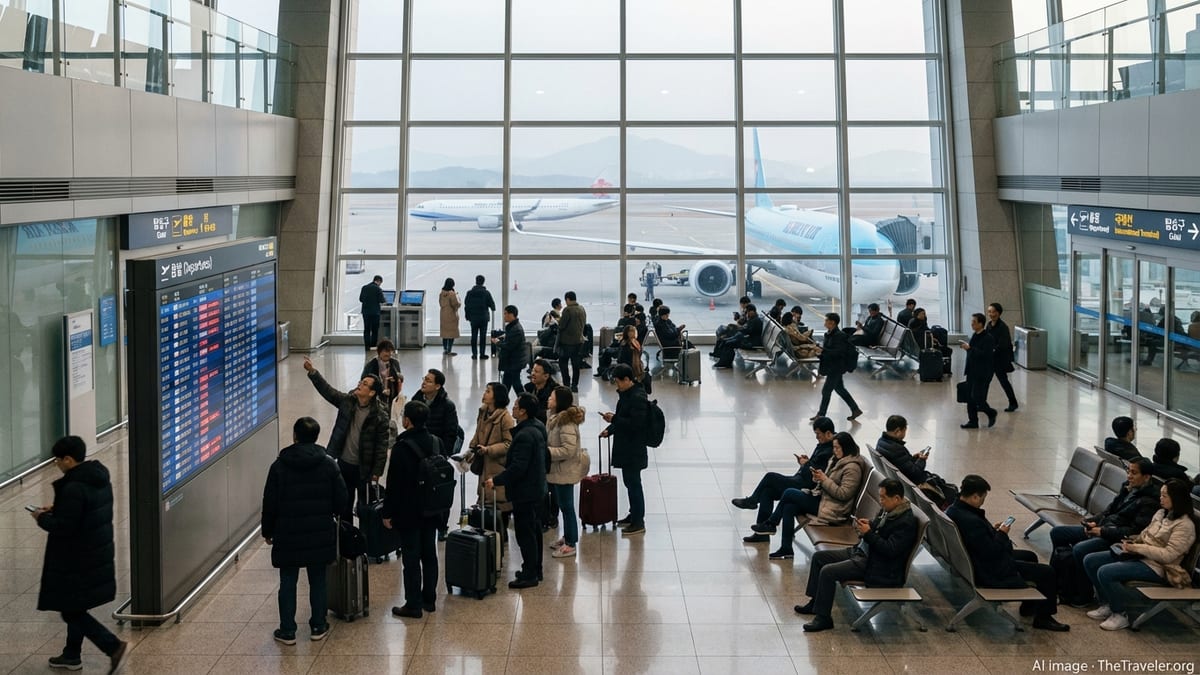
New Cancellations Hit Korea–Asia Network
Korean Air and Taiwan-based China Airlines have both confirmed the cancellation of three recently introduced flights that were designed to strengthen air links between South Korea and key cities in greater China and Southeast Asia. The affected services include connections involving Hong Kong and the regional South Korean gateway of Cheongju, according to airline and airport industry officials in Seoul and Taipei.
The cancellations come at a sensitive moment for the Korean aviation market, which has been rebuilding its short-haul Asian network after years of pandemic-related restrictions and structural changes driven by the merger of Korean Air and Asiana Airlines. Routes to and from Hong Kong, central China and emerging secondary Korean airports such as Cheongju had been at the center of that recovery strategy, aimed at dispersing traffic beyond Seoul’s main Incheon hub.
While the carriers have not provided a detailed public breakdown of passenger numbers on the cancelled flights, analysts say the routes were still in their ramp-up phase, making them vulnerable to any combination of weaker-than-expected demand, higher fuel costs and operational constraints ranging from crew availability to slot allocations.
Neither Korean Air nor China Airlines has indicated that the cancellations will be reversed in the near term, suggesting that travelers will need to rely on alternative connections through Incheon, Busan and other regional hubs for the coming months.
Cheongju and Hong Kong Passengers Scramble for Alternatives
The impact is being felt most acutely in Cheongju, a growing low-cost and regional hub for central South Korea that has marketed itself as a convenient alternative to Seoul for both outbound leisure travelers and inbound tour groups. Local travel agencies reported a spike in calls from customers seeking to rebook itineraries after learning that planned nonstops linking Cheongju with key Asian cities would no longer operate.
Passengers booked on the cancelled Korean Air and China Airlines services to Hong Kong and other destinations are being offered rerouting through larger airports, typically via Incheon or Busan’s Gimhae, as well as partial refunds where re-accommodation is not practical. However, the shift often adds hours to total travel time, and in some cases requires overnight stays due to misaligned schedules on connecting legs.
In Hong Kong, travel agents say group tours combining Hong Kong with central Korean provinces are being restructured to start and end in Seoul instead of Cheongju, undercutting regional authorities’ hopes of drawing visitors directly into lesser-known destinations. Some travelers arriving from Southeast Asia via Hong Kong now face an extra domestic hop within Korea or a lengthy ground transfer from Seoul to reach resorts and cultural sites in North Chungcheong Province.
Budget-conscious travelers are particularly exposed, as many of the cheapest promotional fares were tied to the now-cancelled nonstop services. With inventory tightening on remaining flights, prices on alternative routes have started to edge higher, especially around upcoming holiday periods and peak weekends.
Operational and Market Pressures Behind the Decision
Industry observers say the latest cancellations highlight the delicate balancing act facing Asian airlines as they rebuild networks in a post-pandemic market marked by shifting demand patterns and intensifying competition from low-cost carriers. Korean Air has been steadily restoring and expanding its China and broader Asia services, but has also shown a willingness to adjust frequencies or suspend routes where loads fall short of projections or overlap with budget rivals.
The integration of Asiana’s network into the enlarged Korean Air group has added another layer of complexity, requiring the combined carrier to rationalize overlapping routes while complying with competition remedies imposed by regulators. That process has already led to the transfer of certain long-haul slots and traffic rights to other airlines, and is influencing how the group deploys capacity on shorter regional sectors.
China Airlines, for its part, is navigating a crowded North Asia market in which Hong Kong, Taipei and Korean hubs are all competing to attract transfer traffic between Southeast Asia, mainland China and Japan. With fuel and staffing costs elevated, marginal routes that do not quickly reach sustainable load factors are increasingly at risk, especially when they serve secondary airports that lack the volume of major hubs.
Aviation analysts note that yield management considerations are also critical. High-density trunk routes such as Incheon to major Chinese and Japanese cities can often deliver stronger average fares than newly launched point-to-point links from regional airports, making it financially rational for airlines to reassign aircraft and crews away from underperforming services.
Wider Ripple Effects for South Korea’s Regional Airports
The cancellations are another setback for South Korea’s push to diversify international traffic away from Incheon and Gimpo toward provincial gateways including Cheongju, Jeju, Daegu and Muan. That strategy is intended not only to ease congestion at the Seoul airports but also to spread the economic benefits of inbound tourism more evenly across the country.
Recent disruptions, such as heavy snow that shut down Jeju’s runway and stranded thousands of passengers this month, have underscored both the importance and vulnerability of these regional hubs. While weather-related closures are distinct from commercial route cancellations, both issues contribute to a perception among travelers that services to smaller Korean airports can be less predictable than those to the main Seoul gateways.
Local governments have invested in marketing campaigns and incentive programs to lure airlines into launching new international services, often offering fee waivers or joint promotions with tourism boards. When routes are cancelled within months of their debut, those investments become harder to justify politically, and officials may face pressure to focus spending on domestic tourism or on improving surface transport links instead.
For businesses and universities in central and regional Korea that had counted on new nonstop links to attract foreign partners and students, the loss of direct air connectivity may also complicate planning. Some institutions that promoted easy access via Cheongju and other secondary airports are now revising travel guidance to emphasize connections through Incheon or Busan.
Travelers Urged to Check Schedules and Rights Carefully
Consumer advocates in South Korea and Hong Kong are advising passengers to closely monitor airline notifications and airport departure boards in the coming weeks, as further timetable adjustments across the region remain possible. Airlines typically update schedules and notify affected customers via email or mobile apps, but uneven communication can leave some travelers unaware of changes until shortly before departure.
Passengers whose flights have been cancelled are generally entitled to rebooking on alternative services or refunds, depending on fare rules and the jurisdiction governing the ticket. Experts recommend that travelers confirm whether they are receiving all options available, and keep detailed records of any additional accommodation or transport costs in case partial reimbursement is later offered as a goodwill gesture.
For those planning new trips involving secondary Korean airports or multi-stop Asian itineraries, travel agents suggest allowing extra buffer time between connections and considering more flexible fare classes where budgets permit. While demand for travel within Asia remains robust, the reshaping of airline networks means that routes still in their early months of operation can be especially prone to sudden adjustments.
Airport authorities in Cheongju, Hong Kong and other affected cities are expected to continue discussions with Korean Air, China Airlines and rival carriers in an effort to restore lost connectivity. In the meantime, travelers are likely to face a period of higher uncertainty and less convenience on some of the very routes that had been touted as symbols of Asia’s aviation rebound.