

More news on this day
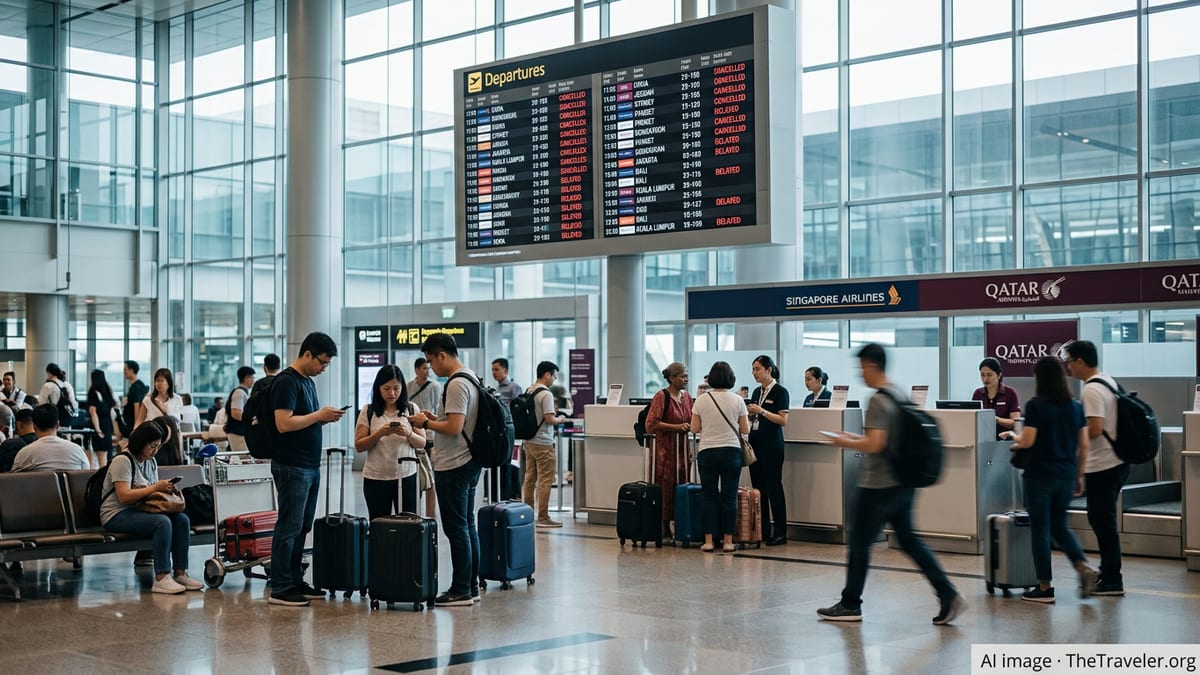
Passengers transiting Singapore Changi Airport are facing mounting disruption as Qatar Airways, Gulf Air, Singapore Airlines, Qantas and other carriers cancel or trim services, severing or rerouting key links to Doha, Jeddah, Sydney and popular Asian leisure hubs just as regional airspace restrictions tighten.
Get the latest news straight to your inbox!
Middle East Tensions Ripple Into Singapore’s Skies
Singapore Changi, one of Asia’s busiest transit hubs, has become a visible pressure point in the latest round of Gulf airspace disruption, with more than a dozen flights involving Qatar Airways, Gulf Air, Singapore Airlines, Qantas and other carriers either cancelled or heavily adjusted in recent days. The moves are part of a broader reaction by airlines to security concerns and temporary operating restrictions affecting routes to and from Qatar and neighbouring states.
Qatar Airways, whose global network relies heavily on Doha as a mega hub, continues to operate only a limited schedule after an airspace closure around Qatar forced a sweeping suspension of regular commercial services. The carrier has been publishing short-term operating lists of relief and essential flights, but many regular services that would normally connect through Singapore, including onward links to Jakarta, Bali and Kuala Lumpur via partner or codeshare itineraries, remain disrupted.
Regional authorities have authorised restricted corridors to support evacuation and essential travel, but these do not yet amount to a full reopening of Gulf skies. As a result, airlines that funnel traffic through Doha and other Gulf hubs have had to thin out their schedules from key Asian gateways such as Singapore, Bangkok and Jakarta, leading to an uneven patchwork of cancellations, ad hoc additions and last-minute reroutings.
For travellers, that means itineraries that once relied on seamless Gulf connections are now frequently being broken apart, rebooked via alternative hubs in East and Southeast Asia, or in some cases postponed altogether until more predictable flying patterns return.
Key Routes to Doha, Jeddah and Sydney Affected
The most immediate impact for Singapore-based and connecting passengers is on services to Doha and Jeddah, which are central to both business and religious travel flows. With Qatar Airways’ normal schedule curtailed and Gulf Air trimming its regional operations, many Singapore-origin passengers bound for the Middle East or onward to Europe and Africa are finding their usual one-stop options through Doha or Bahrain temporarily unavailable.
Saudi Arabia-facing routes have also come under strain. Services linking Singapore with Jeddah, an important gateway for pilgrims and expatriate workers, have seen cancellations and aircraft swaps as airlines recalculate routings around sensitive airspace. Travellers planning onward connections from Jeddah across the Saudi domestic network are being urged to leave more buffer time or consider alternative entry points when possible.
Long-haul links to Australia are feeling knock-on effects too. Qantas, which routinely coordinates schedules with Gulf and Asian partners, has adjusted selected services between Singapore and Sydney as it works around the constraints facing Qatar Airways and other Gulf carriers. While Sydney remains broadly accessible, passengers who previously relied on mixed itineraries combining Gulf carriers with Qantas or Singapore Airlines via Changi are now facing longer journey times, extra stops or forced date changes.
The pattern is similar for leisure destinations such as Phuket and Bali, which are popular add-ons to Middle East or Europe trips. With Changi functioning as a key staging point for these itineraries, any reduction in Gulf-bound capacity from Singapore has an outsized effect on connecting traffic into Thailand and Indonesia.
Network Shock for Southeast Asian Leisure and Business Travel
The disruption is being felt most acutely across Southeast Asia, where Singapore’s role as a super-connector feeds traffic to secondary destinations that depend on inbound flows from Europe and the Middle East. Routes to Phuket, Jakarta, Bali and Kuala Lumpur, while still served by local and regional carriers, are seeing softer demand and occasional schedule tweaks as Gulf-origin passengers struggle to reach Changi in the first place.
Travel agents in Singapore and across the region report a spike in itinerary changes, with clients who had originally booked Qatar Airways or Gulf Air services via Doha now seeking alternatives through hubs such as Singapore, Bangkok, Hong Kong or Tokyo. In many cases, that means switching to Singapore Airlines, Qantas or regional low-cost carriers for the intra-Asia legs, while long-haul sectors are rebooked onto airlines that do not rely on the restricted Gulf corridors.
Corporate travel managers are also reassessing routings for staff heading to energy, construction and finance projects in Qatar and Saudi Arabia. Some are temporarily favouring connections via Europe or re-routing through alternative Middle Eastern gateways that retain more stable airspace access, even when that adds hours to the journey.
Airports across the region, including Changi, Bangkok Suvarnabhumi and Jakarta Soekarno Hatta, are working with airlines to smooth the operational impact, but officials acknowledge that as long as Gulf airspace remains constrained, schedules will continue to be subject to late changes and rolling cancellations.
Airlines Activate Waivers and Limited Relief Flights
In response to the evolving situation, major carriers have activated flexible rebooking policies and, in some cases, mounted special relief flights. Qatar Airways has outlined a series of short-term operating days to and from Doha, adding select destinations such as Jeddah, Jakarta and Kuala Lumpur on limited dates to help clear backlogs of stranded passengers.
Singapore Airlines and its partners have introduced change-fee waivers for many affected itineraries touching the Gulf, allowing passengers to shift travel dates or reroute via alternative hubs without standard penalties. Qantas and other oneworld members have been absorbing some displaced Qatar Airways customers where alliance ties or interline agreements permit, though seat availability remains tight on peak days.
Gulf Air has similarly pared back certain services while keeping a skeleton network in place, focusing on routes with strong local demand and essential connectivity. For Changi, that has translated into a reduced but still present flow of Bahrain-bound traffic, with onward options beyond the Gulf far more constrained than usual.
Despite the waivers, travellers are being warned that compensation rules differ by jurisdiction and ticket type, and that disrupted itineraries involving multiple airlines can make refund and rebooking processes more complex and time-consuming.
What Travellers Through Singapore Need to Do Now
With conditions changing by the day, passengers booked to travel through Singapore Changi to or from Doha, Jeddah, Sydney, Phuket, Jakarta, Bali, Kuala Lumpur and other affected destinations in the coming weeks are being urged to take a proactive approach. Airlines are updating schedules and limited-flight lists on a rolling basis, often only a few days in advance, which means last-minute cancellations and time changes remain a real possibility.
Travellers should ensure their contact details are up to date in airline booking systems and opt into mobile or email alerts so that notifications of cancellations or reroutings are received as quickly as possible. Checking flight status repeatedly in the 48 hours before departure, rather than assuming previously issued tickets remain valid, is now considered essential for Gulf-bound journeys.
Those with non-essential trips involving Doha or Jeddah may want to consider postponing or rerouting via alternative hubs in East Asia or Europe, especially where flexible tickets or corporate travel policies allow. For essential travel, building in longer connection times at Changi and other intermediate airports can provide a buffer against cascading delays.
Industry observers expect that more clarity will emerge once regional authorities signal a firmer timeline for normalising Gulf airspace access. Until then, Singapore’s role as a resilient, multi-hub gateway remains an asset for travellers, but one that now demands closer monitoring of schedules and a greater willingness to accept detours on the way to key Middle Eastern and Australasian destinations.