

More news on this day
Travelers moving between Beijing and western China faced a new wave of disruption this week as 30 flights were withdrawn and 233 additional services experienced significant schedule setbacks, leading to extended layovers at Urumqi Diwopu, Zhaotong and Beijing Capital airports amid ongoing network instability at China Express, Air China and Chengdu Airlines.
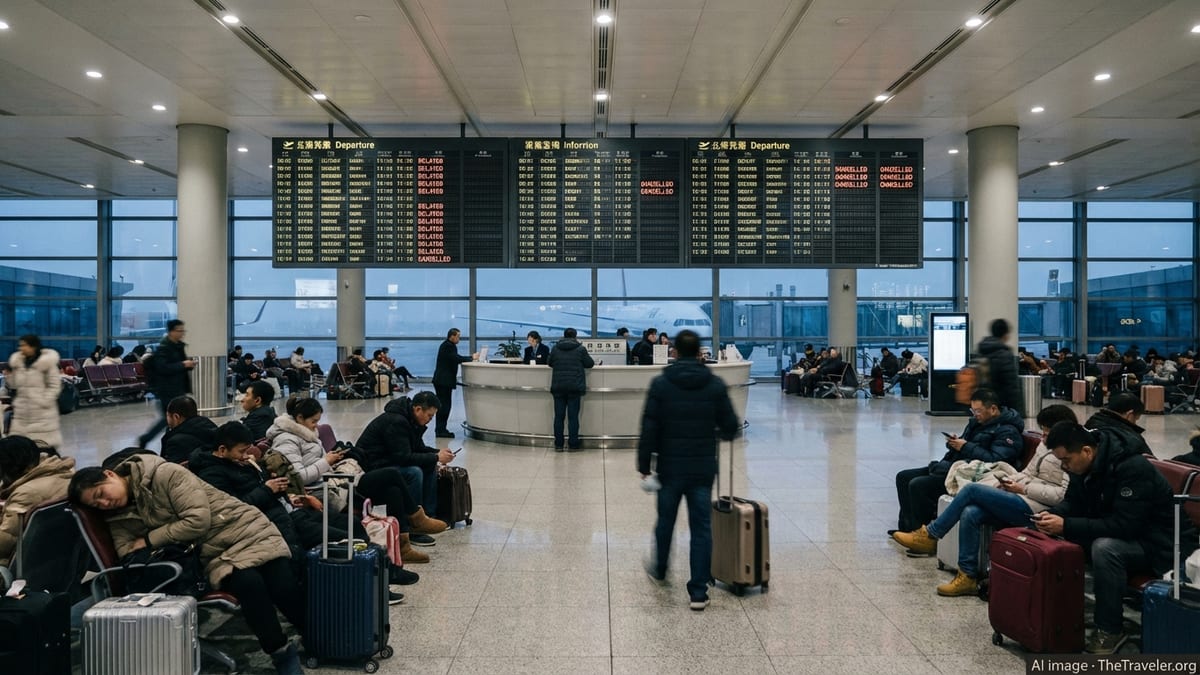
Weather and Network Strain Converge on Key Air Corridors
The latest disruptions come on the heels of an already strained winter travel period in China, where volatile conditions across northern and western regions have repeatedly tested airline operations. From Xinjiang’s Urumqi hub to plateau and valley airports in Yunnan, low visibility, shifting snow bands and fast‑moving frontal systems have narrowed takeoff and landing windows, particularly on evening and early‑morning rotations.
Operational planners at Chinese carriers have been forced to juggle limited aircraft and crew hours along some of the country’s busiest domestic corridors, including Beijing to Urumqi and Chongqing to Yunnan’s secondary cities. When a single sector is withdrawn or heavily delayed, knock‑on effects cascade through multi‑leg itineraries, amplifying disruption for passengers who are relying on timed connections at regional transfer points such as Urumqi and Zhaotong.
Industry analysts note that these pressures are colliding with record post‑pandemic travel demand. With passenger volumes surging around peak holidays and weekend returns, any capacity reduction or prolonged ground stop quickly translates into crowded terminals, rebooking bottlenecks and extended layovers, particularly at airports with limited spare gate and apron capacity.
Routes Worst Affected Across Beijing, Xinjiang, Yunnan and Chongqing
Aviation schedule data reviewed by TheTraveler.org indicates that the bulk of the 30 withdrawn flights are clustered on trunk and feeder routes linking Beijing with western and southwestern China. Sectors touching Beijing Capital and Daxing airports, including services to Urumqi in Xinjiang and to smaller Yunnan gateways via Chongqing, have seen outright cancellations as carriers consolidate lightly loaded or operationally risky rotations into fewer departures.
In Xinjiang, Urumqi Diwopu International Airport has emerged as both a pressure point and a relief valve. Several China Express and Air China flights connecting Urumqi to inland hubs and onward to Beijing were pulled from schedules at short notice, while others departed late, pushing arrival times into the early hours and stranding passengers who missed onward connections. Travelers bound for secondary cities have been particularly exposed, as fewer daily frequencies mean a cancellation can wipe out same‑day options.
In Yunnan, regional links into and out of Zhaotong have been hampered by shifting weather conditions and tight aircraft utilization. Short‑haul sectors feeding into Chongqing and other larger hubs have seen both cancellations and rolling delays, with some flights held on the tarmac awaiting improved conditions en route or at destination. Passengers transiting through Chongqing Jiangbei have reported being rebooked via circuitous routings that add hours to journeys originally planned as single‑stop domestic itineraries.
Extended Layovers and Passenger Experience at Key Transit Airports
The operational turmoil has been most visible in the passenger experience at Beijing Capital, Urumqi and Zhaotong airports, where extended layovers have become commonplace. At Beijing Capital, travelers arriving late from Xinjiang and Yunnan have frequently found onward flights already closed or full, forcing overnight stays in nearby hotels or improvised rest in terminal seating while awaiting spare seats on morning departures.
At Urumqi Diwopu, a critical hub for western China connections, departure boards have alternated rapidly between delayed, boarding and cancelled statuses as airlines adjust in real time to changing weather bands and air traffic flow restrictions. The result has been clusters of passengers waiting hours between updates, with some offered meal vouchers and others relying on airport concessions and business lounges nearing capacity.
Zhaotong, a much smaller operation than Beijing or Urumqi, has faced different constraints. Limited gate space and fewer stands for overnight aircraft mean that when evening services are scrubbed or diverted, entire planeloads must be accommodated in modest terminal facilities. Local authorities and ground handlers have scrambled to coordinate buses, hotels and basic amenities, highlighting the vulnerability of regional airports when multiple disruptions hit on the same day.
How China Express, Air China and Chengdu Airlines Are Responding
China Express, whose network is heavily weighted toward regional and high‑altitude airports, has borne a significant share of the cancellations. To stabilize operations, the carrier has consolidated multiple lightly booked services into single departures where conditions allow, while temporarily suspending some rotations that were most exposed to weather‑related risk. The airline has also leaned on text alerts and app notifications to steer passengers toward rebooking options without overloading airport counters.
Flag carrier Air China has focused on preserving core trunk routes, particularly those linking Beijing to major hubs such as Urumqi, while trimming marginal frequencies and adjusting departure times to align with forecast weather windows. Operational teams have introduced rolling retimings on select flights, shifting departures by 30 to 90 minutes to avoid peak congestion in the air and on the ground. However, these tactical moves have not prevented all delays, and some passengers are still encountering missed connections and same‑day itinerary breakdowns.
Chengdu Airlines, which operates a mixed fleet on routes crisscrossing western China, has been recalibrating aircraft assignment to maintain reliability on its most commercially and strategically important sectors. Industry observers say the carrier’s growing role in testing and deploying new Chinese‑built aircraft has added complexity to fleet planning at a time when spare capacity is limited. Even so, the airline has continued to prioritize safety margins around challenging terrain and weather, accepting cancellations and extended ground times when conditions fail to meet operating thresholds.
What Travelers Should Expect in the Coming Days
With seasonal weather patterns still unsettled and demand remaining high, aviation planners warn that the disruption is unlikely to ease immediately. Capacity buffers on many Beijing–Xinjiang, Beijing–Yunnan and Chongqing–Yunnan routes remain thin, meaning further delays or ad hoc cancellations are possible if additional storms, visibility drops or airspace flow restrictions emerge in the days ahead.
Travelers scheduled to transit through Beijing Capital, Urumqi Diwopu or Zhaotong are being advised by airlines and travel agents to monitor their flight status frequently on day of departure, arrive at the airport earlier than usual and build in longer connection times where itineraries involve multiple domestic legs. Those with tight same‑day connections may wish to explore alternative routings via larger hubs with more back‑up frequencies, even if that introduces an extra stop.
Airport authorities, for their part, are stepping up communication efforts, adding temporary staffing at information desks and security checkpoints, and coordinating with carriers to speed the handling of disrupted passengers. While these measures can ease some of the strain, the current wave of flight withdrawals and schedule setbacks underscores the broader challenge of keeping China’s rapidly expanding domestic air network running smoothly when weather, demand and operational constraints collide.