


More news on this day
Air travel across Asia and the Middle East has been thrown into renewed turmoil as publicly available aviation data indicates that 6,424 flights have been delayed and 349 canceled in a single day across key hubs in Japan, Thailand, Saudi Arabia, Malaysia, Hong Kong, mainland China, and neighboring markets, disrupting operations for carriers including Cathay Pacific, Japan Airlines, All Nippon Airways, Saudia, and several regional rivals.
Get the latest news straight to your inbox!
Ripple Effects From Bangkok To Tokyo
Disruption has rippled across some of Asia’s busiest international gateways, with flight status dashboards for Bangkok Suvarnabhumi, Tokyo’s Haneda and Narita airports, and Hong Kong International Airport showing heavy clusters of late and canceled services. Reports indicate that a mix of congestion, knock-on schedule imbalances, and local operational challenges has slowed departures and arrivals across multiple time zones.
Bangkok and Kuala Lumpur have again emerged as pressure points, with data compiled by flight-rights platforms in recent weeks already highlighting elevated levels of delays and cancellations at both airports. On the latest day of disruption, long-haul services from these Southeast Asian hubs to Japan, the Gulf, and greater China have been particularly exposed, creating complex rebooking challenges for connecting passengers.
In Japan, traffic through Haneda and Narita has been constrained by a combination of crowded summer schedules and lingering operational sensitivities after earlier safety incidents this year. Publicly available flight tracking shows rolling delays on key domestic and regional routes that feed international departures, making it harder for airlines such as Japan Airlines and All Nippon Airways to keep widebody services on time.
Hong Kong and major mainland Chinese hubs, including Shanghai and Guangzhou, have also recorded significant numbers of delayed departures. As aircraft and crews arrive late from elsewhere in the network, turnaround times lengthen and subsequent rotations slide, adding to the overall tally of 6,424 delayed flights across the region.
Flag Carriers Under Pressure
Well-known Asian and Middle Eastern airlines have been at the heart of the current wave of disruption. According to published coverage and aggregated flight-status data, Cathay Pacific, Japan Airlines, All Nippon Airways, Saudia, and several Chinese and Southeast Asian carriers have all faced schedule reliability challenges on affected days.
Cathay Pacific’s operations through Hong Kong have been squeezed by tight aircraft utilization and route consolidation, with recent reports already noting selective cancellations on busy links to Bangkok and Kuala Lumpur. When wider regional disruption hits, this leaves reduced flexibility to absorb additional delays or aircraft swaps, increasing the likelihood that further flights will be pushed back or scrubbed.
Japan Airlines and All Nippon Airways, which typically post strong on-time performance, have nonetheless seen punctuality dented by the congestion around Tokyo’s dual international airports. Delays on feeder flights from regional Japanese cities or from neighboring countries can quickly cascade into missed connections for long-haul passengers heading to Europe or North America, forcing airlines to rebook customers onto later services.
In the Middle East, Saudia’s Jeddah hub has been coping with heavy seasonal demand combined with airspace and routing constraints between Asia and the Gulf region. Public data shows that late inbound services from South and Southeast Asia can translate into significant departure delays from Jeddah, particularly on peak pilgrimage and labor routes.
Numbers That Reveal A Strained System
The headline figures of 6,424 delayed flights and 349 outright cancellations across Asia and parts of the Middle East highlight how finely balanced airline and airport operations remain, even several years after the sharpest pandemic-era shocks. On a typical high-traffic day, a smaller fraction of the schedule might be disrupted, but recent tallies from flight-compensation and tracking services have repeatedly flagged elevated disruption levels across multiple consecutive days.
Earlier snapshots published in May showed nearly 3,000 flight delays and close to 450 cancellations across Asian airports in a single 24-hour period, followed the next day by more than 3,300 further disruptions as congestion shifted between hubs. The latest totals of more than 6,000 delays and hundreds of cancellations suggest that the system has yet to fully clear the resulting backlogs, with some airlines and airports still working through accumulated schedule distortions.
Analysts who track aviation performance note that such figures are especially significant because they are spread across a wide geography. Rather than a single weather event or isolated technical outage, the pattern emerging from recent data points to a network under sustained strain, where small local issues at one hub can reverberate across routes linking Tokyo, Bangkok, Kuala Lumpur, Jeddah, and major Chinese cities.
For carriers, maintaining aircraft rotations and crew duty limits under these conditions becomes increasingly complex. Even airlines with relatively strong long-term on-time records can see daily performance fall sharply when disruption is both widespread and prolonged, adding to costs and challenging already tight profit margins.
Impact On Passengers And Travel Plans
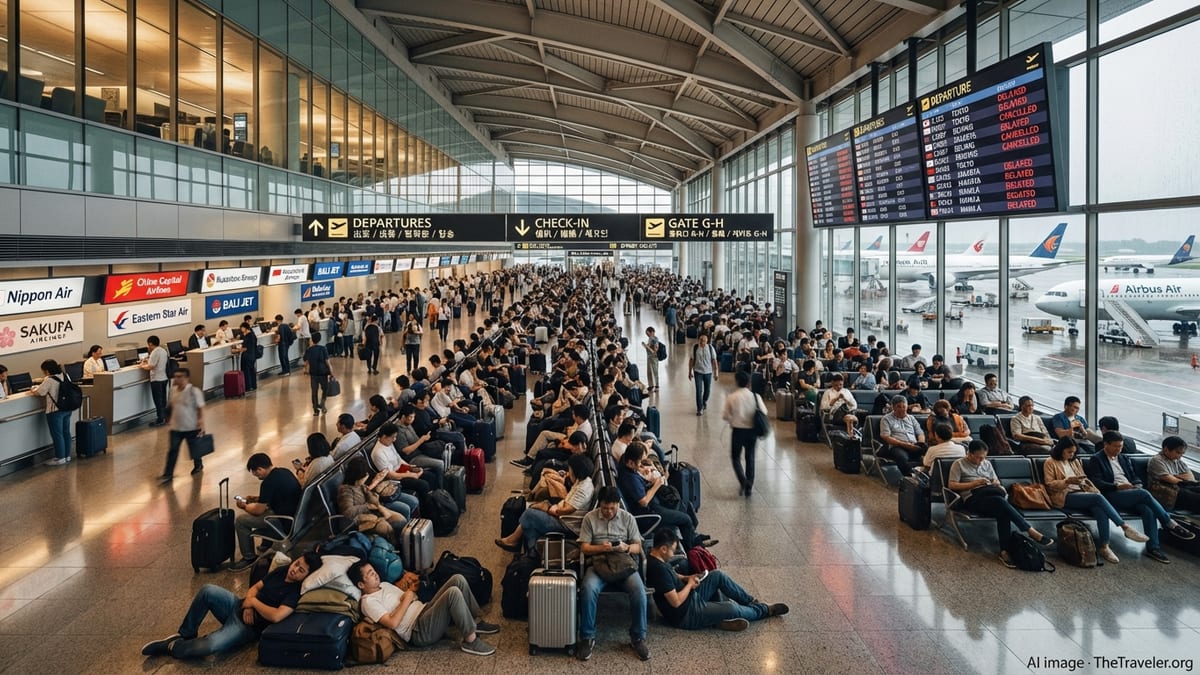
For travelers, the effect of the latest disruption has been immediate and highly visible. Social media posts and traveler forums describe crowded terminals in Bangkok, Kuala Lumpur, Jeddah, and Tokyo, with passengers queueing to rebook itineraries or seek clarification on updated departure times. Missed connections on itineraries involving multiple airlines and stopovers are a recurring theme, particularly on complex journeys between Asia, Europe, and North America.
Publicly available guidance from passenger-rights organizations stresses that, in many jurisdictions, travelers whose flights are canceled are typically entitled to a choice between rerouting at the earliest opportunity and a refund of the unused ticket. Depending on local rules and airline policies, long delays can also trigger obligations for carriers to provide meal vouchers, hotel accommodation, and ground transport when an overnight stay becomes necessary.
However, entitlements can vary widely between countries in Asia and the Middle East, and compensation rules similar to those in the European Union do not apply uniformly across the region. As a result, many passengers caught up in the current wave of disruption are relying on airline goodwill policies, travel insurance, or credit card protections to recover some of their additional expenses.
Travel planners advise that, during such periods of instability, passengers should allow longer connection times, monitor flight status frequently on the day of travel, and consider routing through secondary hubs that appear to be less affected. With the latest data suggesting that disruption remains elevated across multiple days, flexible itineraries and contingency plans may reduce the risk of severe inconvenience.
Uncertain Outlook For Summer Peak
The timing of this latest spike in delays and cancellations is raising concern about the resilience of Asia’s aviation network heading into the northern summer peak. Many airlines in the region have restored or even expanded capacity compared with previous years, but ground infrastructure, air traffic control resources, and staffing levels have not always kept pace.
Published analysis from industry observers suggests that bottlenecks in aircraft maintenance slots, crew training pipelines, and airport security staffing continue to limit operational flexibility. When adverse weather, technical constraints, or routing challenges occur, the system has less spare capacity to recover quickly, leading to the kind of multi-day ripple effects reflected in the current disruption figures.
Looking ahead, regulators, airport operators, and airlines across Japan, Thailand, Saudi Arabia, Malaysia, Hong Kong, and mainland China are expected to scrutinize recent performance data to identify weak points before traffic climbs further. Some carriers have already been consolidating frequencies on marginal routes or adjusting schedules to build in additional buffer time between rotations.
For now, the combination of 6,424 delayed flights and 349 cancellations across such a broad swath of the Asian and Middle Eastern network serves as a warning that, despite strong demand and rapidly recovering tourism flows, the region’s skies remain vulnerable to sudden, sweeping disruption.