

More news on this day
Air travel across Australia was thrown into fresh chaos on Saturday as nearly 400 flights were delayed and more than 40 cancelled, disrupting tens of thousands of passengers flying through Melbourne, Sydney, Brisbane, Adelaide and Perth on services operated by Emirates, Jetstar, Qantas, Virgin Australia and several other carriers.
Nationwide Disruption Hits Major Australian Gateways
Data from aviation tracking platforms and airport operations on 28 February indicates that 394 flights were delayed and 44 services cancelled across Australia’s busiest hubs, causing rolling queues, missed connections and extended waits in terminals. The disruption was felt most acutely at Sydney and Melbourne, but significant operational pressure was also reported at Brisbane, Adelaide and Perth as airlines struggled to reposition aircraft and crews.
The latest figures follow a turbulent month for Australian aviation, with multiple days of severe schedule disruption already recorded in January and February. On several occasions, staffing constraints in air traffic control, heavy summer storms and flow-on effects from international airspace restrictions combined to push airport operations to the limit. Saturday’s wave of delays and cancellations continued that pattern, once again testing the resilience of carriers and airport operators.
While airlines have not released a consolidated national tally, carrier-by-carrier reports and live flight-status boards show an elevated level of delays on core domestic trunk routes such as Melbourne to Sydney, Sydney to Brisbane and services linking Perth and Adelaide with the east coast. Flights operated for and by overseas airlines, including Middle Eastern and Asian carriers, also experienced knock-on schedule changes as crews and aircraft were held on the ground or diverted.
Mix of Weather, Staffing and International Turmoil Blamed
Industry sources point to a combination of factors behind the latest disruption, mirroring trends seen on previous high-impact days this summer. In recent days, severe weather systems and heavy rainfall have swept across parts of South Australia and the eastern seaboard, periodically slowing airport operations and forcing ground crews to halt ramp work during lightning and intense downpours. These pauses, though temporary, quickly cascade into broader network delays when aircraft cannot be turned around on schedule.
At the same time, chronic staffing challenges in air traffic control and ground operations remain a sensitive pressure point. Earlier this year, Australian authorities acknowledged that short-notice illness among controllers at Sydney could require the introduction of wider spacing between arrivals and departures, reducing the number of aircraft that can safely move through the airspace in peak periods. Similar constraints, when they occur on busy travel days, tend to ripple across the national network, as aircraft waiting for clearance are late into their next sectors.
Compounding these domestic issues are ongoing complications from international airspace closures and conflict zones, particularly in the Middle East. Carriers including Qantas and Emirates have been forced in recent months to reroute or adjust long-haul services to and from Australia, occasionally cancelling flights or inserting technical stops for refuelling. When these changes coincide with already stretched domestic operations, they can leave airlines with fewer spare aircraft and crews to absorb last-minute disruptions.
Major Carriers Struggle to Keep Schedules Intact
Among Australian-based airlines, Qantas, Jetstar and Virgin Australia all faced significant schedule challenges on Saturday, with a high proportion of their domestic services recording late departures or arrivals. On top of that, regional affiliates and codeshare partners, including QantasLink and several overseas carriers serving Australian cities, reported secondary disruption as aircraft were held, diverted or substituted.
Emirates and other long-haul airlines flying into and out of Sydney, Melbourne, Brisbane, Adelaide and Perth were also affected, particularly on services connecting to Europe and the Middle East. When a widebody flight is delayed or cancelled, entire planeloads of passengers may miss onward connections, prompting complex rebooking efforts and filling later flights, which can in turn push those services closer to capacity and make same-day recovery harder.
Although airlines have been reluctant to put a precise number on affected customers, aviation analysts estimate that the combined delays and cancellations would impact well over fifty thousand travellers in a single day in a market as heavily trafficked as Australia’s east coast triangle and key transcontinental routes. For many passengers, the disruption meant arriving hours behind schedule, waiting in long lines at service desks and struggling to secure last-minute accommodation or alternative flights.
Long Queues, Missed Holidays and Business Disruption
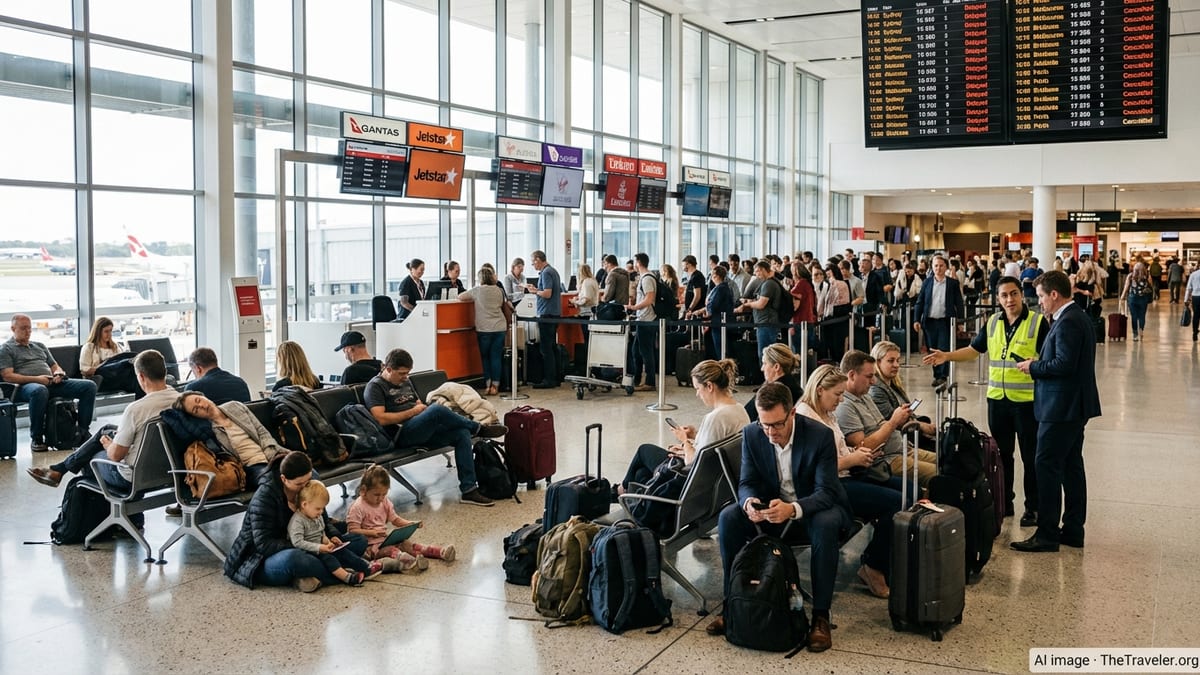
The operational challenges quickly translated into visible strain in terminals. Travellers arriving early for morning departures in cities such as Sydney and Melbourne encountered congested check-in halls and packed security lanes as disrupted flights stacked up against the departing schedule. Departure boards showed clusters of services marked delayed, while gate areas filled with passengers waiting for new boarding times or aircraft swaps.
For leisure travellers, the timing of the chaos was particularly painful, coming during a busy late-summer travel period when families are squeezing in final holidays and domestic tourism remains strong. Missed resort bookings, lost nights of pre-paid accommodation and disrupted cruise departures were among the most common complaints shared by travellers waiting at the gates. Some passengers also reported difficulties rebooking multi-leg itineraries that combined domestic sectors with international flights.
The business community was likewise affected, with frequent flyers reporting missed meetings in interstate capitals and regional centres. Delays on heavily used corporate routes such as Melbourne to Sydney and Brisbane to Sydney forced some travellers to pivot to video calls or reschedule important engagements. Travel managers say that the recurrence of large-scale disruption events this year is prompting companies to build in greater time buffers and contingency plans for staff who must travel.
Airlines Offer Waivers as Travellers Seek Clarity
In response to the disruption, major carriers moved to offer affected customers a mix of fee-free rebooking options, credits and refunds in line with their usual disruption policies. Qantas, Jetstar and Virgin Australia encouraged passengers to use online and app-based tools where possible, both to reduce congestion at airport desks and to give customers faster access to alternative flights. International airlines including Emirates issued statements apologising to travellers and reiterating that safety remains the overriding priority when decisions are made to delay or cancel a flight.
Airport operators urged passengers to check their flight status before leaving for the terminal and to allow extra time for check-in and security screening while disruption continues. Travellers were also advised to monitor airline communications closely, as same-day schedule changes and gate swaps remained likely across the afternoon and evening peaks.
As airlines worked through the backlog, aviation experts noted that a full recovery could take 24 hours or more, with some aircraft and crew still out of position after the initial day of disruption. That raises the prospect of rolling knock-on delays into Sunday’s schedules, particularly on routes where demand is high and spare capacity is limited. For now, passengers planning to travel through Melbourne, Sydney, Brisbane, Adelaide or Perth are being warned to brace for continued uncertainty and to build flexibility into their plans.