

More news on this day
Hundreds of passengers were left stranded across England today as operational data showed 411 flights delayed and 23 cancelled at major airports serving Manchester, Liverpool, London, and Birmingham, disrupting schedules for British Airways, Virgin Atlantic, Ryanair, Jet2, and several other carriers.
Get the latest news straight to your inbox!
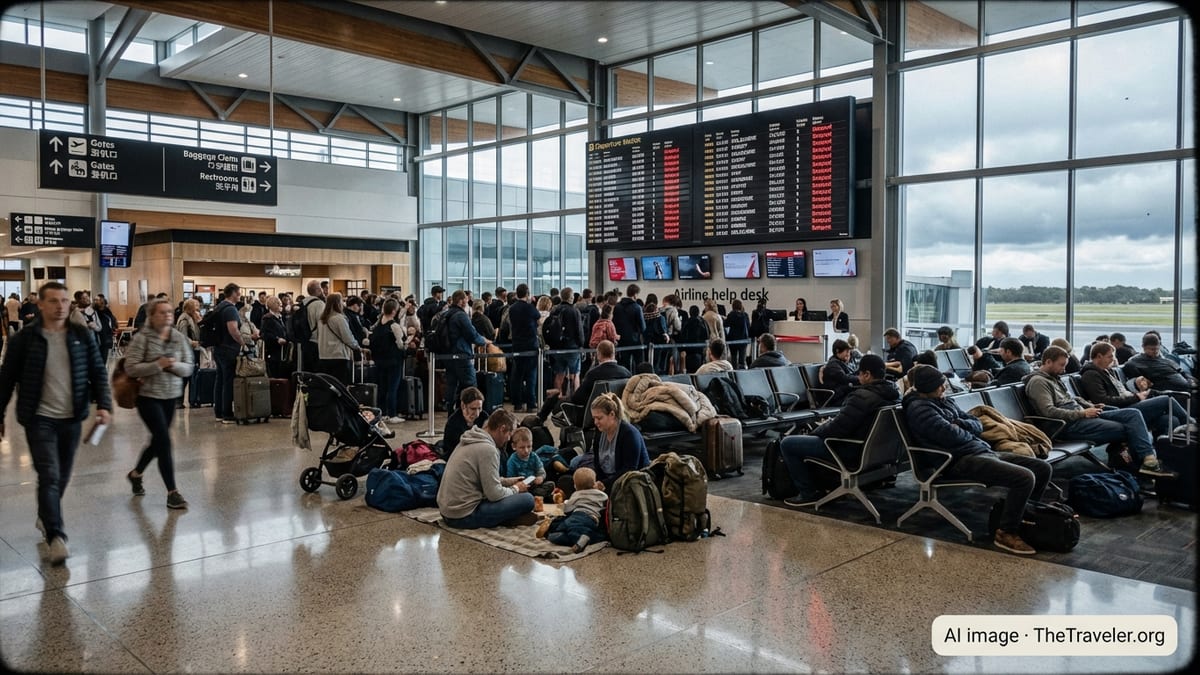
Delays Ripple Across Manchester, Liverpool, London, and Birmingham
Real-time aviation tracking data indicated that disruption was concentrated at the main English hubs, with Manchester, Liverpool John Lennon, Birmingham, and London’s airports collectively recording hundreds of late departures and arrivals. The figures pointed to 411 delayed flights and 23 cancellations across the four cities, affecting both domestic and international routes.
Published reports and airport-status dashboards showed departure boards dominated by amber and red markers, with many services pushed back by more than an hour. The pattern was broadly consistent across airports, suggesting system-wide congestion rather than an isolated local failure at a single facility.
While precise delay causes varied from flight to flight, publicly available information highlighted a familiar mix of contributing factors, including residual knock-on effects from recent European disruption, staffing constraints, and weather-related slot restrictions in parts of the continent. These pressures reduced the ability of airlines and airports to recover once the morning peak began to slip.
For passengers, the immediate impact was long queues at check-in and security, crowded departure lounges, and missed onward connections. Social media posts from travellers described last-minute gate changes and rolling estimated departure times, as carriers sought to reshuffle aircraft and crews to keep as much of the schedule running as possible.
Major Carriers See Schedules Thrown Off Balance
The disruption hit a wide range of airlines, but operational data showed that British Airways, Virgin Atlantic, Ryanair, and Jet2 all experienced notable schedule changes across their networks. With these airlines forming a significant share of the traffic at Manchester, Liverpool, London, and Birmingham, their difficulties quickly translated into widespread delays.
For full-service operators such as British Airways and Virgin Atlantic, late-running feeder flights into London and other hubs created particular problems. When short-haul services arrive behind schedule, long-haul departures often have to be held for connecting passengers, aircraft servicing, or crew rest requirements, adding extra minutes and sometimes hours to turnarounds.
Low-cost carriers including Ryanair and Jet2 faced their own challenges, with tight aircraft utilisation leaving limited slack to absorb disruptions. When a single rotation slips by more than an hour early in the day, subsequent legs can fall successively behind, and a delay on one side of Europe can eventually contribute to a late departure from an English base many hours later.
According to flight-tracking summaries, some affected services were able to reduce delays en route by flying at higher speeds or benefiting from favourable winds, but in many cases aircraft landed late enough to force a cascade of schedule changes into the afternoon and evening peaks.
Knock-on Effects Across Europe’s Crowded Skies
Operational feeds and regional media coverage indicated that the disruption in England did not occur in isolation. European aviation has been grappling with a series of recent pressure points, from severe weather systems impacting key hubs to technical issues and congestion at air traffic control centres in several countries.
These broader challenges contributed to reduced capacity on certain air corridors and periodic flow restrictions, which in turn constrained the number of aircraft that could depart from and arrive into English airports each hour. Even relatively short restrictions can create a backlog, leaving aircraft waiting for departure slots and forcing airlines to reshuffle rotations.
Some of today’s delayed and cancelled flights were linked to aircraft arriving late from previously disrupted sectors elsewhere in Europe. When an inbound aircraft turns up hours behind schedule, carriers may choose to cancel a subsequent leg or combine passengers onto a later service, a strategy that can stabilise operations but leaves travellers facing significant itinerary changes.
The timing of the disruption, occurring during a busy spring travel period, further complicated recovery. With many flights already operating at high load factors, options for rebooking stranded passengers were limited, and some travellers were advised through public channels to expect overnight stays or substantial re-routing via alternative hubs.
What Today’s Chaos Means for Travellers
For passengers caught up in the disruption, today’s events once again highlighted the importance of understanding air-travel protections in the United Kingdom and European Union. Under UK rules that mirror the EU’s Regulation 261/2004, travellers on eligible flights may be entitled to meals, hotel accommodation, and, in some circumstances, financial compensation when delays or cancellations meet specific criteria.
Publicly available guidance notes that entitlements depend on factors such as the length of delay, flight distance, and the reason for disruption. Events judged to be within an airline’s control, including many technical and crew-related issues, are treated differently from extraordinary circumstances such as severe weather or air traffic control outages.
Consumer-rights organisations frequently advise passengers to keep boarding passes, booking confirmations, and any written notices from airlines when seeking redress after major disruption. In cases where services are cancelled or delayed beyond a set number of hours, travellers may have the option to abandon their journey and request a refund for unused segments, or to accept re-routing at a later time.
With hundreds of flights across Manchester, Liverpool, London, and Birmingham affected today, those protections are likely to be tested once again as passengers pursue claims and carriers work through a backlog of schedule adjustments and customer-service requests.
Outlook for Operations in the Coming Days
Industry observers noted that, while many flights were still operating, the volume of delays and cancellations across key English airports would likely have lingering effects beyond today. Once aircraft and crews fall out of their planned positions, it can take several rotations for schedules to realign, particularly for airlines operating dense networks with limited spare capacity.
Publicly accessible planning data suggested that airlines were already adjusting upcoming rotations, swapping aircraft types, and trimming some frequencies to create the headroom needed to restore stability. Such steps can help operations recover but may result in further timetable changes for passengers over the next 24 to 48 hours.
Travel analysts pointed to recent episodes of European-wide disruption as evidence that the region’s aviation system is operating with relatively little margin, especially during busy travel periods. When weather, technical, or airspace issues emerge simultaneously at several hubs, knock-on delays can quickly spread and concentrate at major nodes such as Manchester and London.
Passengers with upcoming departures from Manchester, Liverpool, London, or Birmingham are being advised in public information channels to monitor their flight status closely on airline apps or airport displays, arrive at the airport with extra time, and be prepared for gate changes or extended waits if conditions fail to stabilise as planned.