

More news on this day
Thousands of airline passengers across China have been caught in a widening web of delays and cancellations this week, with disruptions radiating from major hubs in Shanghai, Chengdu, and Hohhot Baita International Airport to cities including Changsha, Taiyuan, Chifeng, Urumqi, Shijiazhuang, and other key regional gateways.
Get the latest news straight to your inbox!
Major Hubs Log Hundreds of Disrupted Flights
According to data compiled from Chinese aviation trackers and local media on March 11 and 12, 2026, a combined 199 flights were delayed and 160 were cancelled at major airports serving Shanghai, Chengdu and Hohhot Baita. The knock-on effects quickly rippled through the domestic network, stranding travelers and stretching airline resources at smaller regional airports.
Shanghai’s dual-hub system at Pudong and Hongqiao, which together handle one of the country’s heaviest daily flight schedules, reported mounting delays through Tuesday evening as operators worked to resequence departures, prioritize long-haul connections and absorb aircraft arriving late from elsewhere in the country. Ground handling teams struggled to turn aircraft around on time as congestion built at gates and taxiways.
At Chengdu’s Tianfu International Airport, a critical junction between eastern and western China, a similar pattern emerged, with airlines consolidating services, canceling lower-demand rotations and rebooking passengers on remaining departures. Hohhot Baita International Airport in the northern region saw an unusually high share of cancellations relative to its normal daily schedule, further amplifying disruption on routes across Inner Mongolia and neighboring provinces.
While exact tallies continued to fluctuate through Wednesday morning, the scale of the disruption was clear on departure boards, where clusters of red status markers for “cancelled” and “delayed” stretched across domestic routes linking the country’s largest cities.
Secondary Cities Feel the Domino Effect
With aircraft and crews out of position, delays cascaded quickly into secondary hubs. Airports in Changsha, Taiyuan, Chifeng, Urumqi and Shijiazhuang all reported waves of late departures and day-of-flight schedule changes as carriers attempted to reconnect disrupted rotations and reposition planes.
In Urumqi, a key aviation gateway for the Xinjiang region, passengers on eastbound flights toward Shanghai and Chengdu faced rolling departure-time revisions as inbound aircraft arrived behind schedule or were reassigned to other routes. Several services between Urumqi and coastal cities were canceled outright, forcing travelers to queue at transfer counters in hopes of securing scarce seats on later flights.
Changsha Huanghua and Taiyuan Wusu airports, both important provincial hubs, saw increasingly crowded departure halls as passengers from canceled flights converged on customer service desks. Airport staff deployed additional personnel to manage rebooking lines, but some travelers reported waiting several hours to speak with an agent as airlines juggled limited inventory and crew duty-time restrictions.
In smaller cities such as Chifeng, where flight frequencies are lower, the cancellation of a single rotation meant some passengers would have to wait until the following day for the next available departure. Others opted for overland alternatives, booking overnight trains or long-distance buses to reach larger hubs where more flight options were available.
Weather, Airspace Congestion and Operational Strain
A mix of factors lay behind the latest wave of Chinese flight disruptions. Aviation analysts cited unstable regional weather patterns affecting northern, western and eastern China, with low visibility, high winds and shifting storm systems complicating operations at different times in recent days. In several cases, aircraft were forced into holding patterns or diverted to alternate airports, depleting reserves of both aircraft and rested crews.
Operational strain has been intensified by the already tight scheduling at major Chinese hubs, where airlines attempt to maximize use of slots and aircraft. When a disruption occurs early in the day, such as a weather delay or air traffic control restriction on key corridors, the resulting backlog can be difficult to unwind before night curfews and crew duty limits begin to constrain options.
Industry observers also pointed to broader regional airspace congestion across Asia this month, which has led to longer routings and altered flight paths on some international services. While domestic flights within China may not all use the same corridors, any fleet-wide adjustment reduces flexibility, particularly for carriers shuttling aircraft between long-haul and domestic networks.
Carriers operating out of Shanghai, Chengdu and Hohhot Baita responded by canceling a portion of services outright to preserve remaining rotations and reduce the risk of extended tarmac delays. This strategy aims to protect safety margins and maintain a degree of predictability, but it inevitably leaves some travelers without same-day alternatives.
Scenes of Frustration at Crowded Terminals
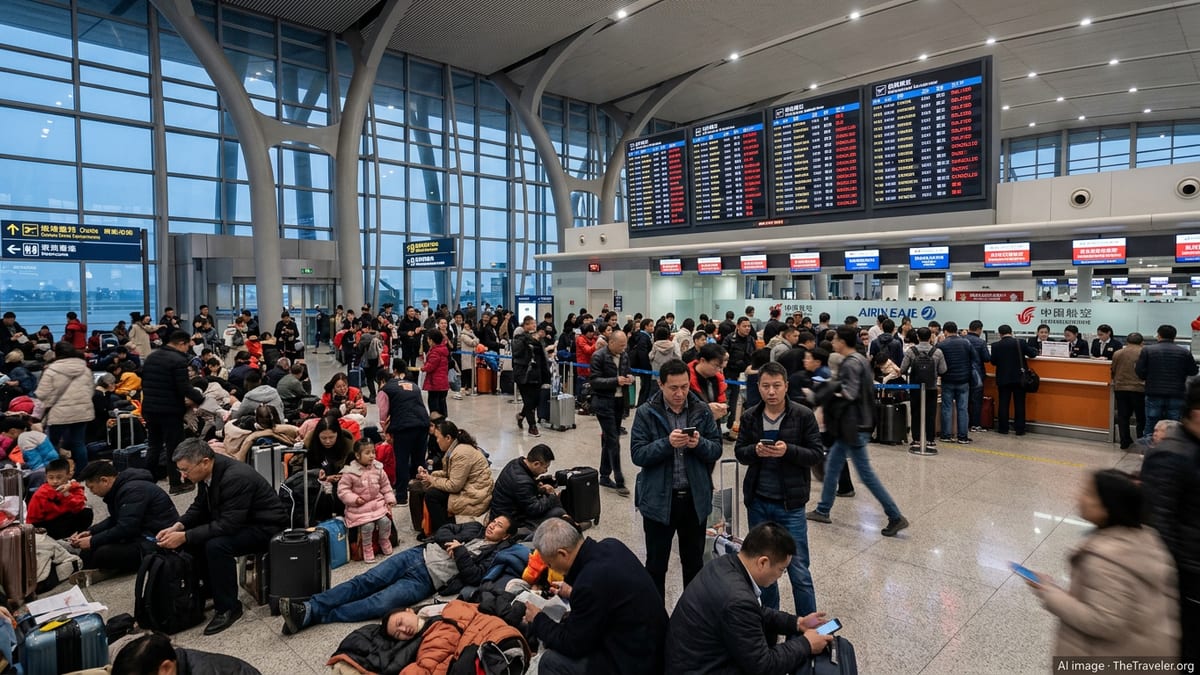
Across the affected airports, scenes on Tuesday night and Wednesday morning were familiar to seasoned travelers: long check-in and rebooking queues, departure boards flickering with updated times, and families clustered around charging points and luggage piles. In several terminals, airport staff made repeated loudspeaker announcements asking passengers to remain patient and to check with their airlines before proceeding through security.
At Shanghai and Chengdu, local media reported many passengers sleeping on benches or on the floor near gate areas after late-night cancellations left them unable to depart. Some airlines distributed vouchers for hotel accommodation and meals, but availability near major airports tightened quickly, leaving a portion of travelers to remain airside until morning.
On social media platforms in China, travelers shared images of crowded information counters and screenshots of flight-tracking apps showing series of cancellations on popular domestic routes. Many expressed frustration at what they described as limited updates from airlines in the early stages of the disruption, while others praised frontline airport staff for remaining calm under pressure and helping elderly passengers and families with children find rest areas.
Despite the visible tension, airports reported no major security incidents. Police and additional ground staff were deployed in higher-traffic terminals to help direct flows of people and prevent overcrowding around gate podiums and boarding bridges.
What Affected Travelers Can Do Now
For passengers still facing disrupted itineraries, Chinese regulators and consumer groups recommend first confirming flight status through official airline apps or customer hotlines before heading to the airport. With schedules changing in real time, travelers arriving at terminals without updated information risk longer waits and fewer rebooking options.
Airlines are generally offering free rebooking on the next available flight in the same cabin class, subject to seat availability, for customers whose flights have been canceled. Some carriers have also relaxed fare rules to allow changes to alternative destinations or later dates, though such options may vary by ticket type and route. Travelers are advised to retain boarding passes, booking confirmations and any written communication from the airline, which may be necessary for later claims.
For those with tight onward connections, particularly involving separate tickets or international legs, travel agents suggest looking at alternative routings through less affected hubs, or in some cases switching to high-speed rail for domestic segments where feasible. With delays continuing to ripple across the network, planning extra buffer time between flights has become more important than ever.
While operations at Shanghai, Chengdu and Hohhot Baita were gradually stabilizing by midday Wednesday, residual delays and occasional cancellations were expected to persist for at least another news cycle. Travelers booked to fly within China over the coming days are being urged to monitor their flights closely and prepare for itinerary changes as airlines continue working to realign aircraft and crews.