

More news on this day
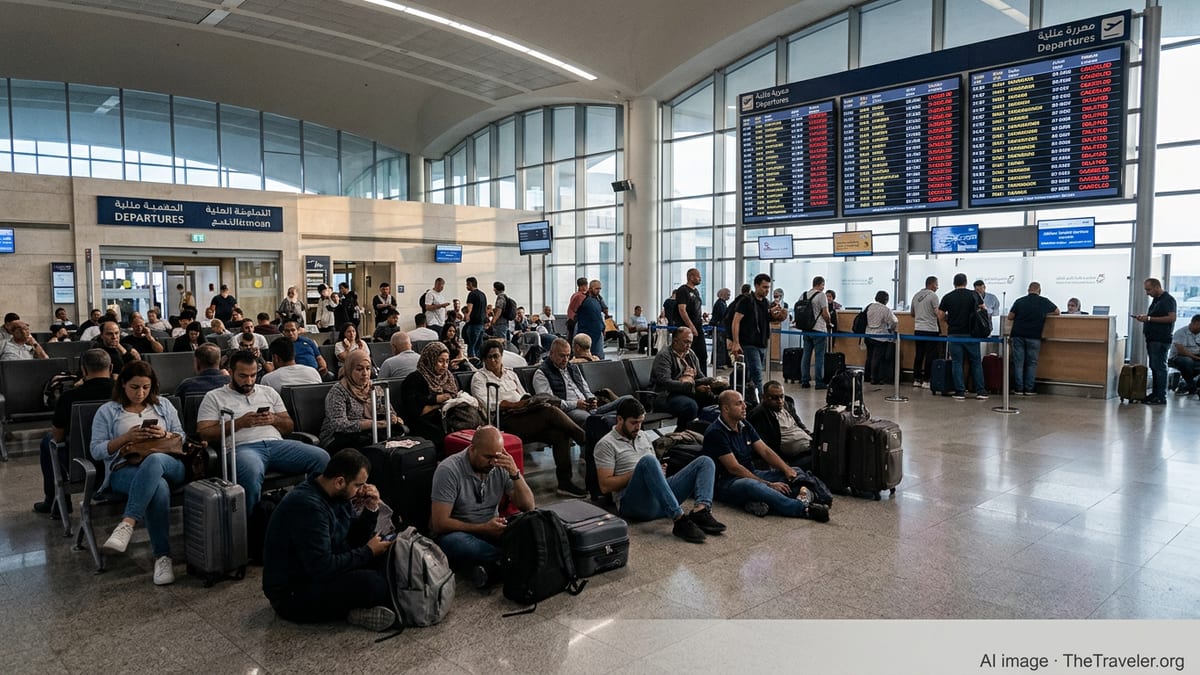
Hundreds of passengers were left stranded at Queen Alia International Airport in Amman after a fresh wave of operational disruption saw 41 flights delayed and 16 cancelled, snarling air links between Jordan, Saudi Arabia and Egypt and impacting services by Royal Jordanian, Saudia, Qatar Airways and other regional carriers.
Get the latest news straight to your inbox!
Severe Disruptions Hit Key Middle East Hub
Queen Alia International Airport, Jordan’s main gateway south of Amman, experienced pronounced schedule upheaval as airlines struggled to maintain services amid a volatile regional operating environment. Publicly available flight-tracking data for departures and arrivals showed a cluster of delays and cancellations concentrated on routes connecting Amman with Riyadh and Cairo, along with knock-on effects across wider networks.
The tally of 41 delayed flights and 16 outright cancellations over a short operational window left departure boards heavily red-marked and contributed to long queues at check-in counters, transfer desks and security checkpoints. Travellers attempting to connect onward to the Gulf, North Africa and Europe faced missed connections and unexpected overnight stays.
According to published aviation statistics, Queen Alia handled nearly nine million passengers in 2024, underscoring its role as a regional transit point. Any sustained disruption at the airport can therefore quickly ripple beyond Jordan’s borders, affecting itineraries and aircraft rotations throughout the Middle East.
Royal Jordanian, Saudia and Qatar Airways Among Affected Carriers
Royal Jordanian, which uses Queen Alia International Airport as its primary hub, saw multiple services pushed back or grounded as part of the latest disruption. Public schedules indicated delays on core regional routes, particularly those linking Amman with Riyadh and Cairo, where aircraft and crews were already operating under tighter constraints due to recent airspace complexities in parts of the region.
Saudia flights between Saudi Arabia and Amman were also impacted, with several departures from both ends delayed beyond their scheduled slots. This created further congestion at Riyadh, where passengers arriving late from Jordan struggled to meet onward connections to domestic Saudi destinations and long-haul services.
Qatar Airways and other international carriers operating via Doha, the Gulf and major European hubs encountered similar challenges, with some rotations re-timed or cancelled as airlines adjusted routings and sought to re-balance aircraft deployment. Travel-industry tracking platforms showed that even a modest number of cancellations at Amman could cascade into broader scheduling issues as aircraft arrived late into other already congested airports.
Stranded Travellers Face Long Waits and Limited Options
For passengers on the ground in Amman, the immediate reality was one of crowded terminals and uncertain departure times. Images and descriptions circulating on social and local media channels showed families resting on terminal floors, queues forming around airline customer-service counters and departure screens dominated by delayed statuses.
With 16 flights cancelled outright, many travellers reported being rebooked onto later services or rerouted through alternative hubs such as Istanbul, Doha or Gulf airports where capacity was available. However, publicly available information from travel forums and airline advisories suggested that alternative seats were in high demand, leaving some passengers facing waits of 24 hours or more for confirmed onward travel.
Hotel availability near the airport and in central Amman appeared to tighten as disrupted passengers sought last-minute rooms. Travel advisers noted that some travellers were encouraged via published guidance to remain flexible on routing, accept indirect journeys, or travel at off-peak times in order to secure a seat out of Jordan, Saudi Arabia or Egypt.
Regional Airspace and Operational Pressures Behind the Delays
The latest disruption at Queen Alia International Airport comes against a backdrop of intermittent airspace restrictions and heightened operational pressures across parts of the Middle East. In recent weeks, published coverage has documented temporary closures or limitations affecting segments of airspace over countries including Iran, Iraq and Israel, prompting large-scale rerouting of flights between Europe, the Gulf and Asia.
As airlines adjust flight paths to avoid sensitive areas, journeys often become longer and more fuel-intensive, stretching aircraft and crew utilisation. This can reduce the margin for recovering from routine delays and makes regional hubs such as Amman, Riyadh and Cairo more vulnerable to knock-on disruption when weather, technical issues or security measures arise.
Aviation data providers have recently highlighted spikes in delays and cancellations across the wider Middle East on days when airspace rules changed with little notice. When such shifts coincide with peak travel periods, airports like Queen Alia may see departure and arrival waves bunch together, creating temporary gridlock at gates, taxiways and baggage systems.
What Travellers Through Amman, Riyadh and Cairo Should Expect
Public advisories from airlines and travel agents in recent days have emphasised the importance of checking flight status repeatedly before leaving for the airport, particularly for passengers flying between Amman, Riyadh and Cairo or connecting onward to Europe and the Gulf. Same-day changes to departure times and routings remain possible while carriers work through backlogs created by the latest round of delays and cancellations.
Travellers are being urged through published guidance to build in longer connection times, especially if their itinerary requires a transfer at more than one regional hub. Those with non-essential trips have been advised in some cases to consider flexible rebooking options, while passengers already en route are encouraged to stay in close contact with their airline’s official communication channels and mobile apps.
For now, operations at Queen Alia International Airport and across the wider region continue under a heightened level of uncertainty. While the number of affected flights on any given day can fluctuate, the episode that left hundreds stranded in Amman, with 41 delays and 16 cancellations, underscores how quickly conditions can change for travellers moving through one of the world’s most strategically important air corridors.